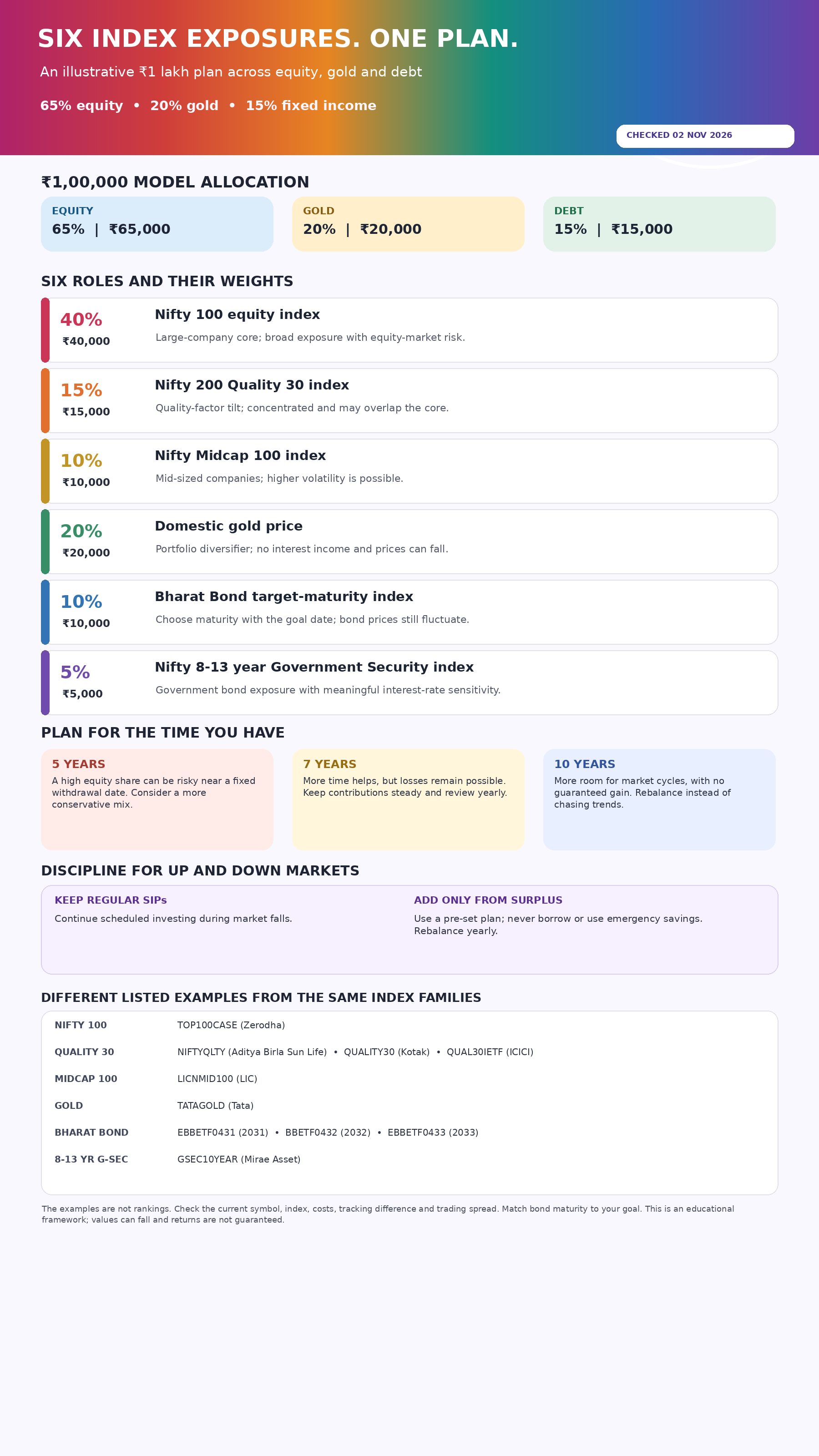
This is a model for thinking about diversification across Indian shares, gold and fixed income. On a ₹1 lakh starting amount, it assigns 65 per cent to equity, 20 per cent to gold and 15 per cent to debt. The weights are examples for discussion, not a personal recommendation or a forecast of returns.
The equity portion has three index exposures. Allocate ₹40,000 (40 per cent) to a Nifty 100 ETF for large-company breadth; ₹15,000 (15 per cent) to a Nifty 200 Quality 30 ETF for companies selected using profitability, leverage and earnings-stability measures; and ₹10,000 (10 per cent) to a Nifty Midcap 100 ETF for mid-sized businesses. The quality index is concentrated in 30 companies and may share holdings with the Nifty 100. Mid-cap shares can be more volatile, so the smaller allocation limits their influence on the whole portfolio.
Set aside ₹20,000 (20 per cent) for a gold ETF. Gold may diversify financial assets, but it does not produce interest or company earnings and its price can fall. The remaining ₹15,000 (15 per cent) goes to fixed income: ₹10,000 (10 per cent) in a Bharat Bond target-maturity ETF chosen to suit the investor’s goal date, and ₹5,000 (5 per cent) in an ETF tracking the Nifty 8-13 year Government Security index. Target-maturity bond funds still carry market, credit and reinvestment risks. Long-maturity government bonds have low sovereign credit risk but can lose value when interest rates rise.
Examples from the products shown include Zerodha Nifty 100 ETF (TOP100CASE); Aditya Birla Sun Life Nifty 200 Quality 30 ETF (NIFTYQLTY), Kotak Nifty 200 Quality 30 ETF (QUALITY30) and ICICI Prudential Nifty 200 Quality 30 ETF (QUAL30IETF); LIC MF Nifty Midcap 100 ETF (LICNMID100); Tata Gold ETF (TATAGOLD); Bharat Bond ETF maturities April 2031, April 2032 and April 2033 (EBBETF0431, BBETF0432 and EBBETF0433); and Mirae Asset Nifty 8-13 year G-Sec ETF (GSEC10YEAR). These are examples, not rankings. Before investing, compare current index, costs, tracking difference, trading spread and activity.
For a five-year goal, 65 per cent in shares may be too volatile if the money must be withdrawn on a fixed date. Consider lowering equity exposure and matching bond maturities to the goal. Seven years gives a longer runway but does not remove the possibility of loss. Ten years allows more time for market cycles, yet no outcome is assured. Revisit the maturity of the bond allocation as the goal date approaches.
Invest monthly in line with the chosen weights through a regular systematic investment plan. Continue scheduled contributions during market declines. Any extra purchase should use surplus money under a pre-decided plan, never borrowed money or emergency savings. Review the allocation once a year and rebalance if it has drifted materially. ETF prices, liquidity and tracking vary; past performance does not assure future results.
Source note: Index and ticker examples checked against NSE India, NSE Indices and issuer listings on 2 November 2026.