Latest Blog
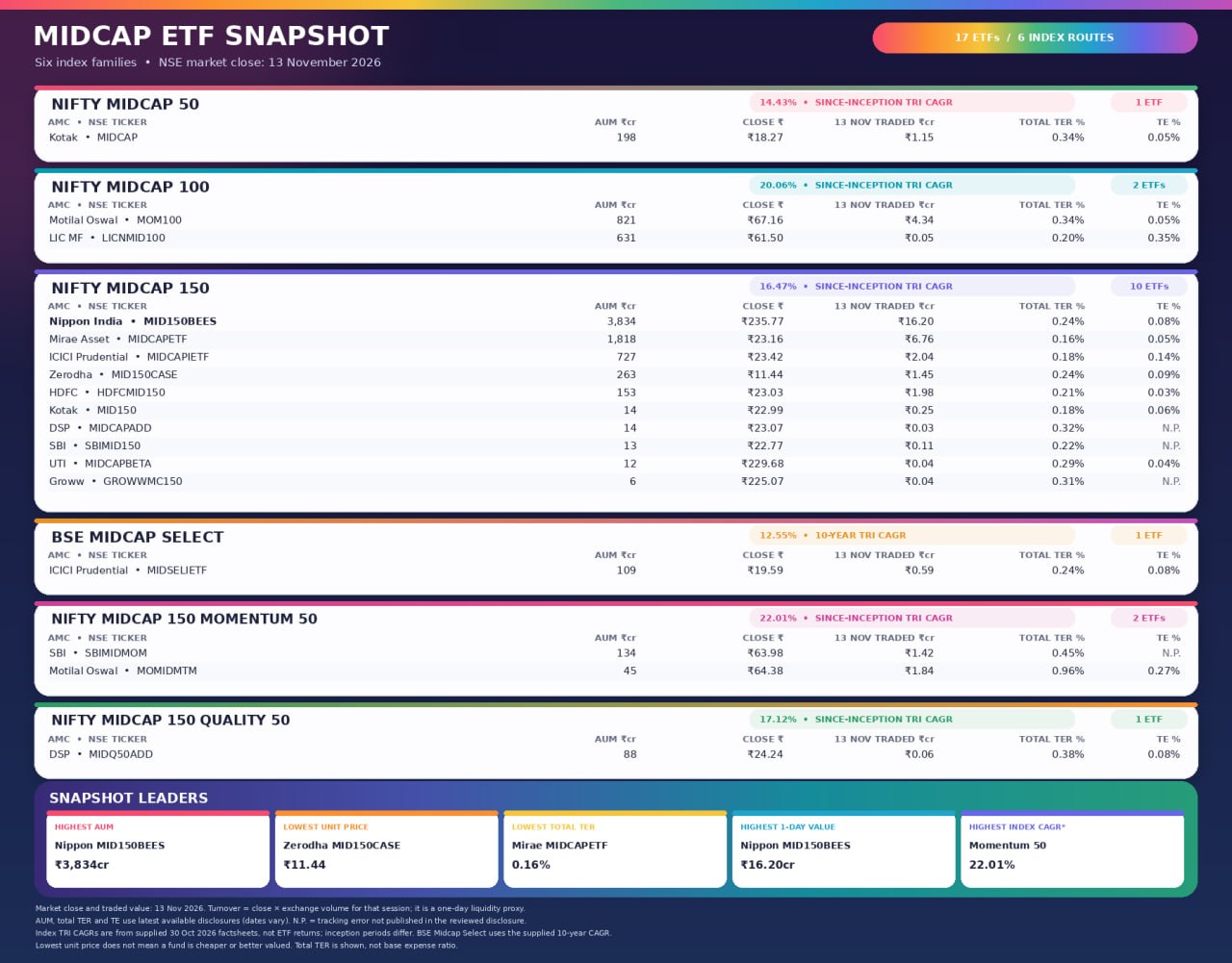
Indian Midcap ETFs and Index Choices
Mid-cap ETFs track medium-sized companies, but nearby indices often share holdings. These six families have 17 ETFs;
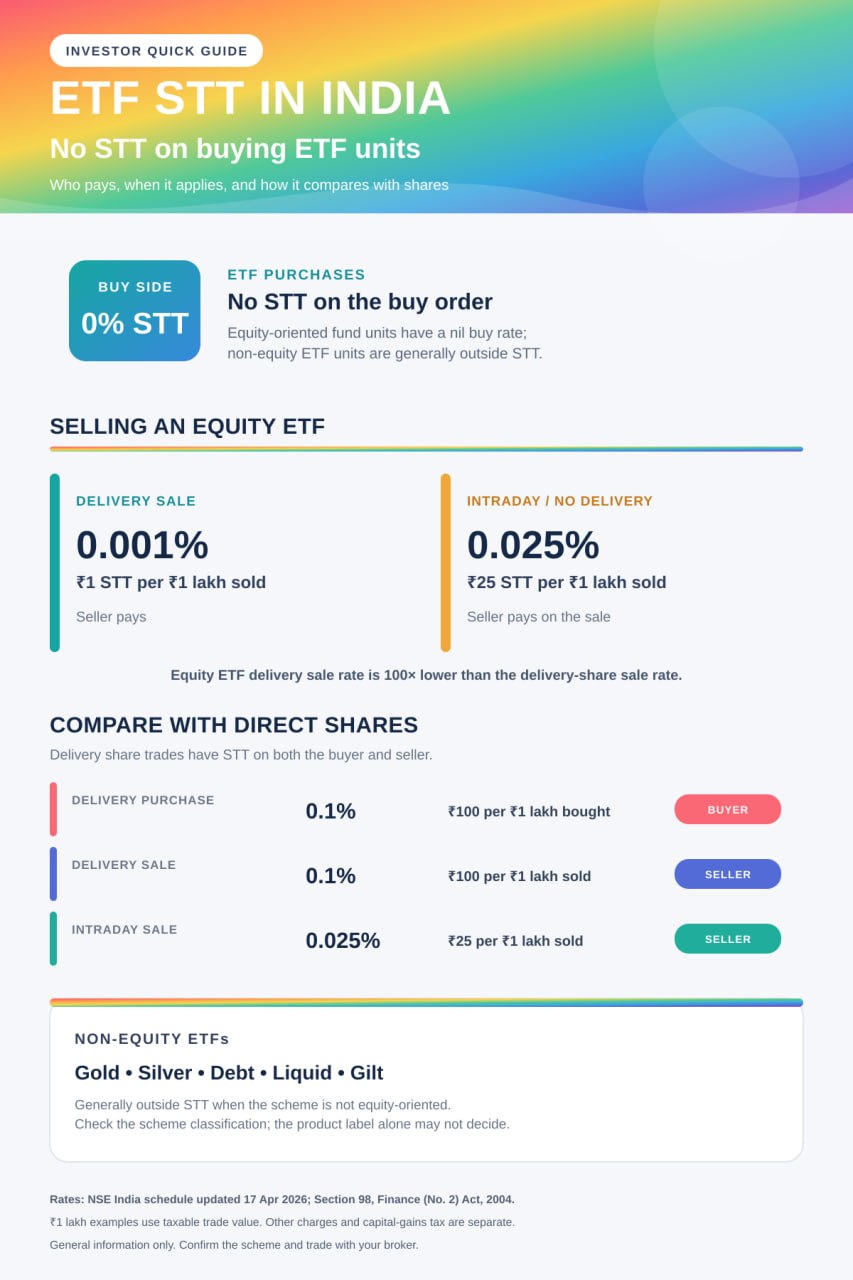
ETF STT in India No STT on Buying ETF Units
For ETF units bought on a recognised exchange, the buyer generally pays no STT. The statutory schedule gives a nil buy rate for units of an equity-oriented fund, while non-equity ETF units are generally outside the levy. On sale, the applicable rate depends on the scheme classification and whether the trade settles with delivery.
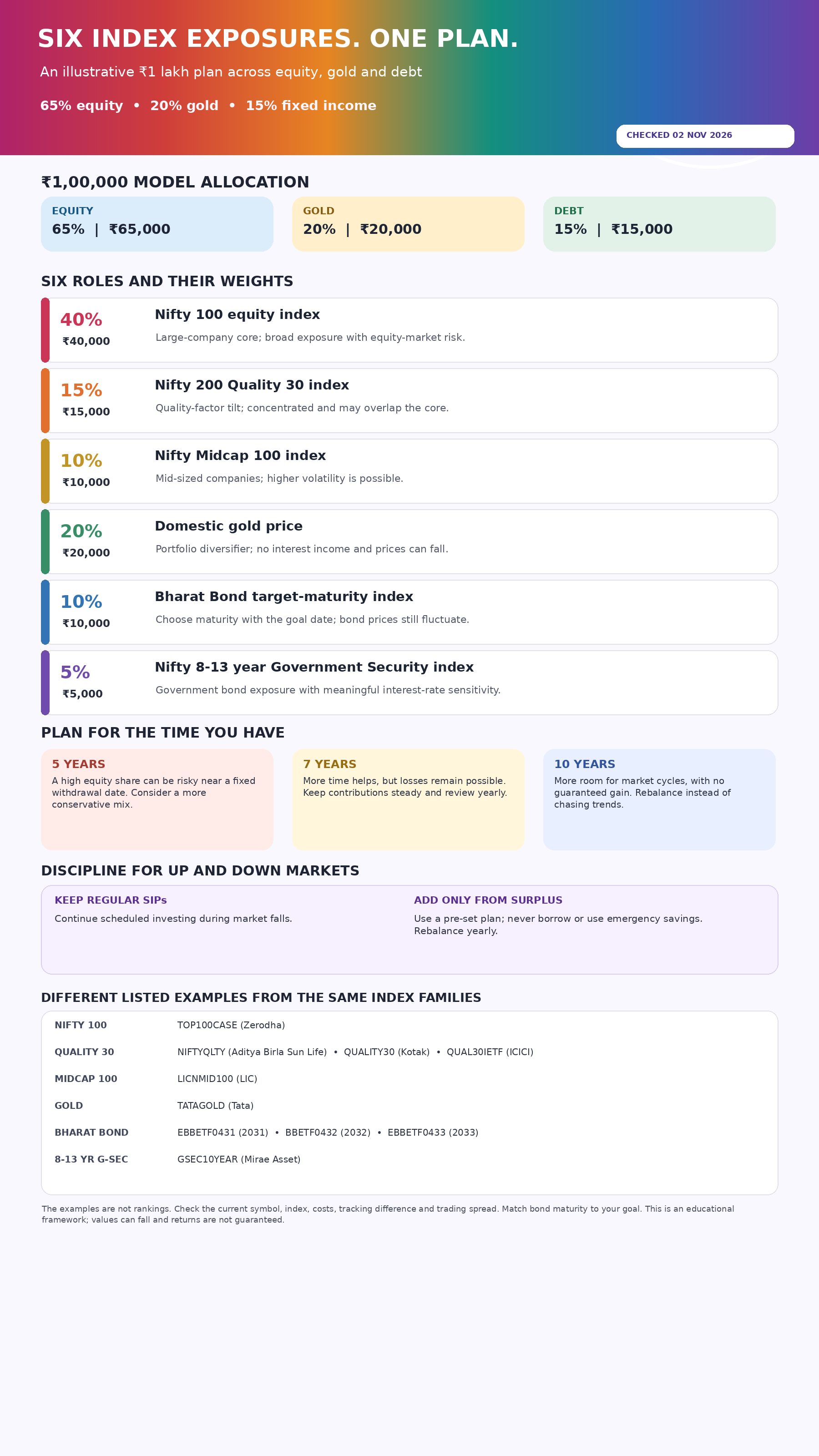
A Diversified Six-ETF Allocation Framework
This is a model for thinking about diversification across Indian shares, gold and fixed income. On a ₹1 lakh starting amount, it assigns 65 per cent to equity, 20 per cent to gold and 15 per cent to debt. The weights are examples for discussion, not a personal recommendation or a forecast of returns.
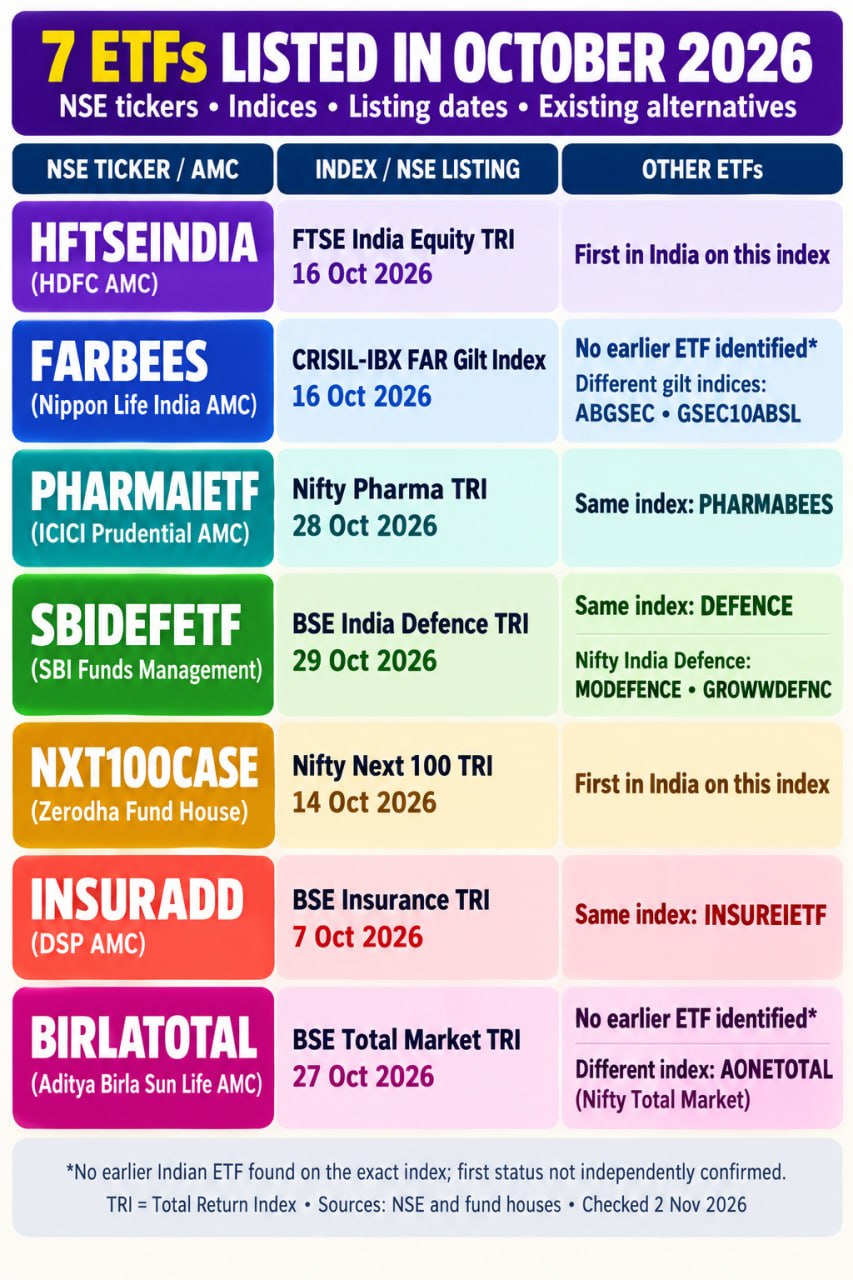
Seven ETFs Listed in the Month of October 2026
All seven are new NSE listings. Pharma, Defence and Insurance already had competitors tracking the same indices. HDFC FTSE India Equity and Zerodha Nifty Next 100 are confirmed firsts. FAR Gilt and BSE Total Market appear to be firsts on their respective indices.
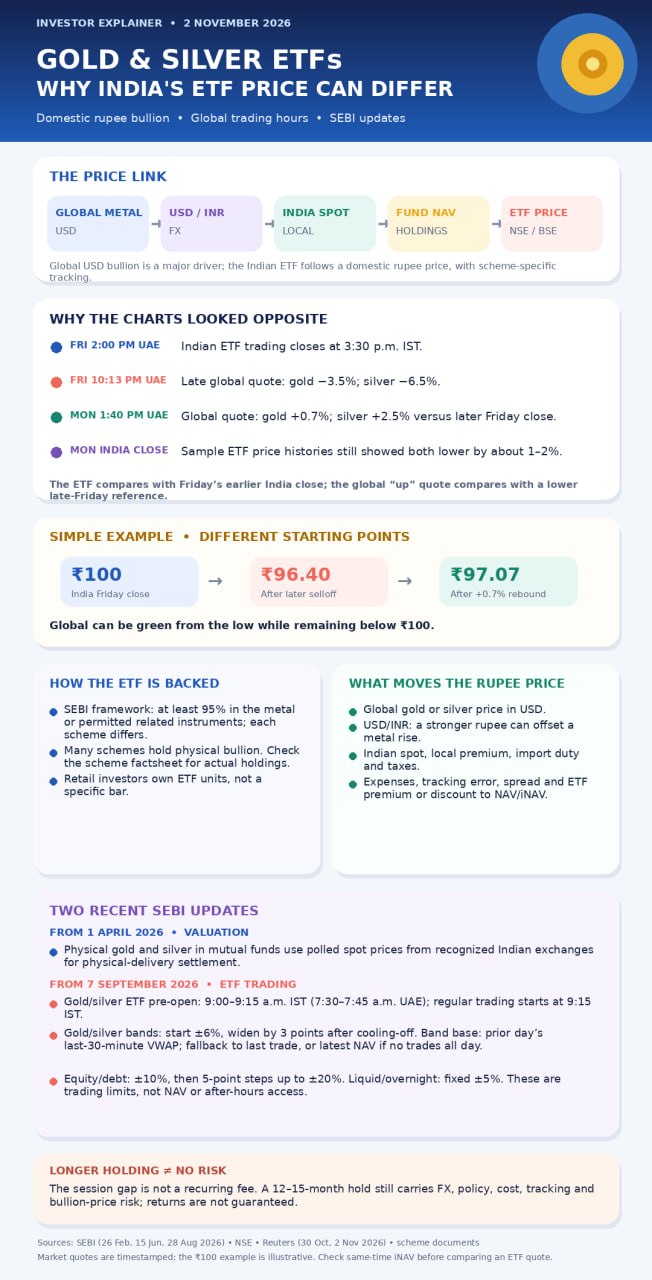
How Indian Gold and Silver ETFs Track Bullion Prices
Indian gold and silver ETFs trade like shares and target a domestic rupee benchmark. SEBI rules require at least 95% of net assets in metal or permitted related instruments; holdings vary. Many hold physical bullion, but investors own ETF units, not a specific bar. Nippon Gold BeES tracks domestic gold through physical gold.
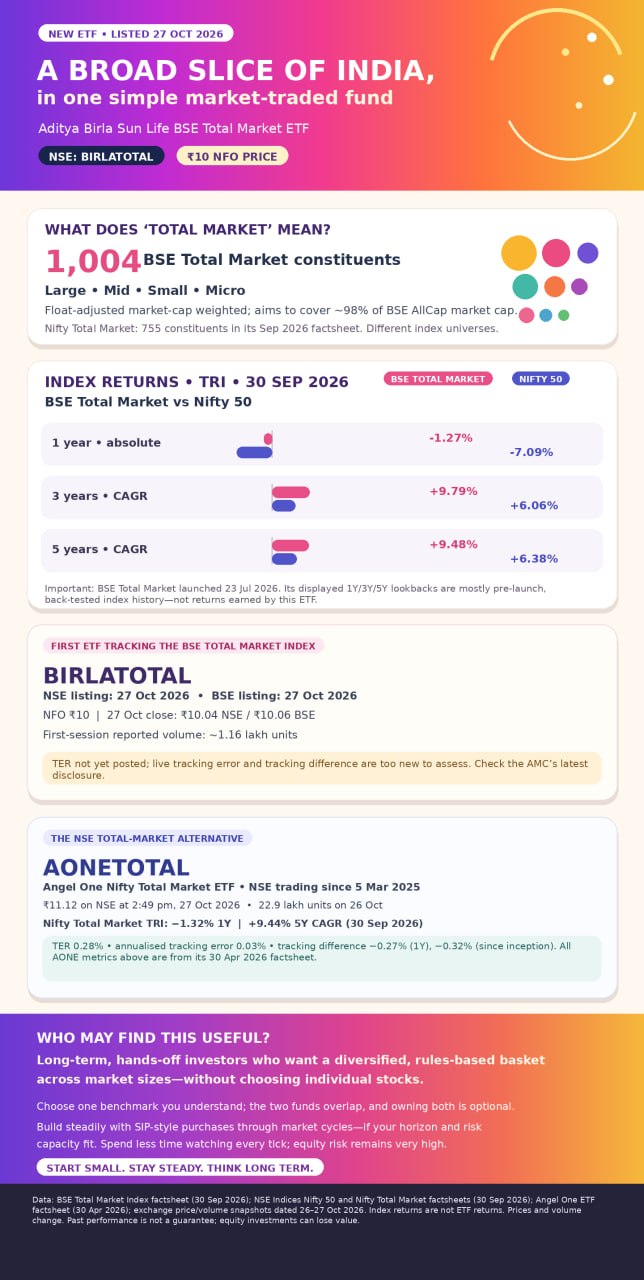
India's First ETF Tracking the BSE Total Market Index
Aditya Birla Sun Life BSE Total Market ETF (NSE ticker BIRLATOTAL) listed on BSE and NSE on 27 October 2026. It is India's first ETF tracking the BSE Total Market Total Return Index (TRI). Its new fund offer price was Rs 10 per unit, not a fixed exchange price. On listing day it traded around Rs 10.00 to Rs 10.10, with reported volume of about 116,163 units.
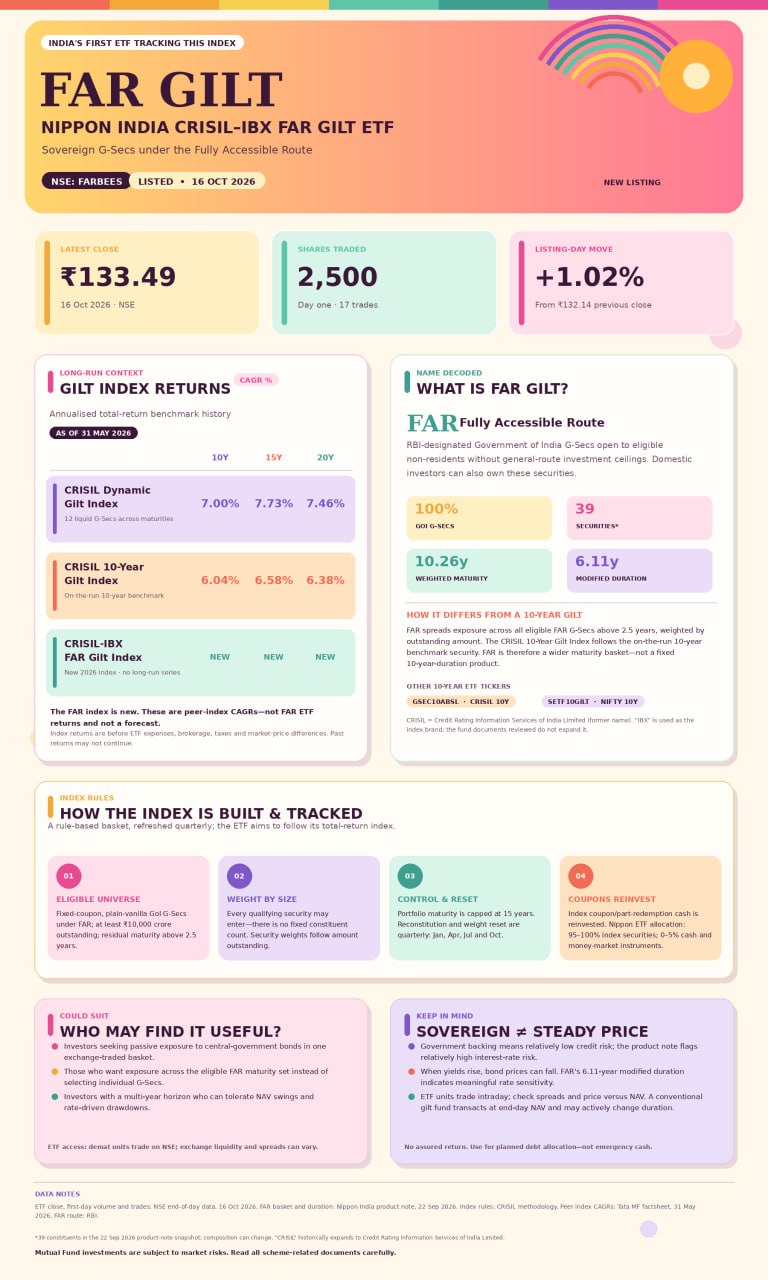
Nippon India CRISIL-IBX FAR Gilt ETF: India's First ETF Tracking the FAR Gilt Index
Listed on NSE on 16 October 2026 as FARBEES, Nippon India CRISIL-IBX FAR Gilt ETF is India's first ETF tracking the CRISIL-IBX FAR Gilt Index. FAR means Fully Accessible Route, the RBI framework allowing eligible non-residents to invest in specified Government of India dated securities without an investment ceiling. Gilt means government bonds. CRISIL originally stood for Credit Rating Information Services of India Limited; official scheme documents use IBX as the index-series label without expanding those letters.
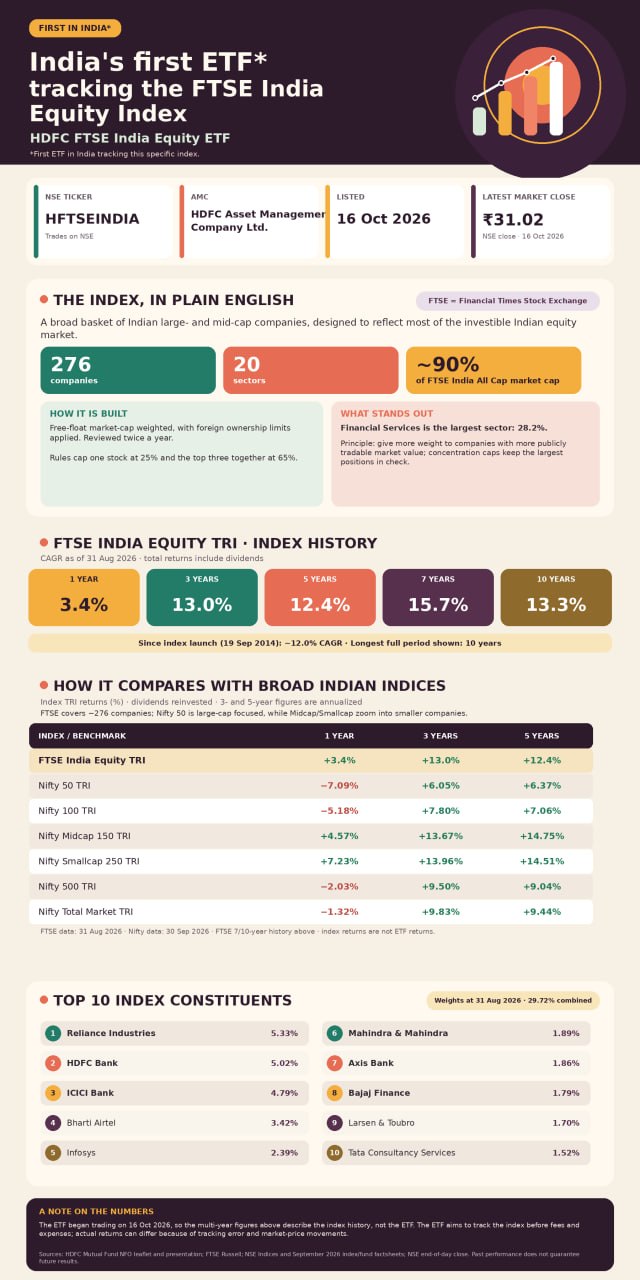
India's First ETF Tracking the FTSE India Equity Index
The HDFC FTSE India Equity ETF is India's first exchange-traded fund to track the FTSE India Equity Index (Total Return Index). Managed by HDFC Asset Management Company Limited, it was listed on the National Stock Exchange on 16 October 2026 under the ticker HFTSEINDIA. The scheme aims to replicate index performance before fees and expenses, subject to tracking error. Because the fund has only recently listed, its own performance history is limited.
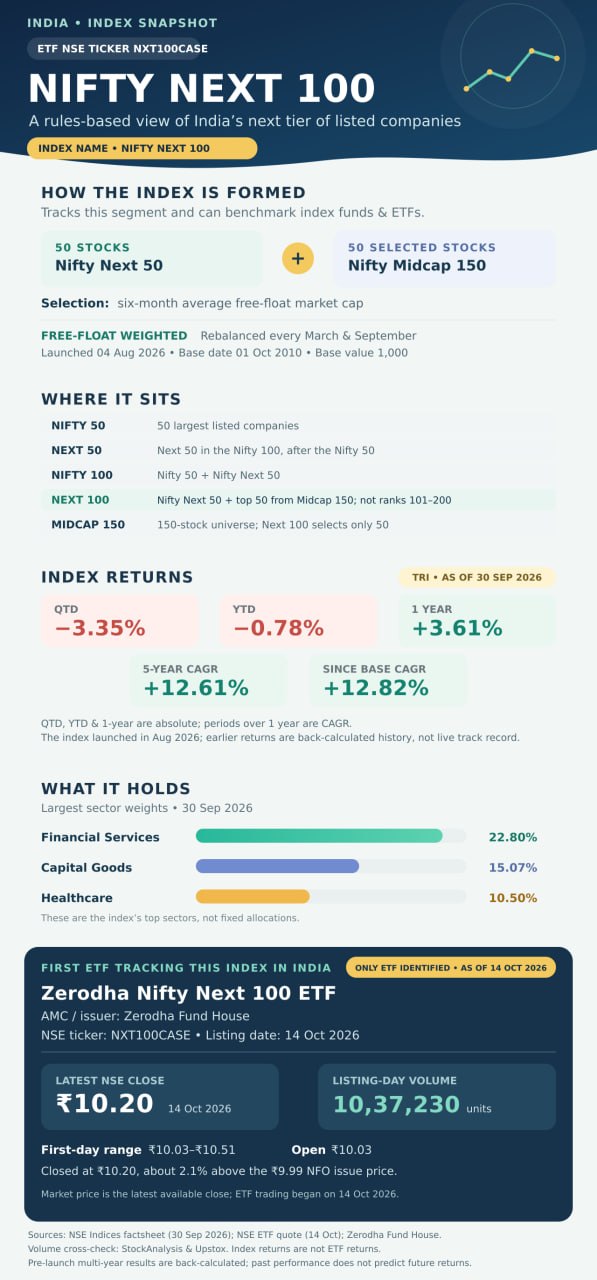
India's First Nifty Next 100 ETF
The Zerodha Nifty Next 100 ETF is India's first exchange-traded fund tracking the newly launched Nifty Next 100 Index, as described by Zerodha Fund House. Managed by Zerodha CASE Asset Management Private Limited (Zerodha Fund House), it began trading on the National Stock Exchange on 14 October 2026 under the symbol NXT100CASE. The ETF seeks to track the index, subject to expenses and tracking difference.
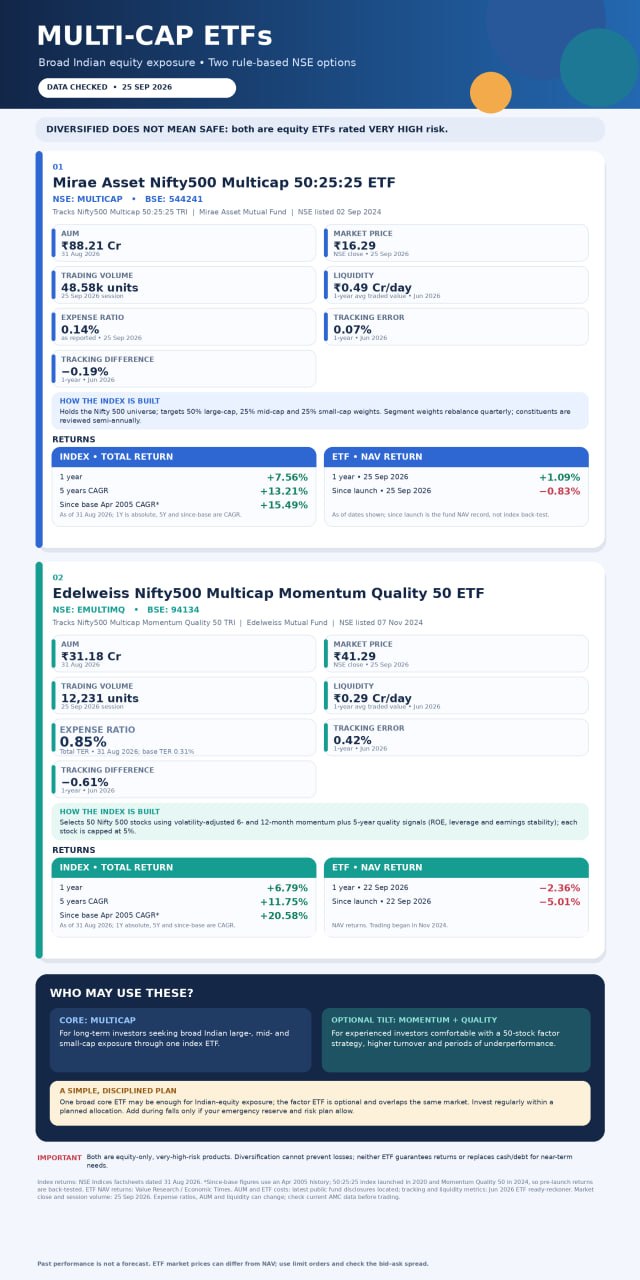
Multi Cap ETFs for Broad Based Equity Exposure
Multi-cap exchange-traded funds (ETFs) offer a single, rules-based way to hold large-, mid- and small-cap companies. They can simplify a portfolio compared with selecting and rebalancing separate size-based ETFs. They are not inherently safer or always better than a market-cap-weighted Nifty 500 ETF: a fixed mid- and small-cap allocation can increase volatility, and equity losses remain possible.
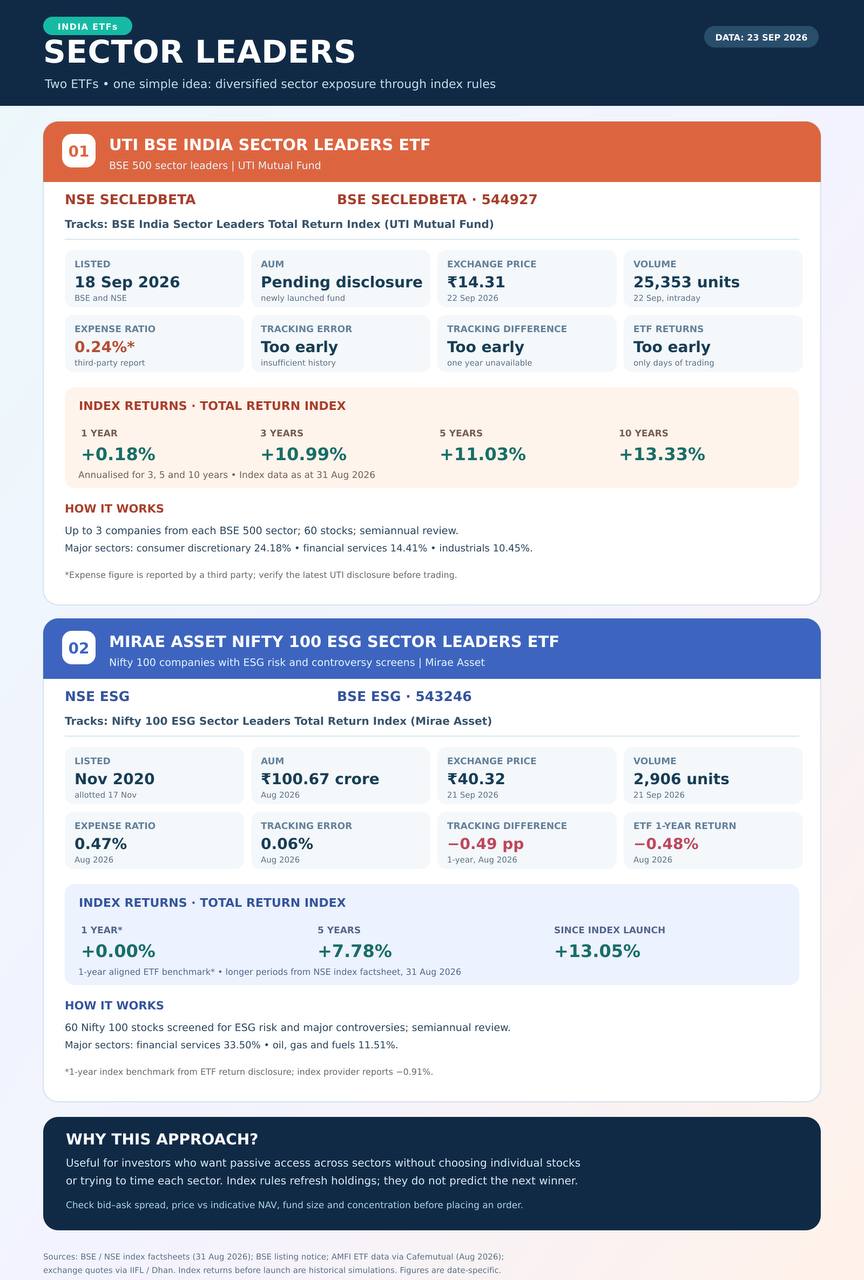
Sector Leaders ETFs Across India
Two exchange traded funds offer a rules based way to own companies across sectors without choosing a single sector yourself. Their selection rules differ: UTI follows company size within BSE 500 sectors, while Mirae Asset adds environmental, social and governance screening within the Nifty 100.
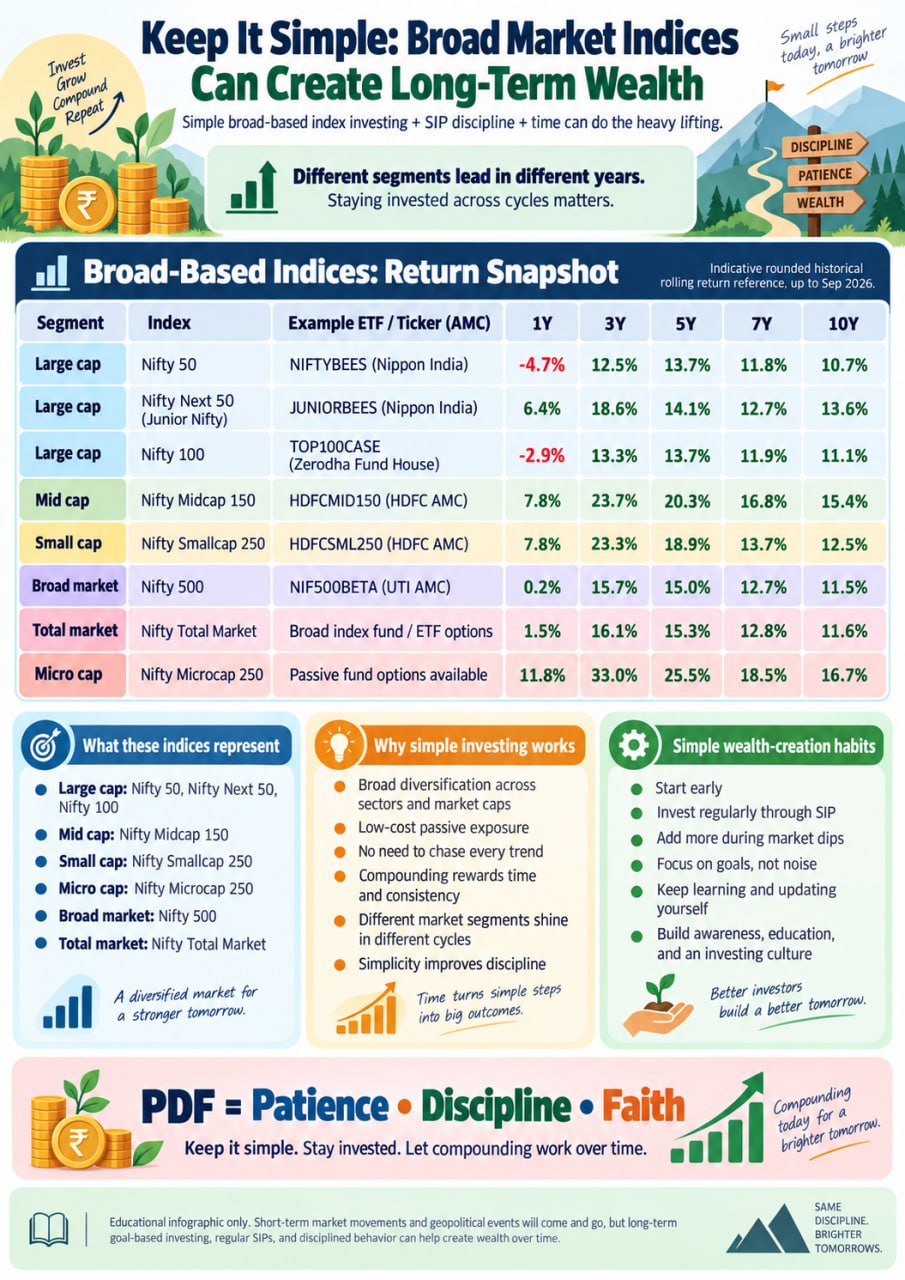
Keep It Simple: Broad Market Indices Can Also Create Wealth Over the Long Run
Wealth creation does not always require complicated strategies, frequent trading or chasing the latest theme. A simple, disciplined approach using broad market indices can be enough for long-term goals. The key is to start early, invest regularly through a monthly systematic investment plan, continue through market cycles and, when suitable for one’s risk capacity, add more during meaningful market corrections.
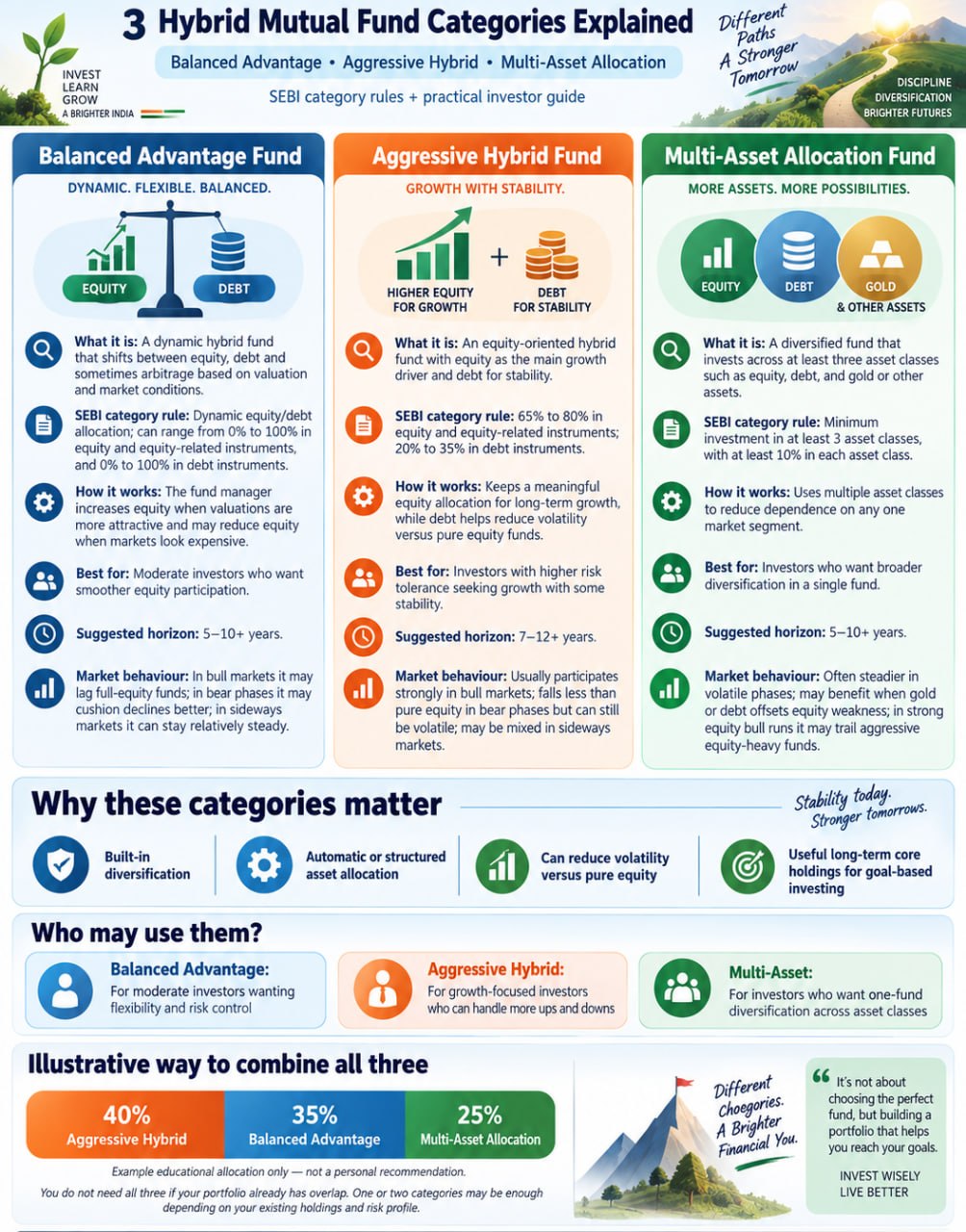
Hybrid Mutual Fund Categories for Long-Term Investing
Hybrid mutual funds combine more than one asset class to balance growth and stability. Balanced Advantage, Aggressive Hybrid and Multi-Asset Allocation funds are useful for investors who want long-term wealth creation without depending entirely on pure equity. The three categories differ mainly in how they divide money between equity, debt and other assets.
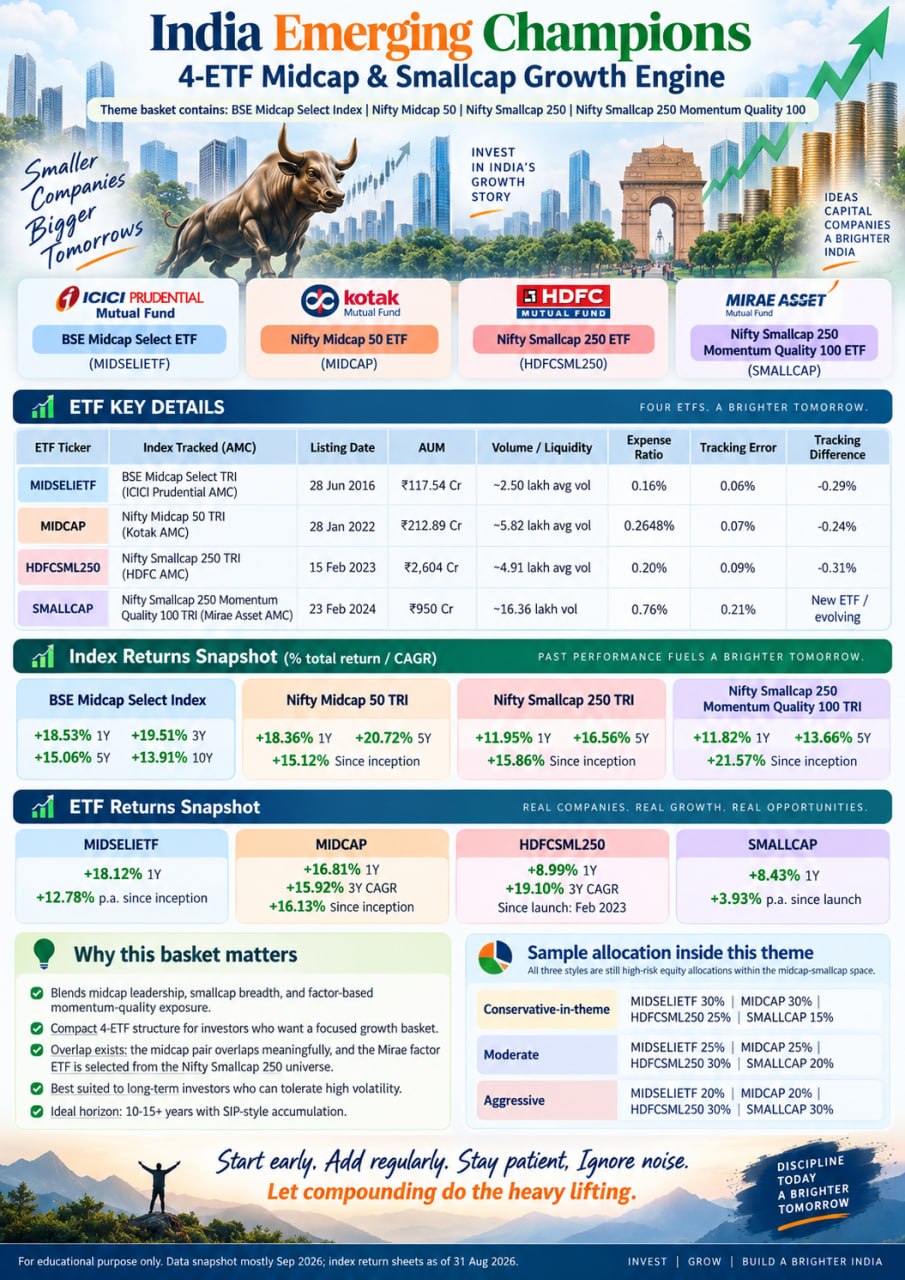
India Emerging Champions: The 4-ETF Midcap-Smallcap Growth Engine
This theme blends two midcap and two smallcap ETFs into a “core + select/factor” growth basket. It is not four completely independent exposures: BSE Midcap Select and Nifty Midcap 50 share many of the same larger, liquid midcaps, while Nifty Smallcap 250 Momentum Quality 100 is selected from the Nifty Smallcap 250 universe itself. The attraction is the mix of concentrated liquid midcaps, broad smallcap participation and a rules-based momentum-quality tilt.
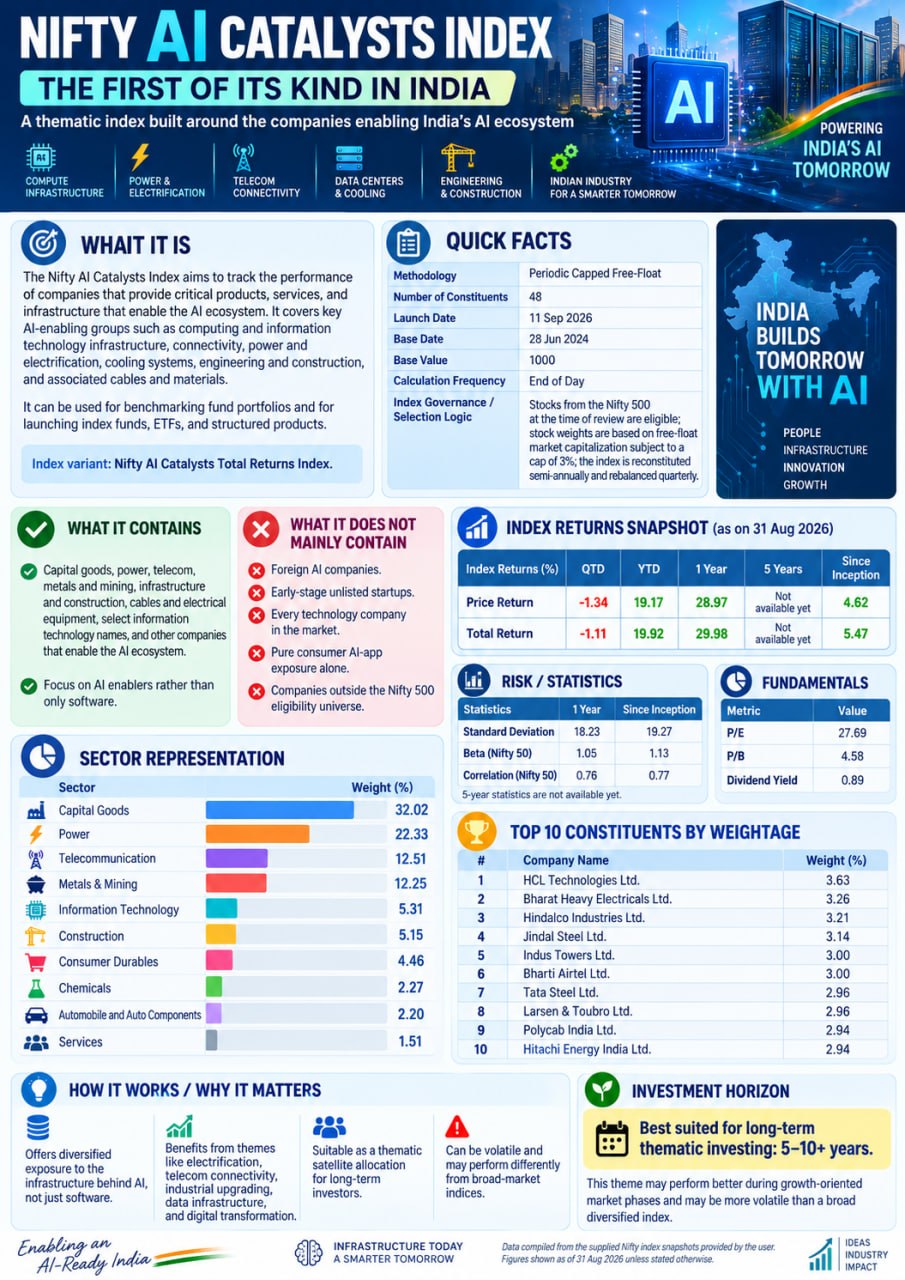
Nifty AI Catalysts Index - India’s AI Infrastructure Theme
NSE Indices has introduced the Nifty AI Catalysts Index, a new thematic index designed to capture Indian companies that provide the critical products, services and infrastructure enabling the artificial intelligence ecosystem. Rather than being a pure artificial intelligence software index, it focuses on the ‘picks and shovels’ behind artificial intelligence growth: computing and information technology infrastructure, connectivity, power and electrification, cooling systems, engineering and construction, cables, metals and related materials. The index was launched on 11 September 2026, has a base date of 28 June 2024 and a base value of 1,000.
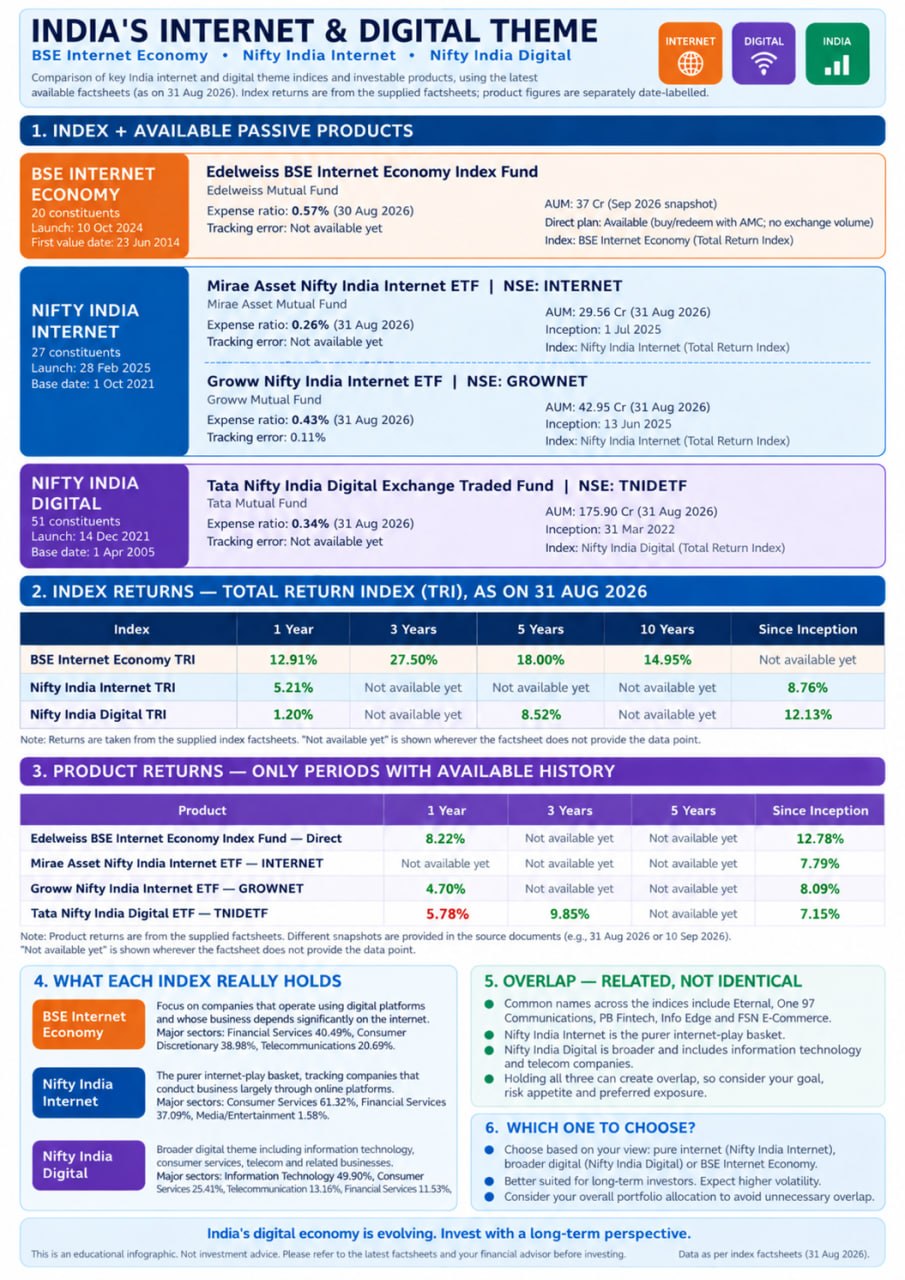
India's Internet and Digital Theme
India's internet and digital economy is now large enough to be represented through different thematic indices rather than one single basket. The three useful benchmarks are the BSE Internet Economy Index, Nifty India Internet Index and Nifty India Digital Index. They are related, but they are not identical. Each captures a different part of India's digital growth story, so investors should understand the index construction before choosing a fund or exchange traded fund that tracks it.
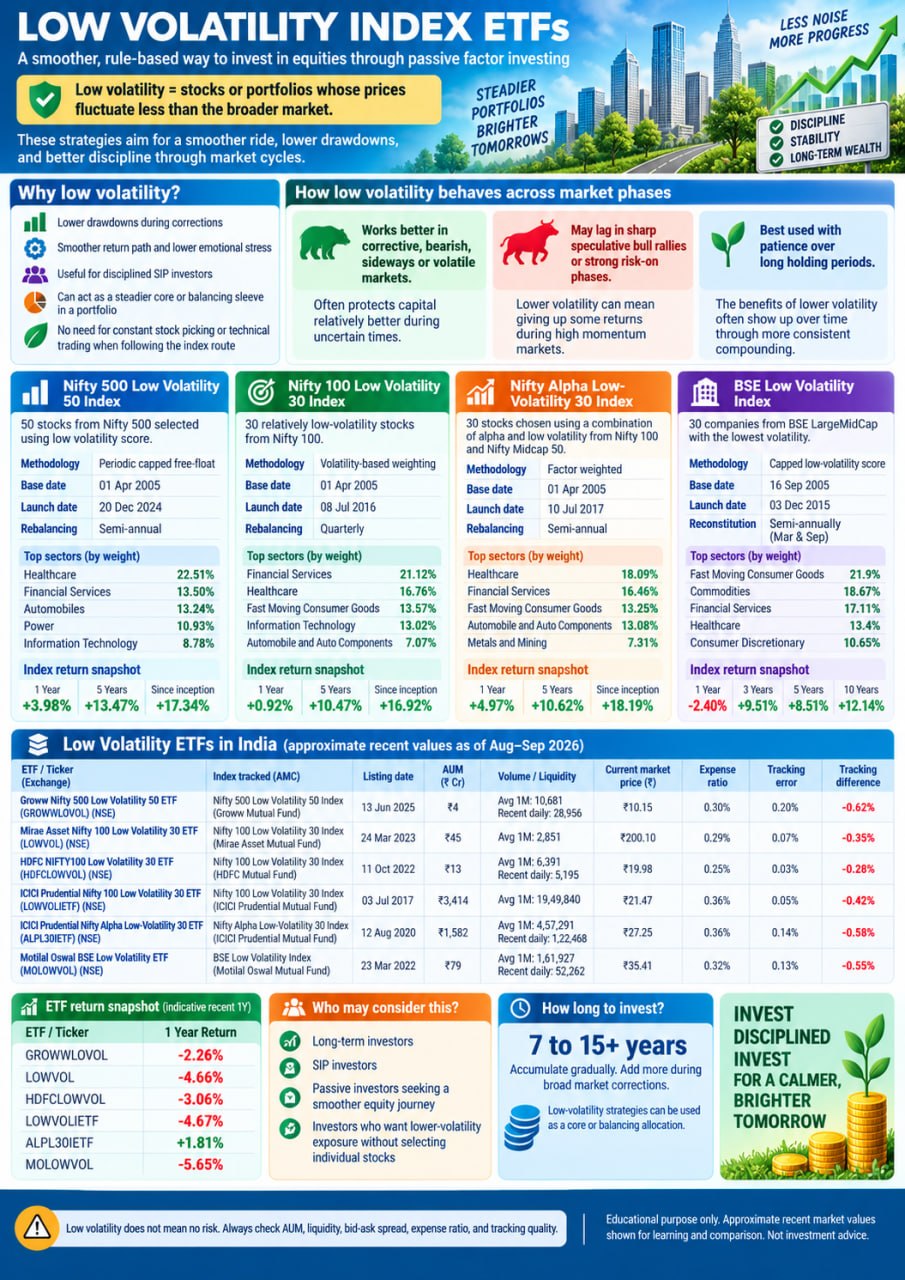
LOW VOLATILITY INDEX ETFS – A PASSIVE WAY TO SEEK SMOOTHER EQUITY JOURNEYS
Low volatility is one of the better-known equity factors. In simple words, it focuses on companies or portfolios whose prices fluctuate less than the broader market. This does not mean no risk, but it often means a relatively smoother ride, lower drawdowns and better emotional comfort for disciplined investors. Low volatility strategies are generally useful in corrective, sideways, uncertain or bear phases, though they may sometimes lag sharply speculative rallies. For long-term investors, a 7 to 15 year or longer holding period with systematic investment plan discipline can be a practical way to use this factor.
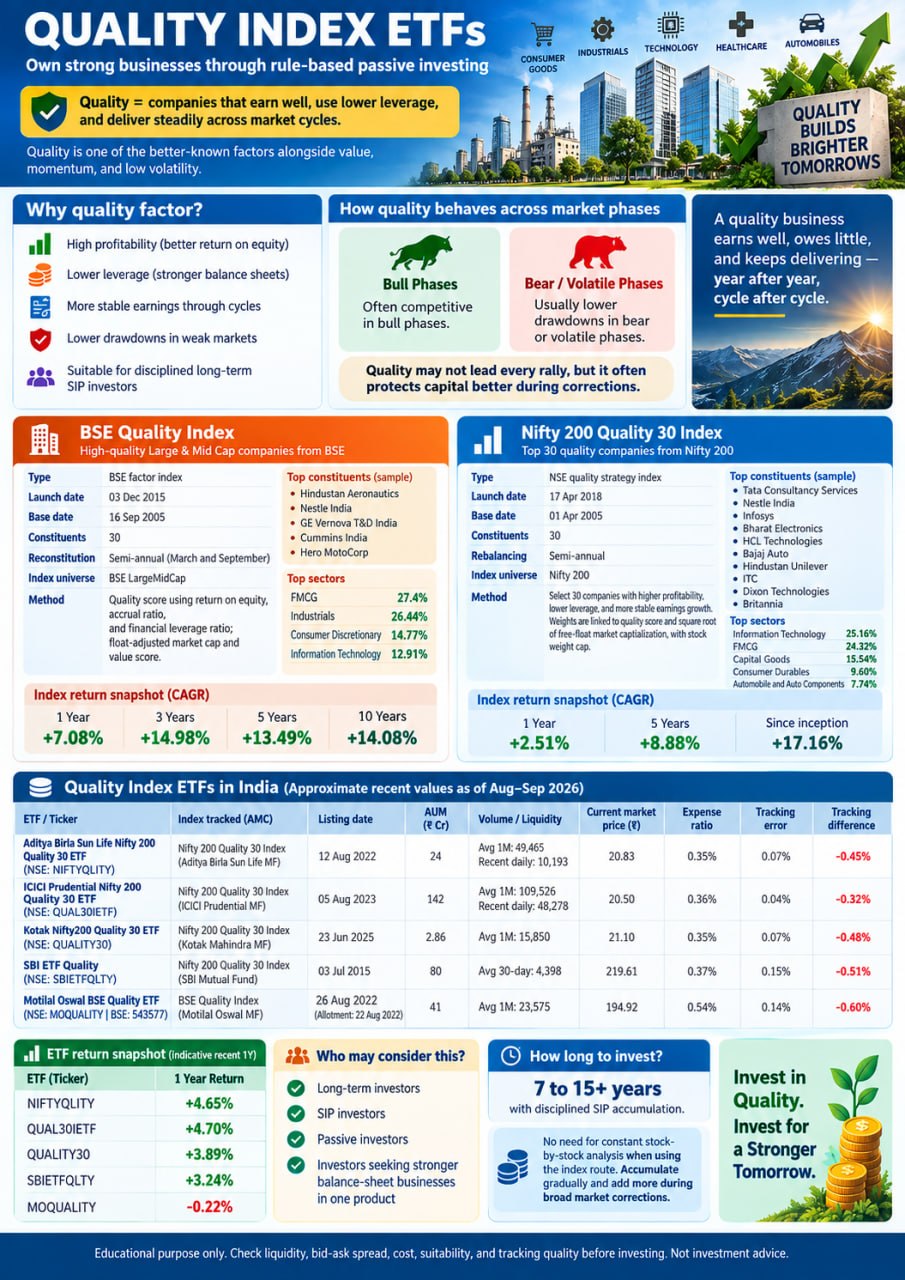
QUALITY FACTOR INDEXING – A SIMPLE WAY TO OWN STRONGER BUSINESSES THROUGH BSE AND NSE QUALITY ETFS
Quality is one of the better-known equity factors, along with value, momentum and low volatility. In simple words, a quality business is one that earns well, carries lower leverage and shows more stable performance across market cycles. Because of these features, quality investing often aims for better resilience rather than excitement. It may not lead every sharp rally, but it has historically shown an ability to participate in good phases and suffer lower drawdowns in weak or volatile phases. That is why many long-term investors like quality as a core, disciplined, passive allocation.
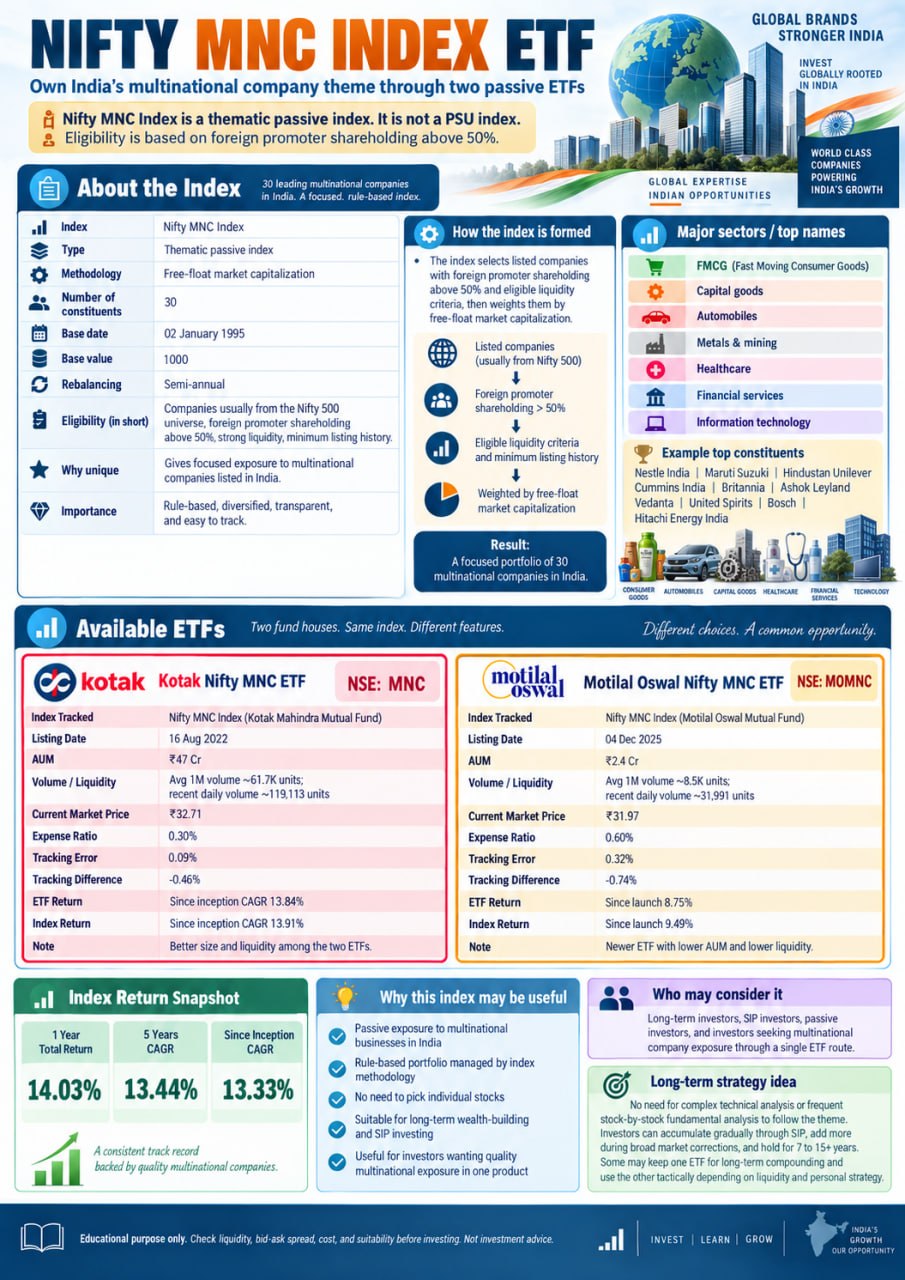
NIFTY MNC INDEX – A RULE-BASED WAY TO OWN INDIA’S LEADING MULTINATIONAL COMPANIES
The Nifty MNC Index is a thematic passive index from NSE Indices. It is not a PSU index: the key eligibility condition is foreign promoter shareholding above 50%, not FII holding above 50%. As of 31 August 2026, it had 30 constituents. It uses free-float market capitalization, is calculated in real time, has a base date of 2 January 1995 and base value of 1,000, and is rebalanced semi-annually. Eligible companies are mainly drawn from the Nifty 500 and must meet liquidity and listing-history requirements.
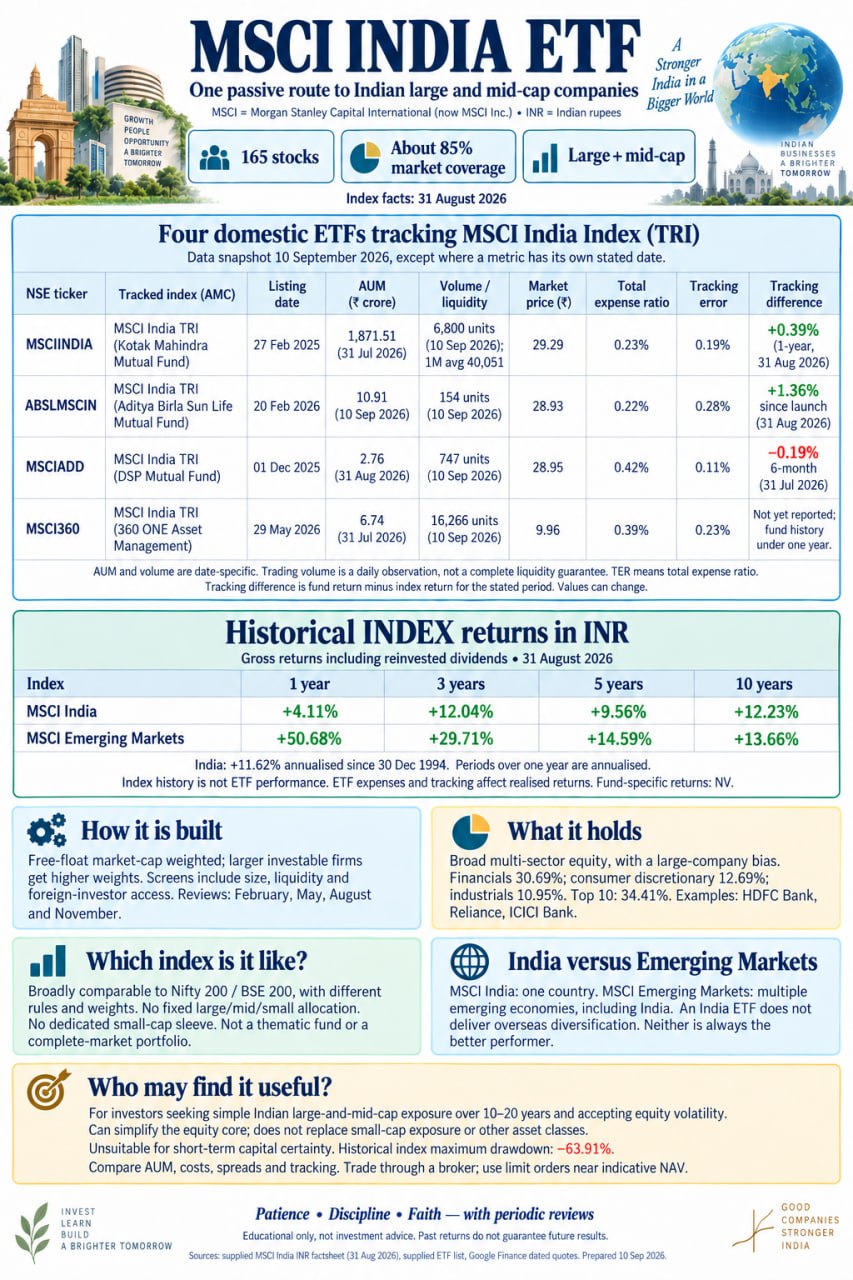
MSCI India ETF
MSCI, originally Morgan Stanley Capital International, is now MSCI Inc., a global index provider. An MSCI India exchange-traded fund (ETF) offers passive exposure to Indian large and mid-sized companies. “INR” means returns expressed in Indian rupees; it does not mean overseas diversification.
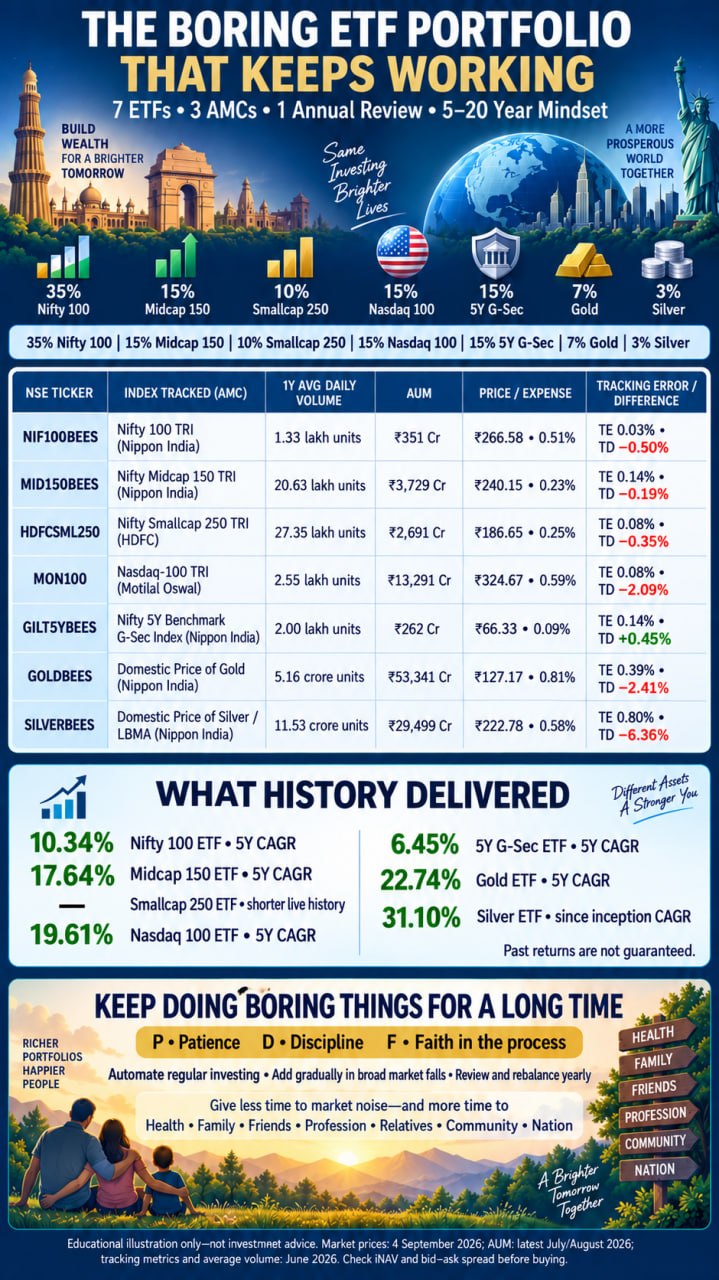
Seven ETFs, One Calm Portfolio: A Simple SIP Plan for 20 Years
A long-term portfolio need not be complicated. Seven exchange-traded funds can combine Indian large-, mid- and small-cap growth, United States innovation, government debt, gold and silver. An illustrative allocation is 35% Nifty 100, 15% Nifty Midcap 150, 10% Nifty Smallcap 250, 15% Nasdaq 100, 15% five-year Government Securities, 7% gold and 3% silver.
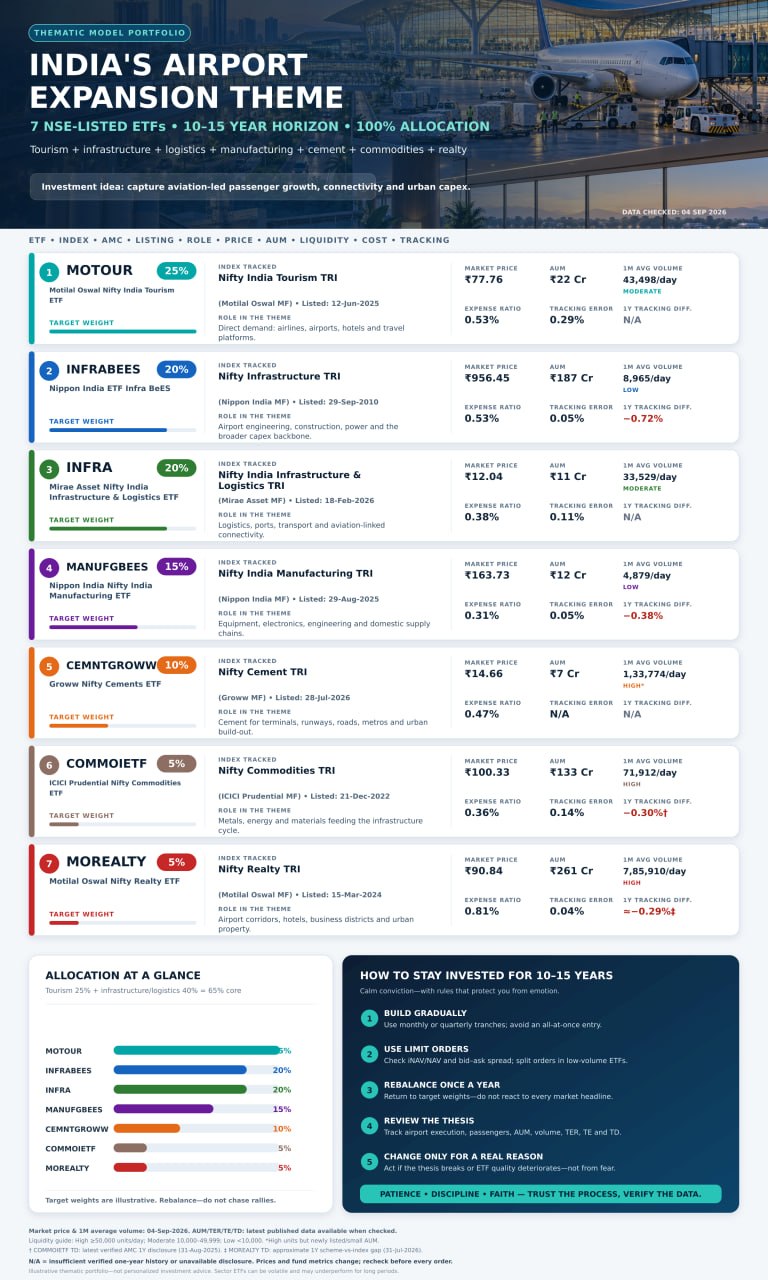
India’s Airport Expansion Opportunity – A Seven-ETF Portfolio for the Next 10–15 Years
India’s plan to develop about 100 additional airports over the coming decade may create a long-term opportunity across aviation, tourism, infrastructure, logistics, manufacturing, cement, commodities and real estate. Instead of depending on one company, this seven-ETF portfolio spreads the theme across direct beneficiaries and supporting industries. It requires a 10–15-year horizon and acceptance of significant market volatility.
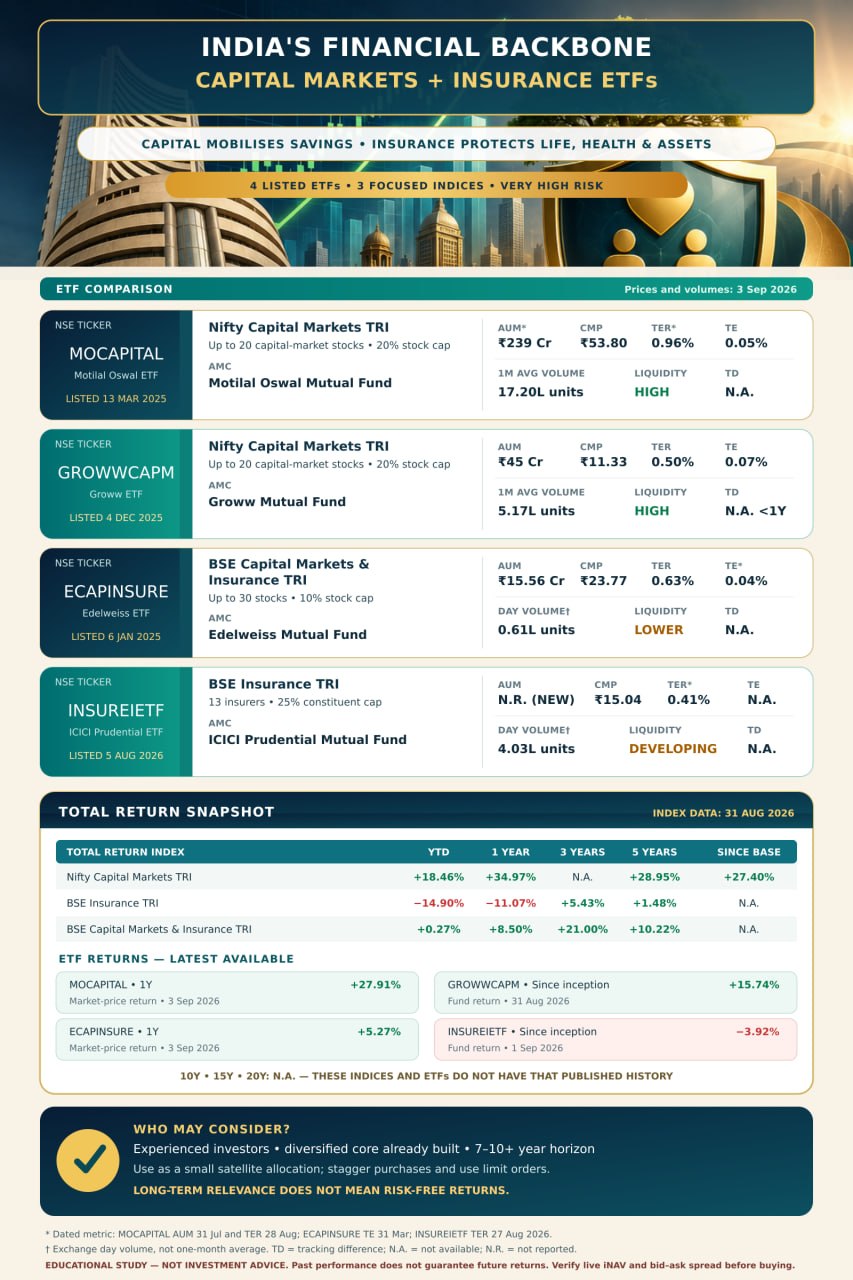
India's Financial Backbone: Capital Markets and Insurance ETFs
Capital markets mobilise savings into productive businesses, while insurance protects families and assets. As India's formal savings, demat participation, mutual funds, pensions and insurance penetration expand, these activities may benefit over time. Investors can access the theme through three focused indices, but each follows a different risk-and-return path.
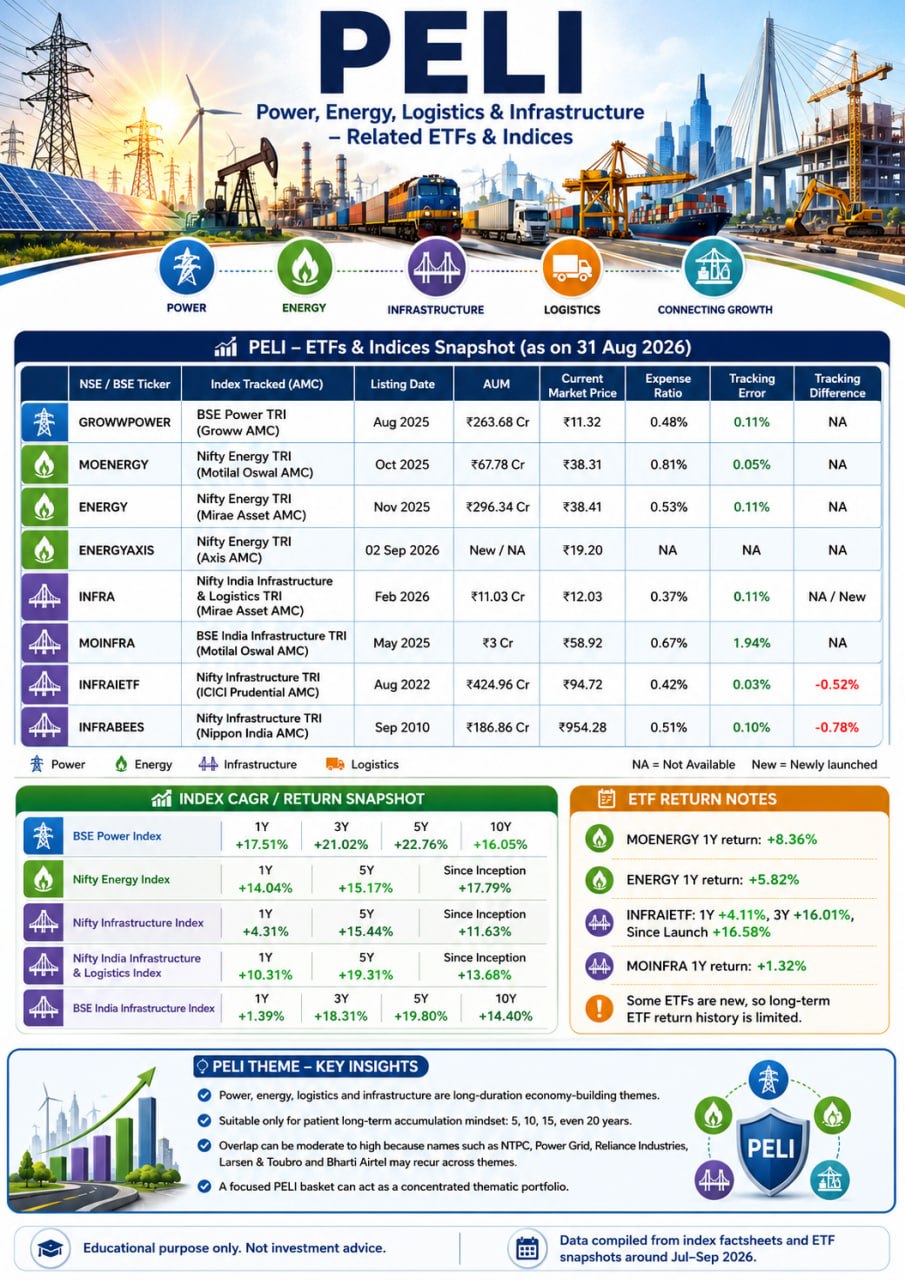
Power, Energy, Logistics & Infrastructure - Related ETFs and Indices
PELI combines power, energy, infrastructure and logistics - long-duration requirements supporting economic activity. These themes may suit a 5-20 year accumulation approach, but thematic concentration, valuations, liquidity and tracking quality still require periodic review.
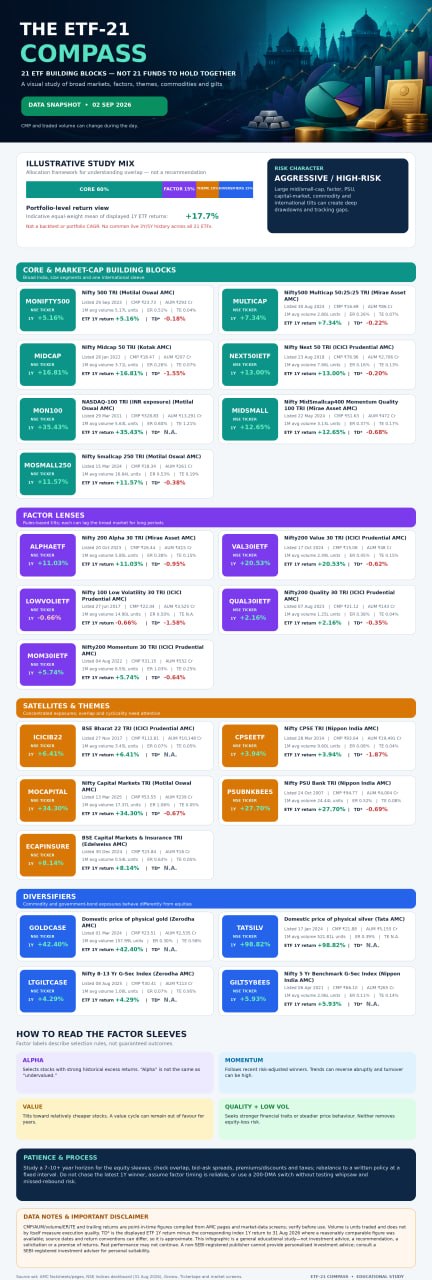
THE ETF-21 COMPASS
The idea. The ETF-21 Compass is a study framework for examining 21 exchange-traded funds across broad Indian equity, market-cap segments, factors, themes, United States equity, precious metals and government bonds. It is a menu of alternatives, not a proposal to own every ticker. More funds do not automatically mean better diversification because underlying holdings can overlap.
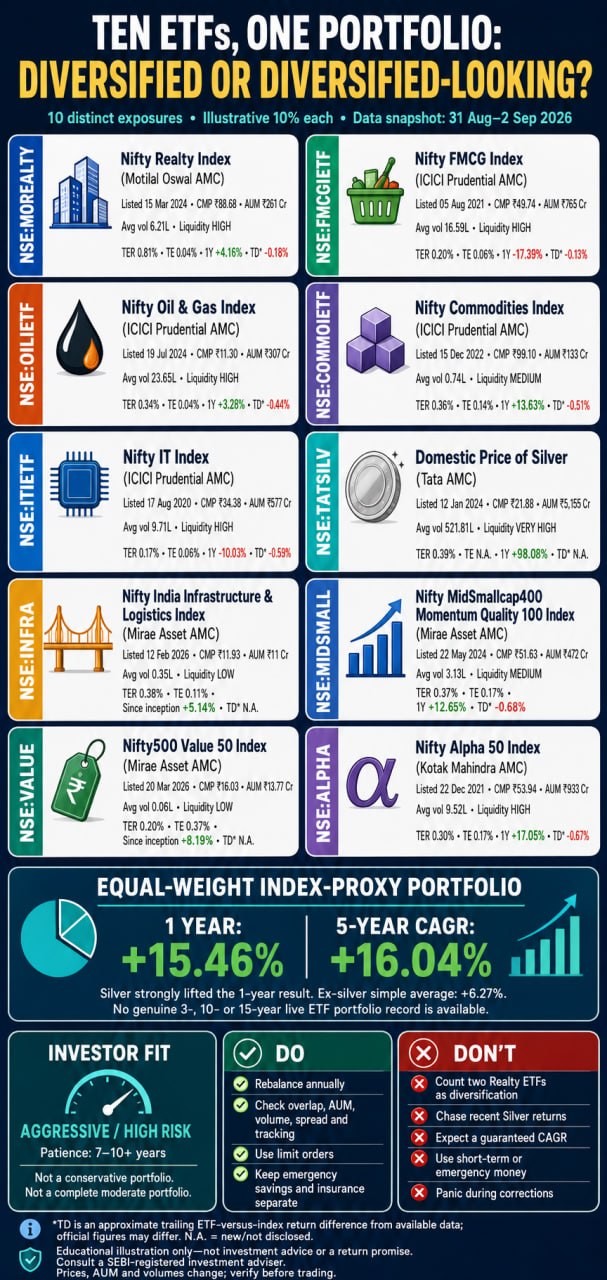
TEN ETFs, ONE PORTFOLIO: DIVERSIFIED OR DIVERSIFIED-LOOKING?
10 distinct exposures. GROWWRLTY and MOREALTY both track the Nifty Realty Total Return Index; therefore, they are alternatives, not separate diversification. The other exposures are FMCGIETF (Nifty FMCG), OILIETF (Nifty Oil & Gas), COMMOIETF (Nifty Commodities), ITIETF (Nifty Information Technology), TATSILV (domestic silver price), INFRA (Nifty India Infrastructure & Logistics), MIDSMALL (Nifty MidSmallcap400 Momentum Quality 100), VALUE (Nifty500 Value 50) and ALPHA (Nifty Alpha 50).
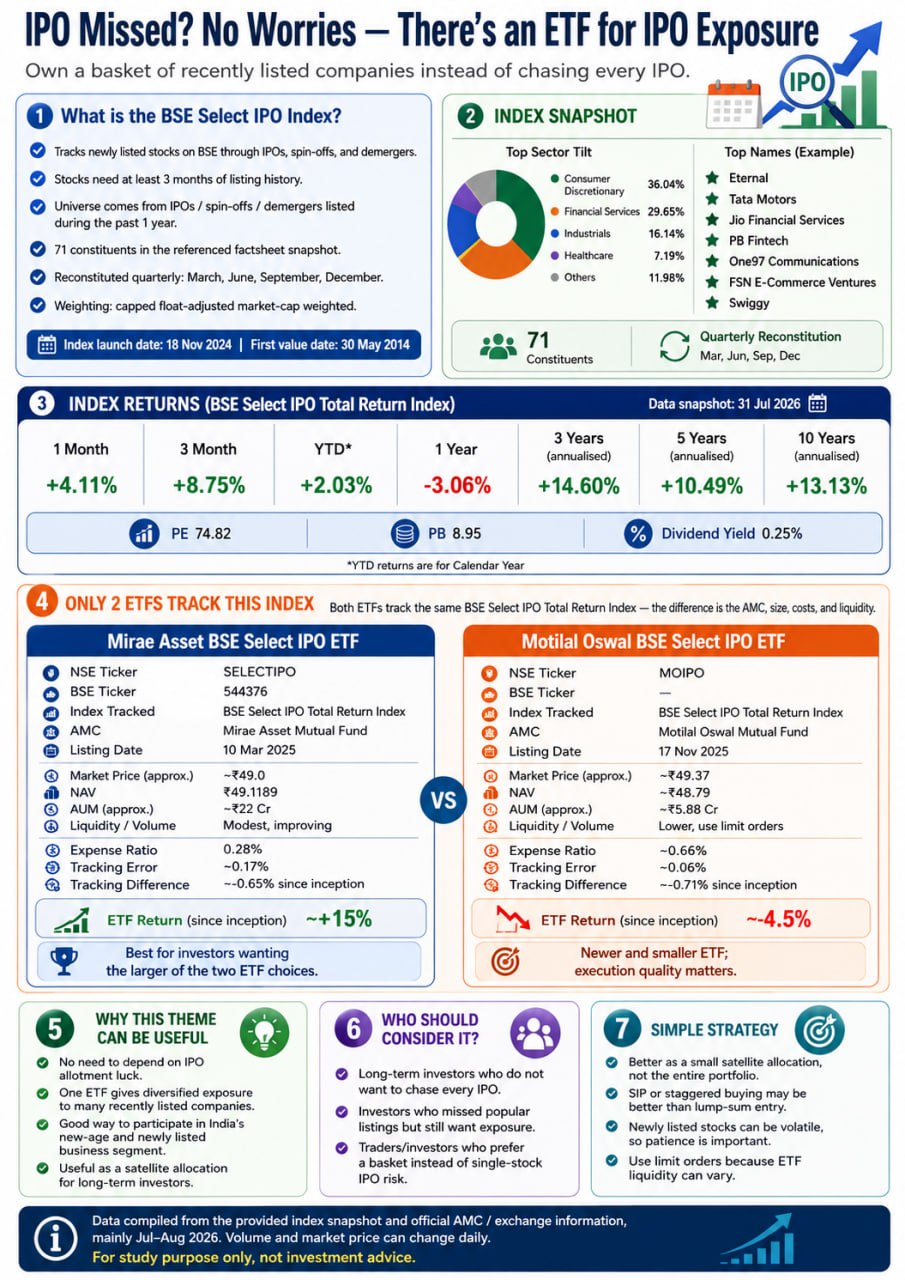
Missed the IPO? No Worries - There Is an ETF for India's New Listings
Missing an IPO allotment does not mean missing the company forever. The BSE Select IPO Index provides a rules-based way to own a basket of recently listed companies after they establish a trading history. Two exchange-traded funds track this same index, offering a diversified alternative to applying for individual IPOs.
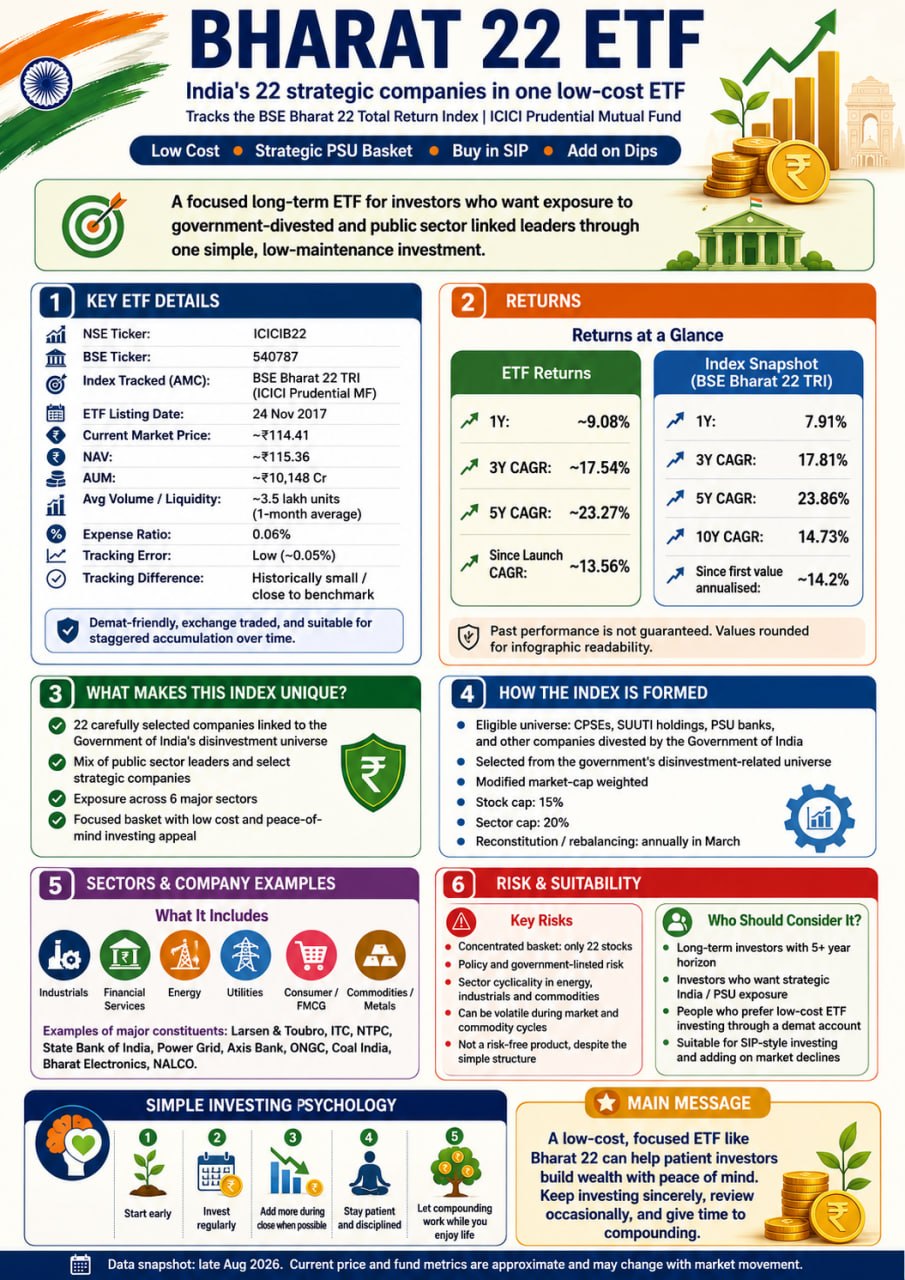
BSE Bharat 22 Index: 22 Strategic Companies in One ETF
The BSE Bharat 22 Index offers a distinctive way to participate in a focused basket of companies linked to India’s public-sector and government-disinvestment universe.
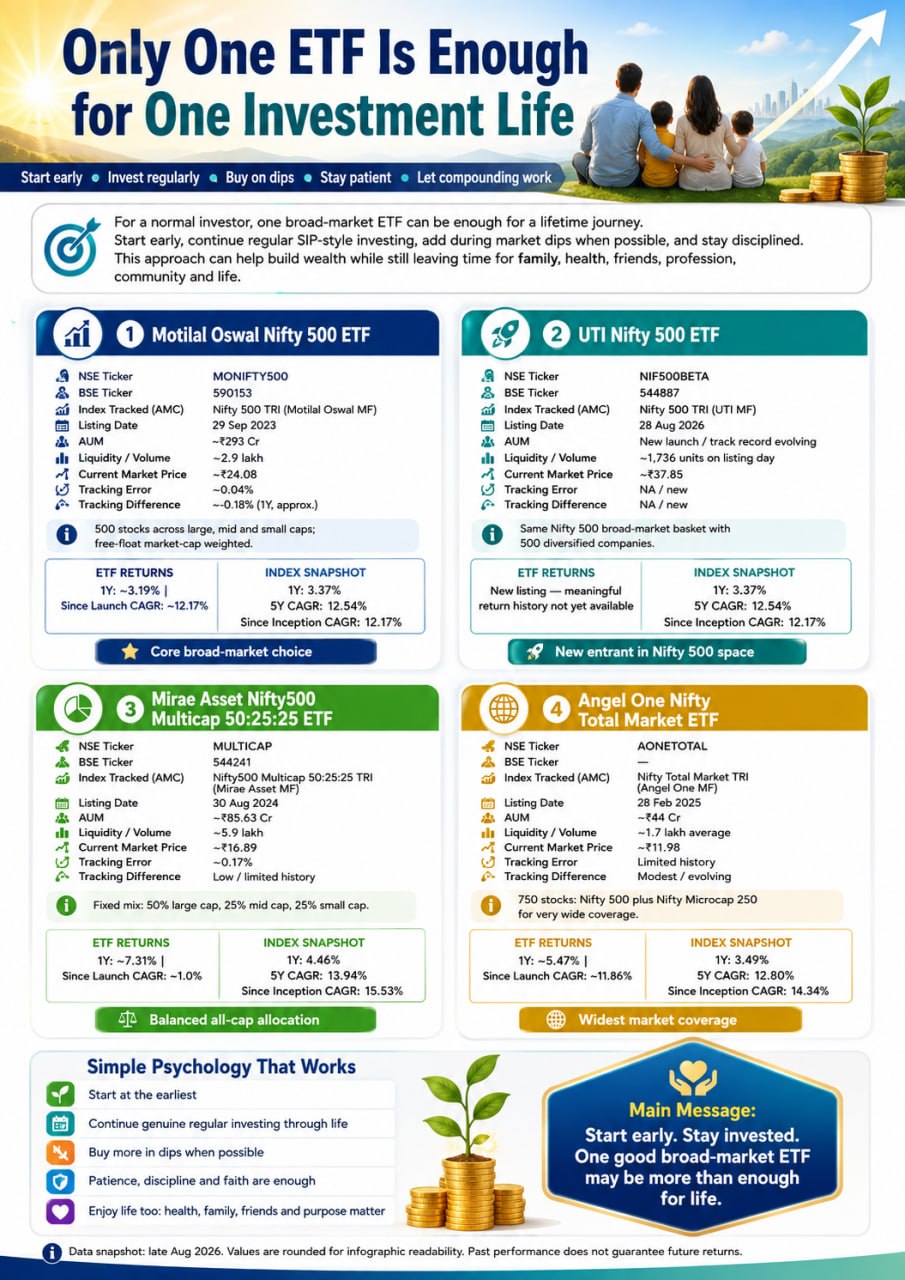
Only One ETF Is Enough for One Investment Life
For a normal long-term investor, investing need not become a second profession. Start early, invest every month through a systematic investment plan-like process, add more during meaningful market declines when finances permit, and continue for decades. The real edge is patience, discipline, consistency and faith in a sound process
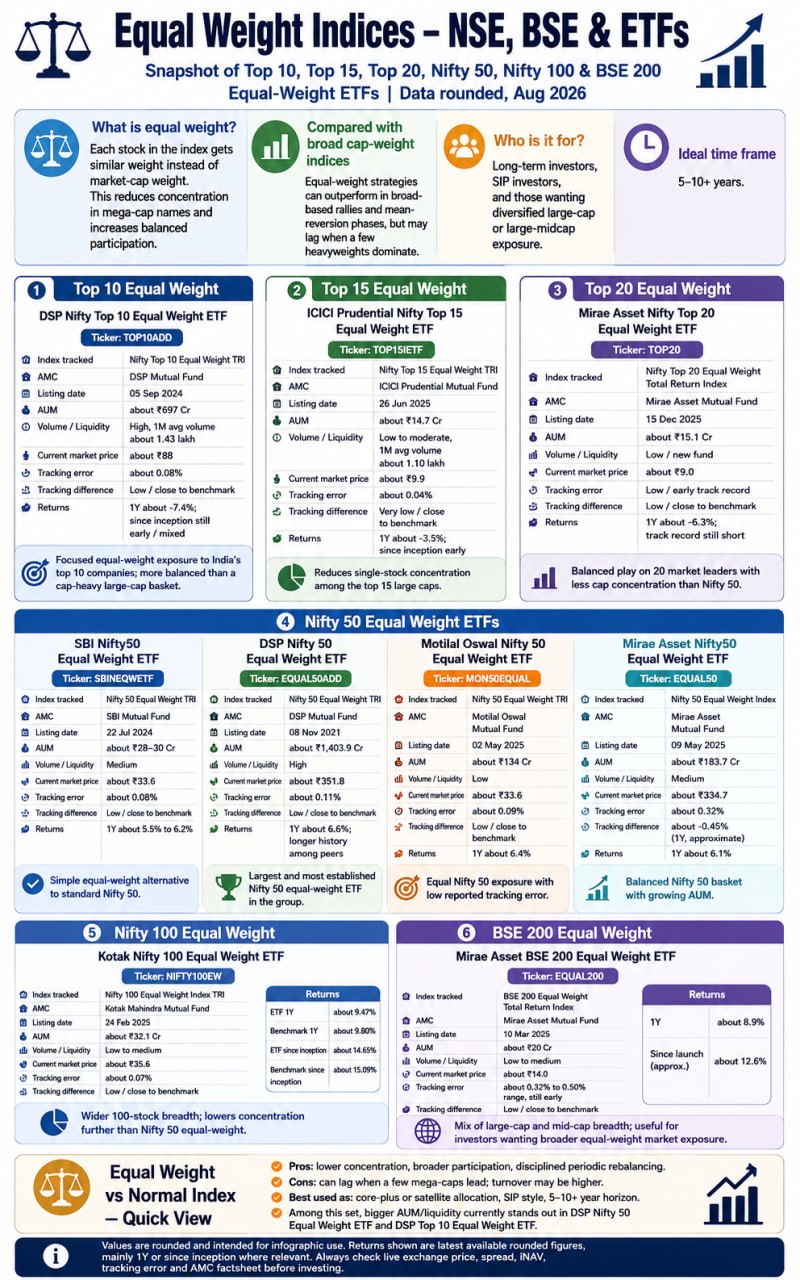
Equal Weight Indices, NSE, BSE, and ETFs on Them
An equal-weight index gives every constituent the same weight at each rebalancing instead of allowing the biggest companies to dominate by market capitalization. A 10-stock index starts near 10% per stock, a 50-stock index near 2%, and a 100-stock index near 1%. Between rebalances, weights drift with prices and are reset periodically. Nifty50 and Nifty100 Equal Weight use the same constituents as their parent indices; Nifty Top 10, Top 15 and Top 20 select the largest stocks from the Nifty 50 universe and then weight them equally.
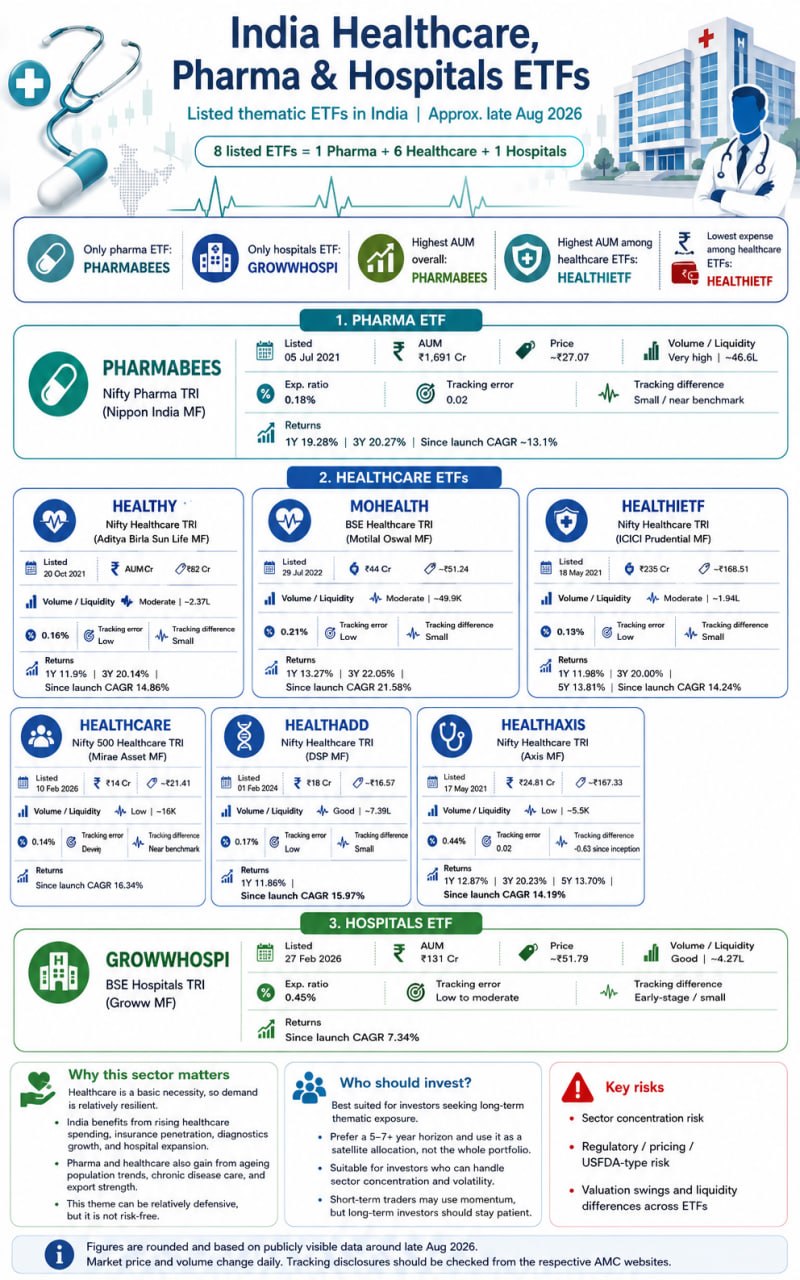
Healthcare, Hospitals & Pharma ETFs in India – August 2026
Healthcare is an important long-term structural theme in India. Rising incomes, population ageing, lifestyle diseases, wider health-insurance coverage, hospital expansion, diagnostics, medical tourism and India’s global pharmaceutical manufacturing base can support long-duration growth. Yet this remains a sectoral investment: valuations, price controls, regulatory actions, drug approvals, currency movements and company-specific events can cause sharp cycles.
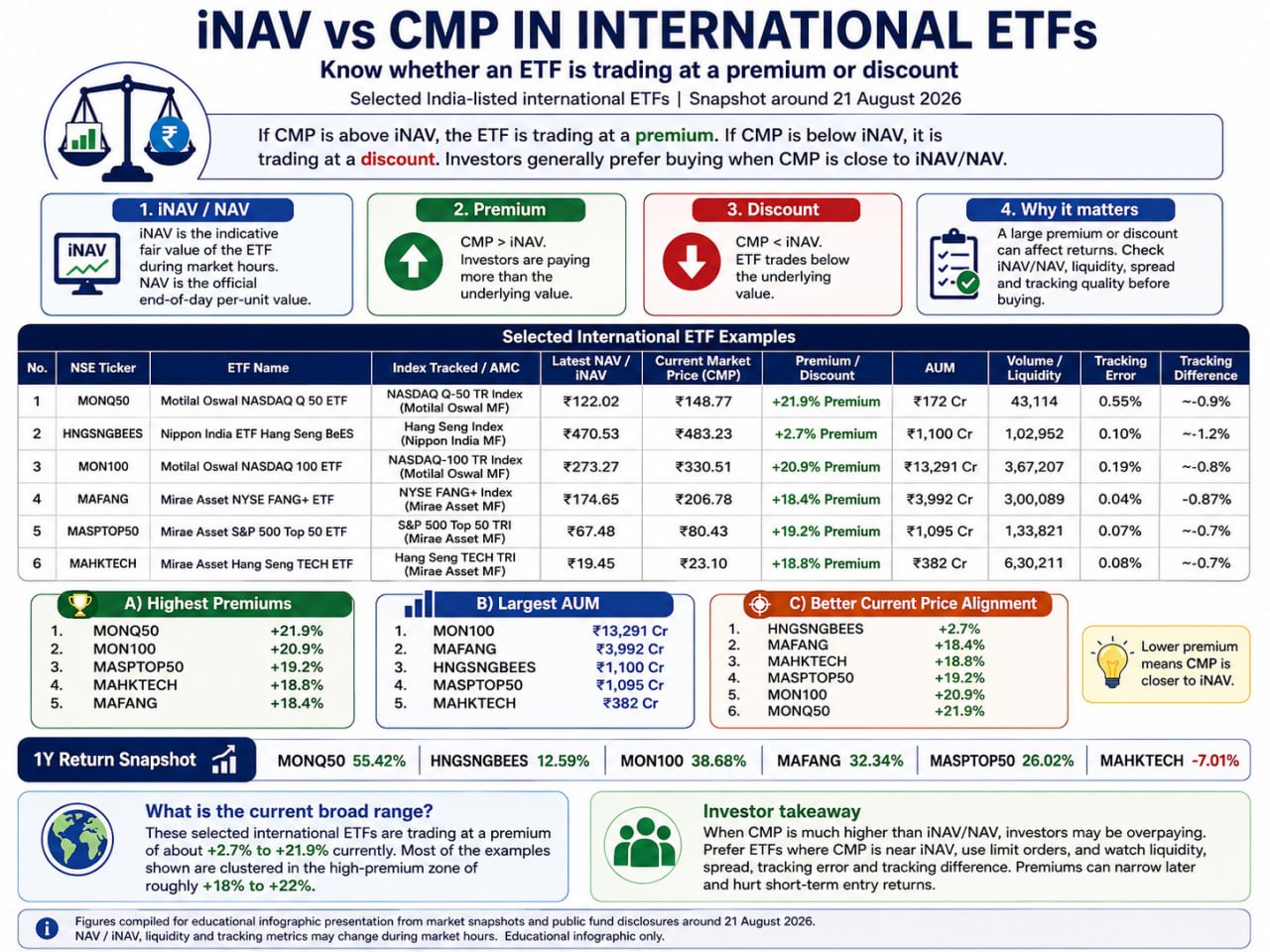
NAV, iNAV AND CURRENT MARKET PRICE IN ETFs
An ETF has two important values. NAV (Net Asset Value) represents the per-unit value of the assets held by the fund, usually calculated at the end of the day. iNAV (Indicative Net Asset Value) is an intraday estimate of fair value. CMP (Current Market Price) is the price at which the ETF is actually trading on the stock exchange.
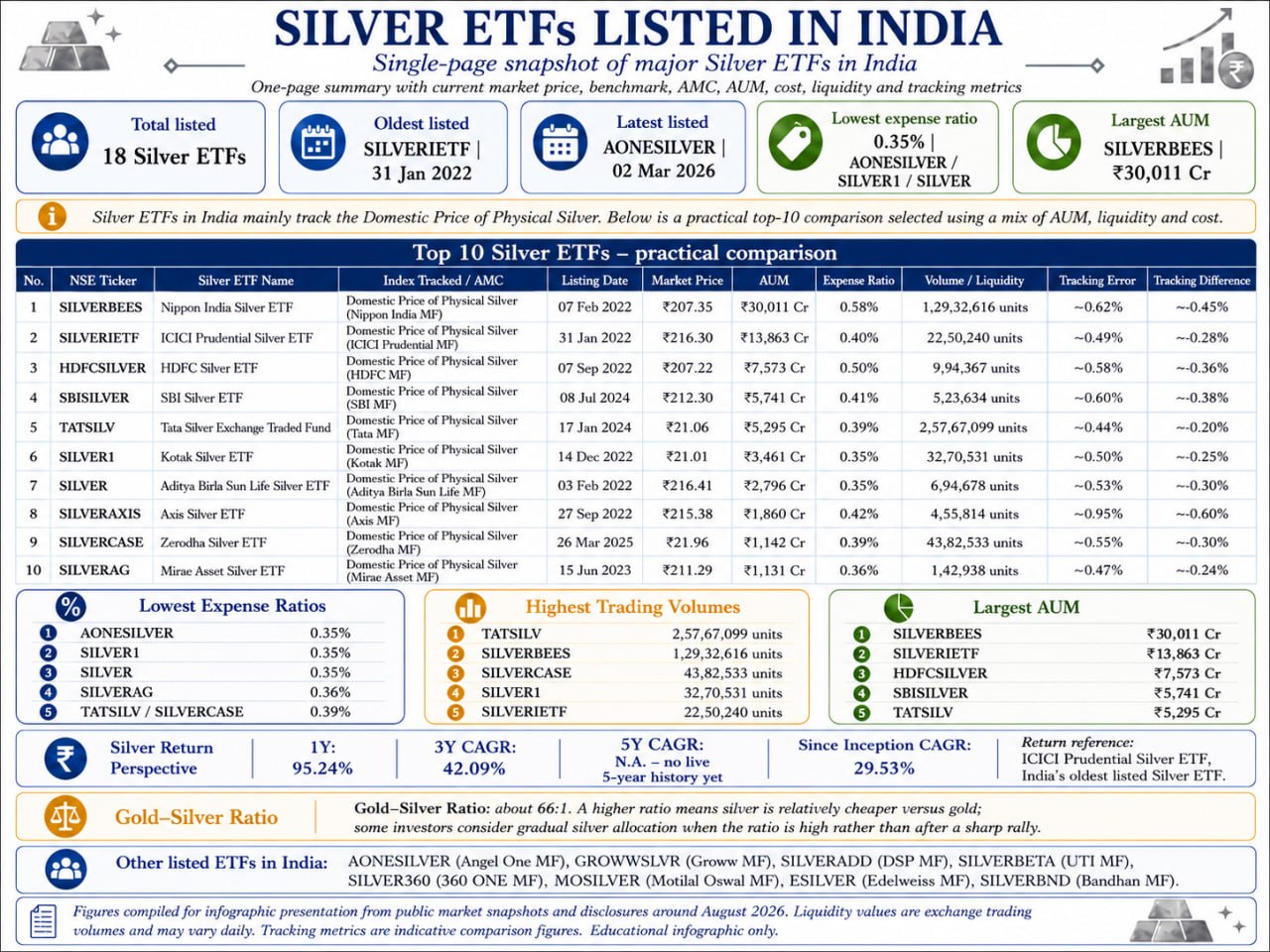
SILVER ETFs LISTED IN INDIA
India has 18 listed Silver ETFs based on the latest available list through 21 August 2026. The oldest is ICICI Prudential Silver ETF (NSE: SILVERIETF), listed on 31 January 2022. The most recent is Angel One Silver ETF (AONESILVER), listed on 02 March 2026. Among the largest schemes, Nippon India Silver ETF remains the AUM leader at roughly ₹29,500–30,000 crore, followed by ICICI Prudential Silver ETF at about ₹13,700 crore and HDFC Silver ETF at about ₹7,470 crore.
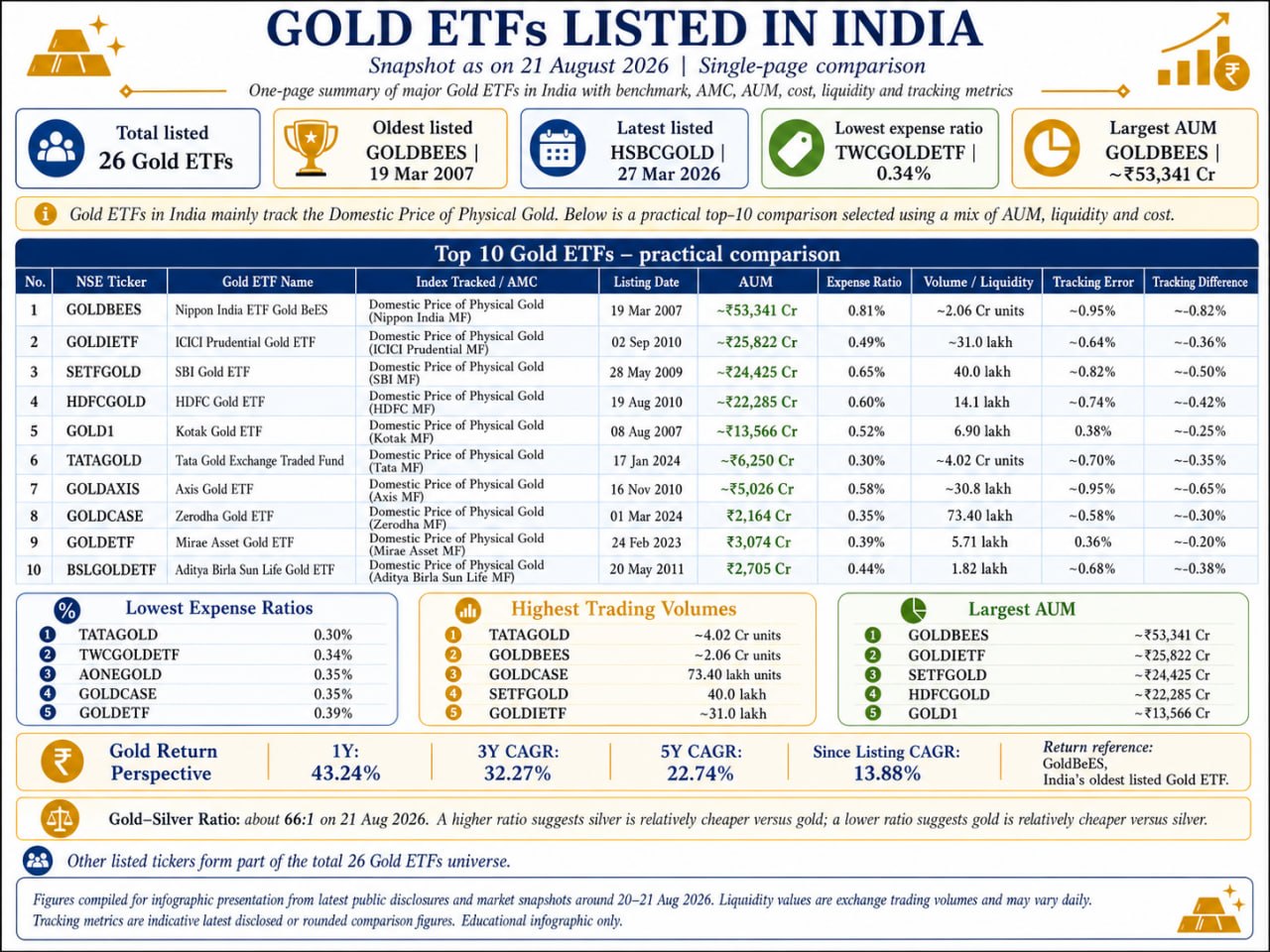
GOLD ETFs IN INDIA: UPDATED REVIEW TO 22 AUGUST 2026
India now has 26 listed Gold ETFs. The pioneer is Nippon India ETF Gold BeES (GOLDBEES), listed on 19 March 2007. The most recently listed Gold ETF remains HSBC Gold ETF (HSBCGOLD), admitted to NSE trading from 27 March 2026. Since 22 August was a Saturday, the latest market trading data available for this update is from 21 August 2026.
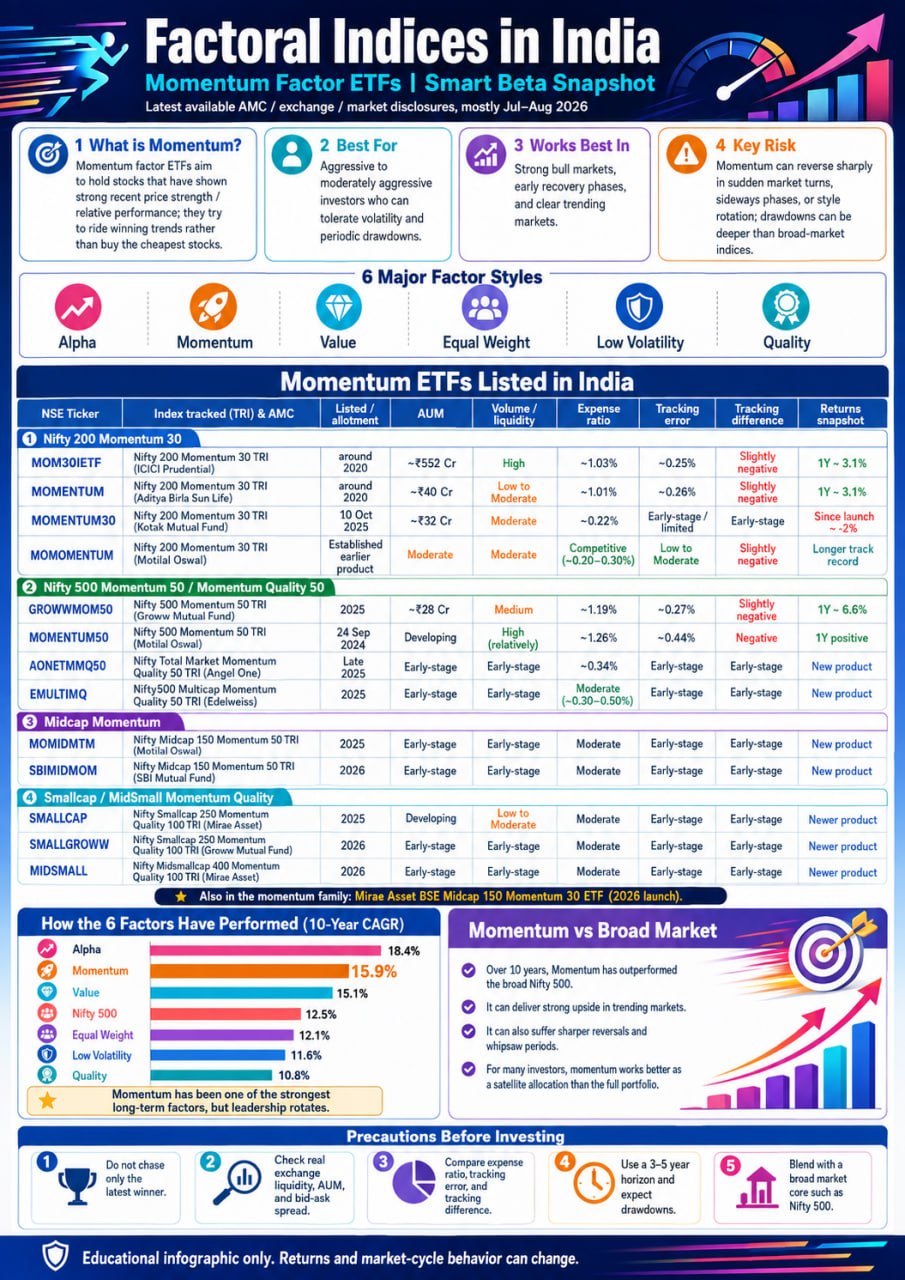
Factoral Indices in India – Momentum Series
Factor investing in India broadly includes six styles: Alpha, Momentum, Value, Equal Weight, Low Volatility, and Quality. Momentum is the style that selects stocks showing the strongest recent price strength and relative performance, usually from a defined index universe. In simple words, it tries to ride the winners rather than buy the cheapest stocks. Momentum generally works best in strong bull markets, early recovery phases, and periods when market leadership is clear and trends are persistent. It usually struggles in sideways markets, sudden reversals, or sharp style rotations, when yesterday’s winners can correct quickly.
Factoral Indices in India Value Series
Value is one of the six major factor styles used in Indian smart-beta investing, along with Alpha, Momentum, Equal Weight, Low Volatility and Quality. Instead of simply buying the largest companies by market capitalisation, a value index systematically selects companies that appear attractively priced relative to their fundamentals.
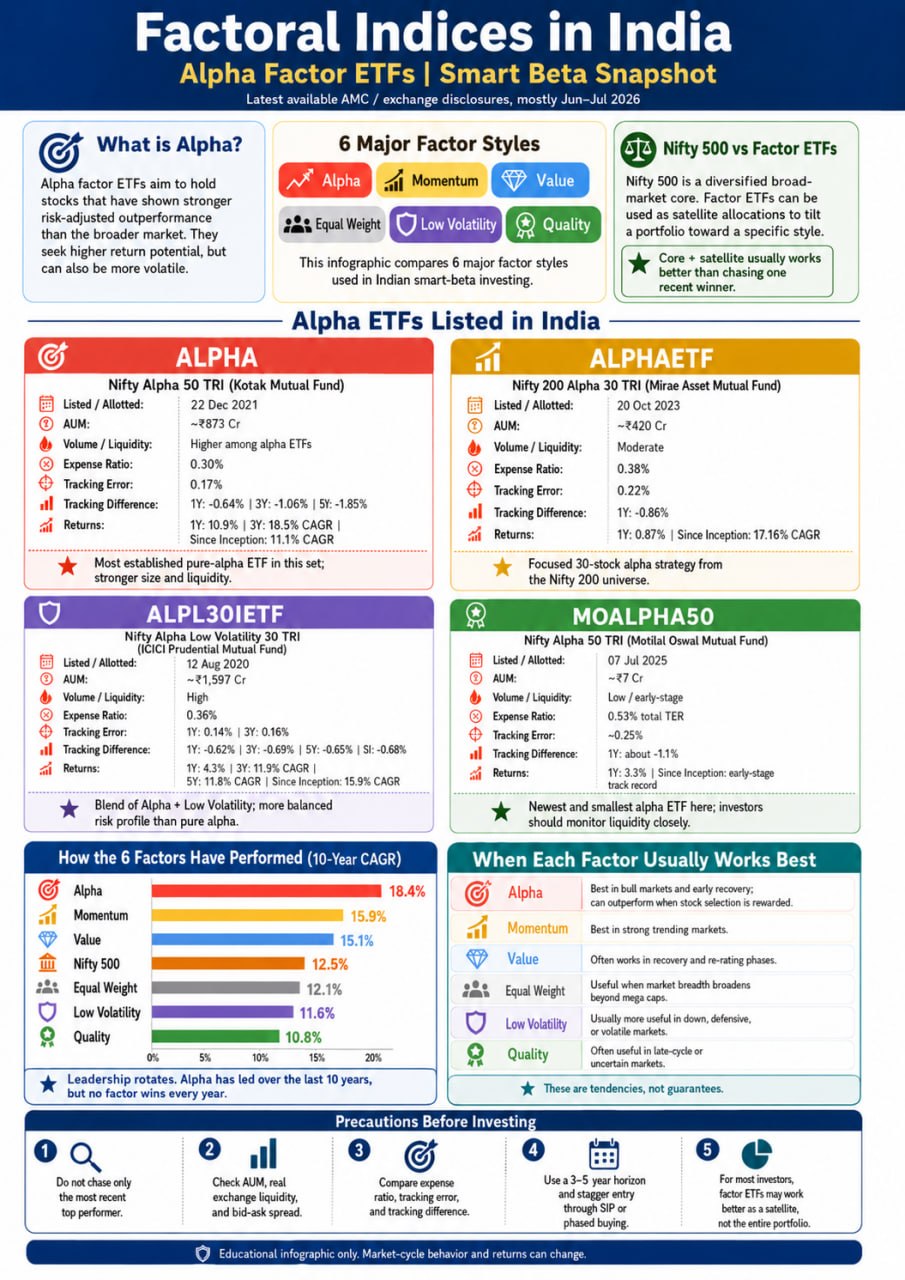
Factoral Indices in India
Factor investing selects stocks using defined characteristics rather than only market-capitalisation. In India, six commonly followed factor styles are Alpha, Momentum, Value, Equal Weight, Low Volatility and Quality. The supplied 10-year performance snapshot shows an important lesson: leadership keeps rotating and no factor wins every year. Over the 10-year period, Alpha led with an 18.4% CAGR, followed by Momentum at 15.9% and Value at 15.1%, while the broad Nifty 500 delivered 12.5%; Equal Weight, Low Volatility and Quality returned 12.1%, 11.6% and 10.8%, respectively. In 2026 through 11 August, Alpha was again ahead at 6.8%, with Equal Weight at 4.2%, while Nifty 500 was -1.0%. Therefore, Nifty 500 can remain a diversified core holding, while factor indices may be used as satellite allocations rather than chasing the latest winner.
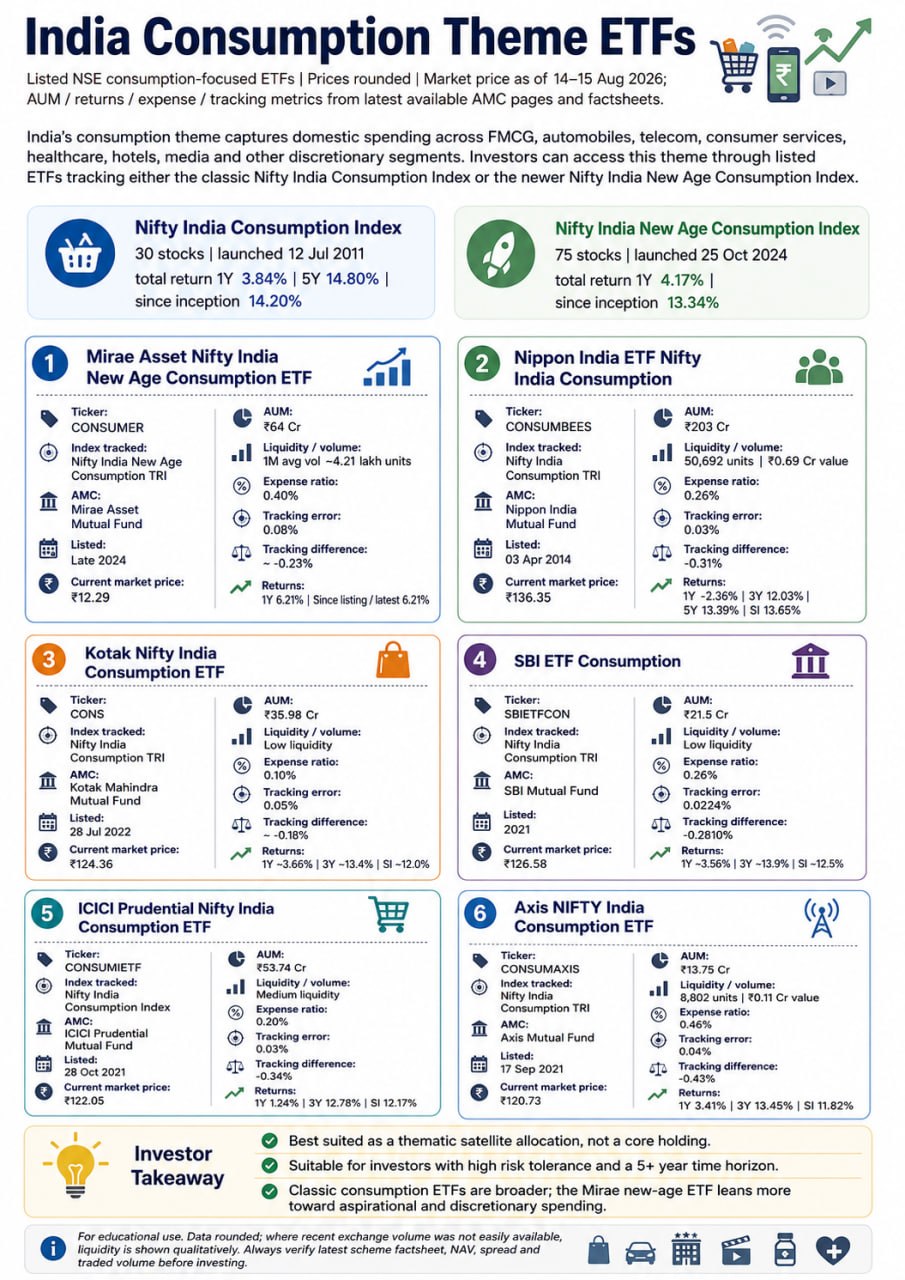
India Consumption Theme: Investing in India’s Consumer Growth Story
India’s consumption theme represents companies that benefit from rising incomes, urbanisation, changing lifestyles, greater digital access and higher discretionary spending. Consumption today is much broader than traditional fast-moving consumer goods. It includes automobiles, consumer services, durables, telecommunications, healthcare, travel, real estate-linked consumption and newer digital businesses.
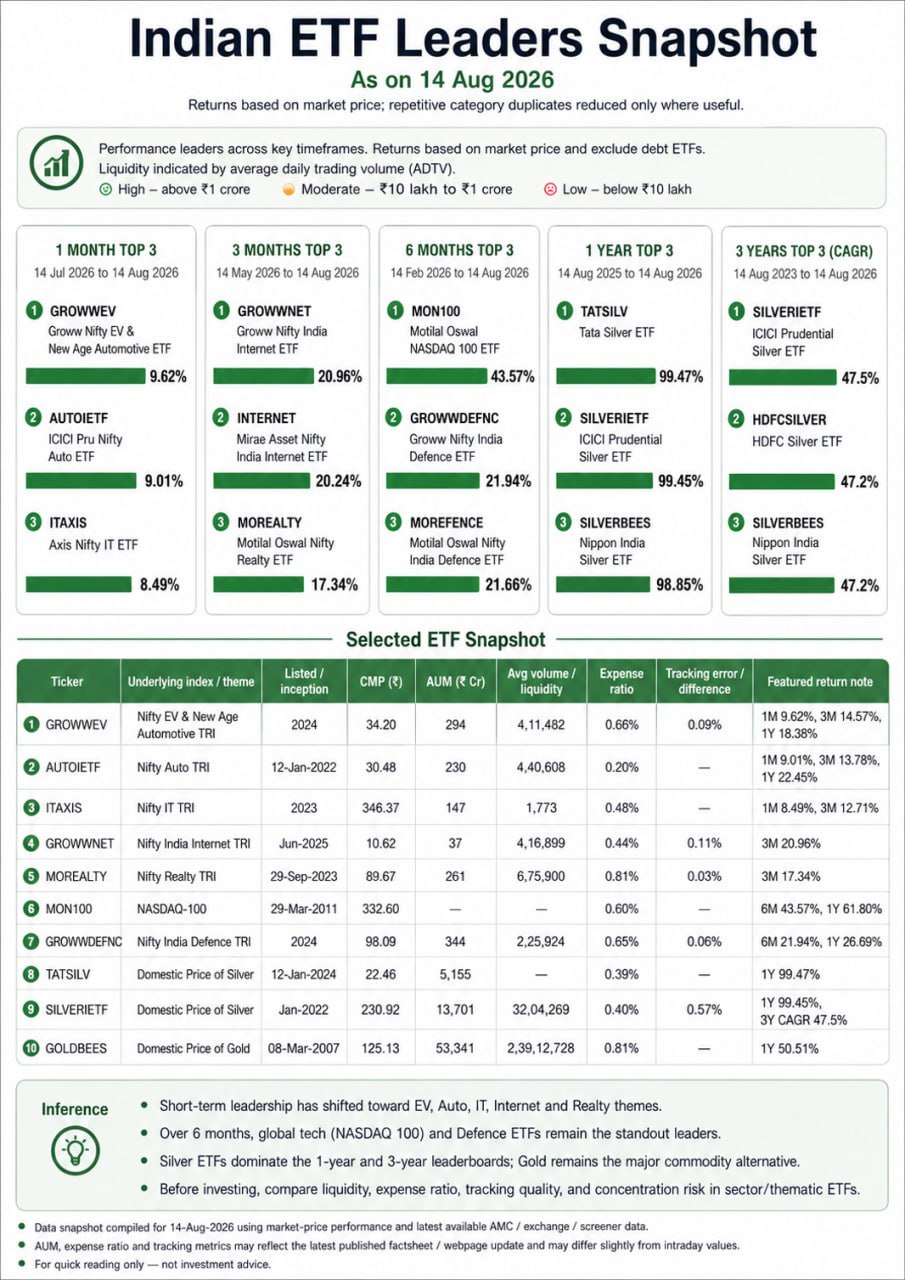
Key Learnings from the Indian ETF Leaders Snapshot
The ETF performance snapshot from 1 month to 3 years gives a useful lesson: market leadership keeps changing. In the short term, EV, Auto, IT, Internet and Realty ETFs have shown stronger momentum. Over six months, global technology exposure through the Nasdaq 100 and Defence ETFs has stood out. Over the longer period, Silver ETFs have dominated the 1-year and 3-year return tables, while Gold continues to remain an important commodity diversifier.
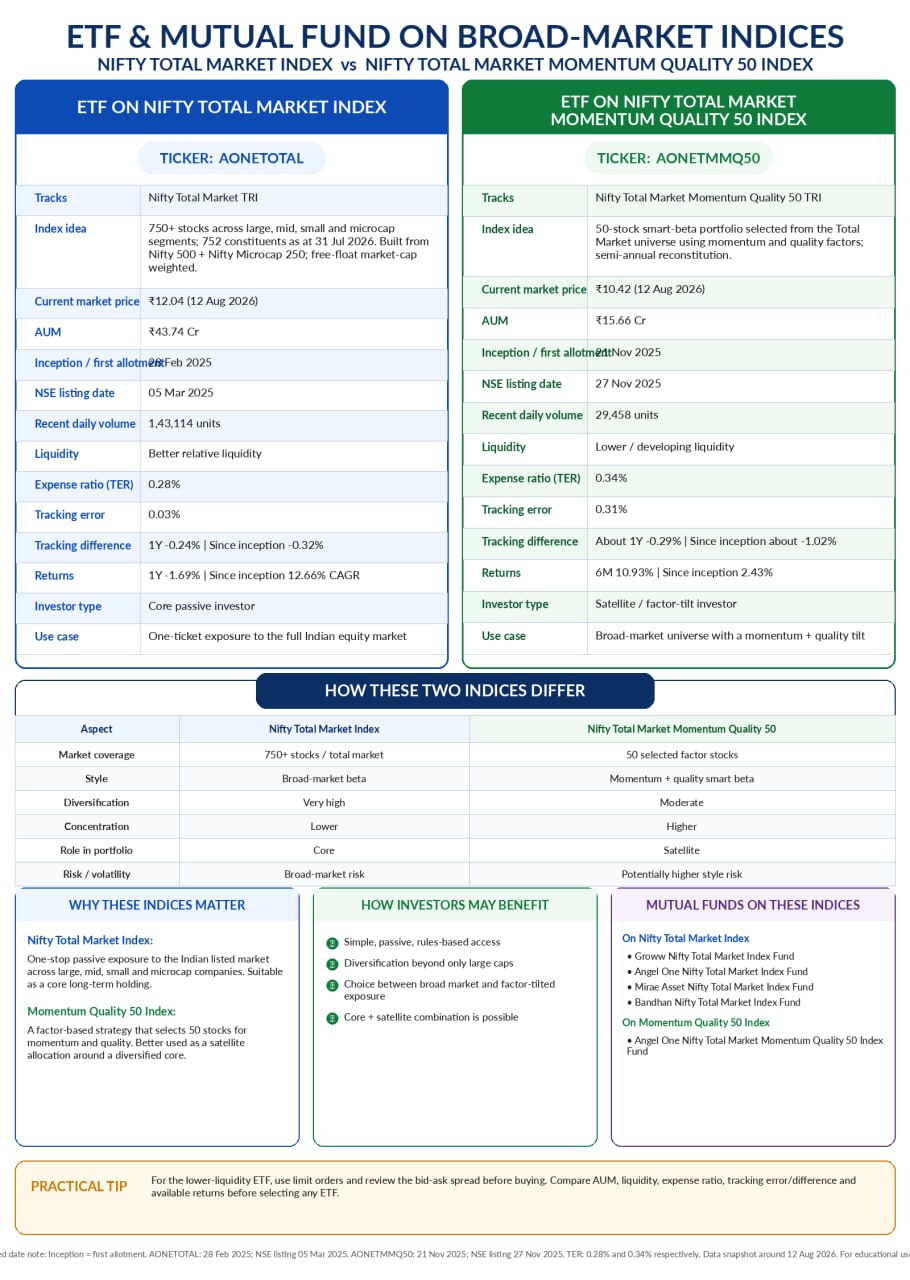
Nifty Total Market ETFs: Broad Market vs Momentum Quality
India now has passive products that provide either very broad “whole-market” exposure or a concentrated smart-beta selection from the same universe. The two Angel One ETFs below show this difference clearly.
REITs & InvITs: Understanding the 2026 Tax and Regulatory Reset
The proposed 2026 tax and regulatory changes for REITs and InvITs could bring important changes for investors looking for regular income and long-term exposure to infrastructure and real estate.
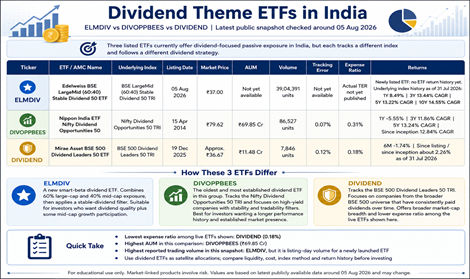
DIVIDEND THEME ETFs IN INDIA
ELMDIV vs DIVOPPBEES vs DIVIDEND
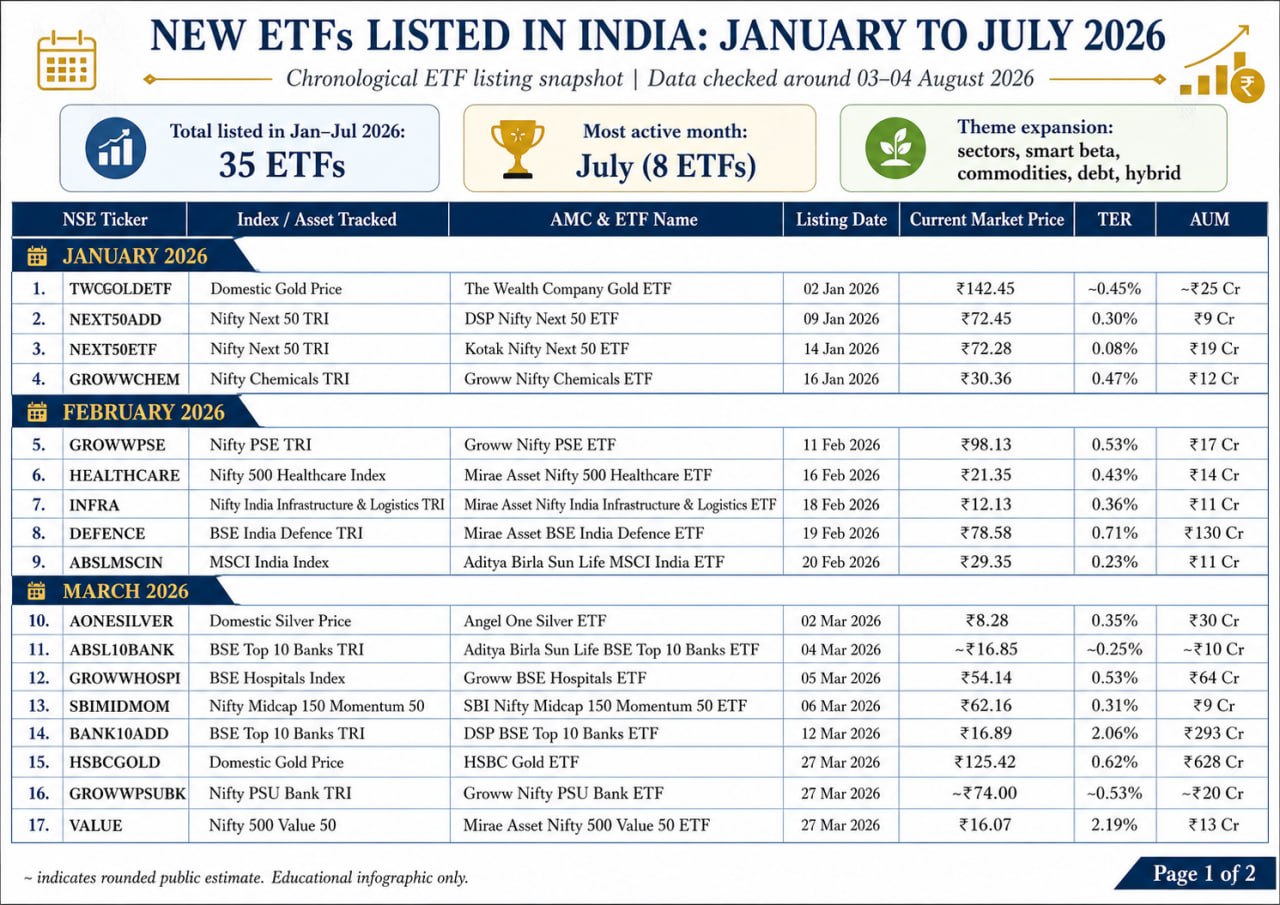
NEW ETFs LISTED IN INDIA: JANUARY TO JULY 2026
Chronological NSE listing review | Latest public data checked around 03-04 August 2026
HOW TO USE NIFTY INDICES FOR ETF RESEARCH
Nifty Indices is the official source for Nifty index definitions, factsheets, methodology, constituents and reports. It is the best place to understand what an ETF is designed to track. Not every index has an ETF, and the same index may be tracked by more than one AMC.
HOW TO STUDY BSE INDICES FOR ETF RESEARCH
The BSE Indices website helps investors study the underlying indices followed by many ETFs. You can explore index categories, review performance and constituents, and download the official fact sheet.
ETF STUDIES ON THE NSE INDIA WEBSITE
The NSE India website is a useful official starting point for studying listed ETFs. It allows investors to view ETF market data, compare important trading fields, download the list, and check newly listed products.
ETF BASICS
ETF means Exchange Traded Fund. It is a basket of shares, bonds or commodities that trades on a stock exchange like a share. A single ETF unit can provide diversified exposure through one transaction.
ETF Basics: A Simple Starting Point for New Investors
ETF stands for Exchange Traded Fund. It is a basket of investments—such as shares, bonds or commodities—that trades on a stock exchange like an ordinary share. One ETF unit can provide exposure to several securities or to a particular asset through a single transaction. ETFs can be bought and sold during market hours.
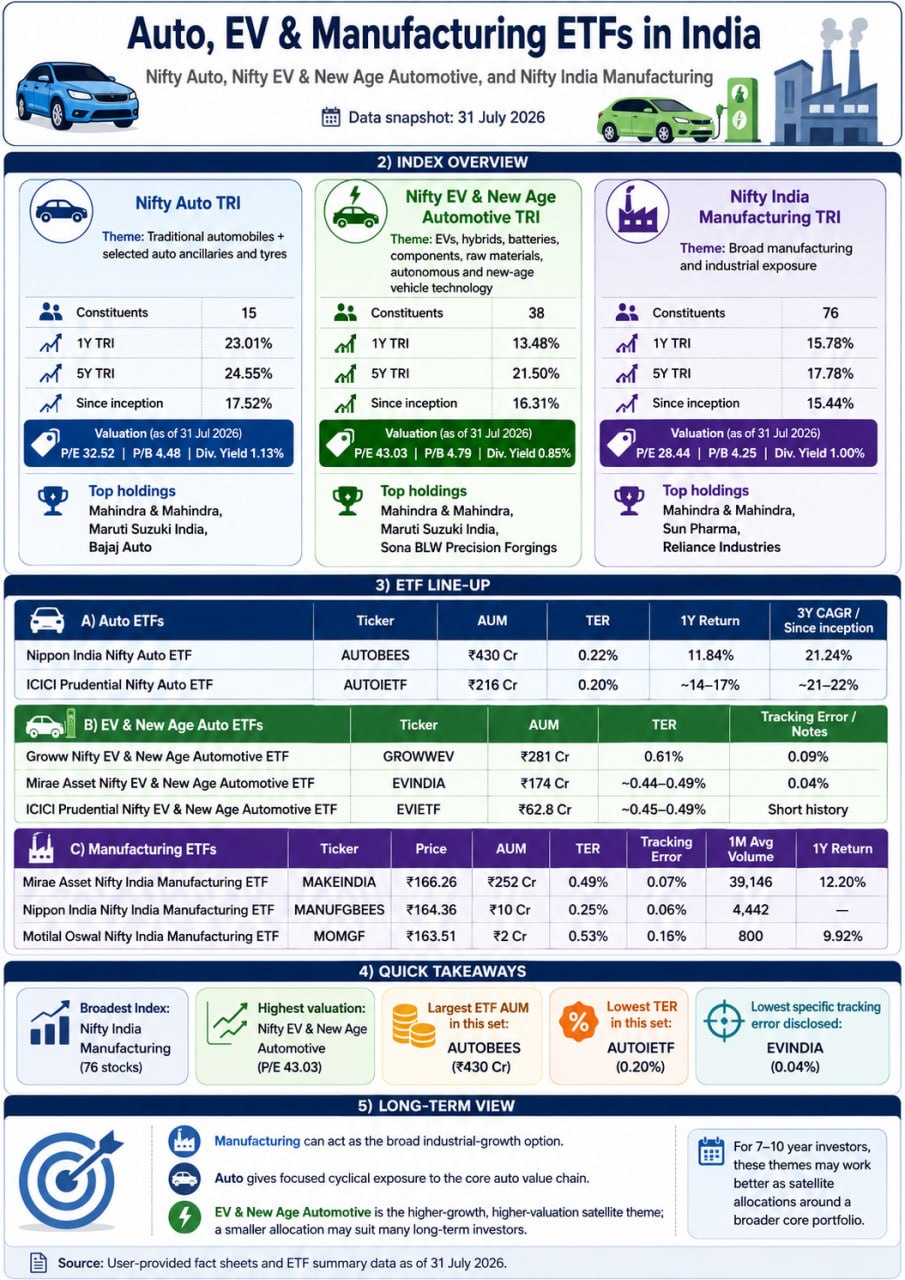
AUTO, EV & MANUFACTURING ETFs IN INDIA
These three indices together provide a practical way to study the automobile value chain. Nifty Auto offers traditional auto and auto-ancillary exposure, Nifty EV & New Age Automotive provides the high-growth EV and technology angle, and Nifty India Manufacturing gives a broader industrial basket with meaningful automobile and capital goods participation.
₹1,00,000 MONTHLY INVESTMENT PLAN
Investment philosophy Build wealth through a fixed monthly process, broad-market participation, controlled factor and sector tilts, and a gradual risk-reduction mechanism. The process is controllable; the return is market-dependent.
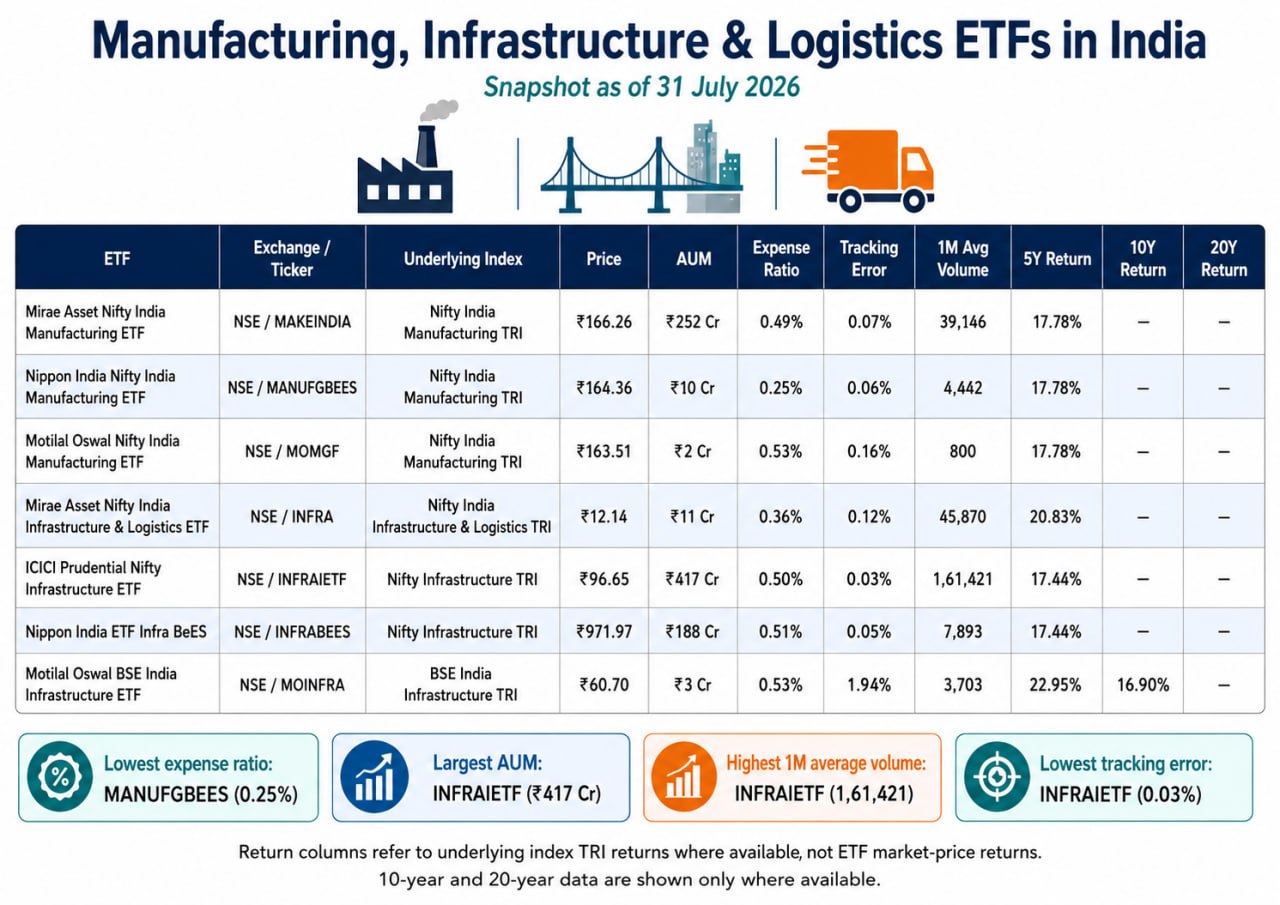
INDIA MANUFACTURING, INFRASTRUCTURE & LOGISTICS ETFs
India now has multiple passive choices for manufacturing and infrastructure themes. Although several ETFs may appear similar, they may track very different indices: a focused 30-stock infrastructure index, a broad 100-stock infrastructure and logistics index, a 76-stock manufacturing index, or the BSE India Infrastructure Index.