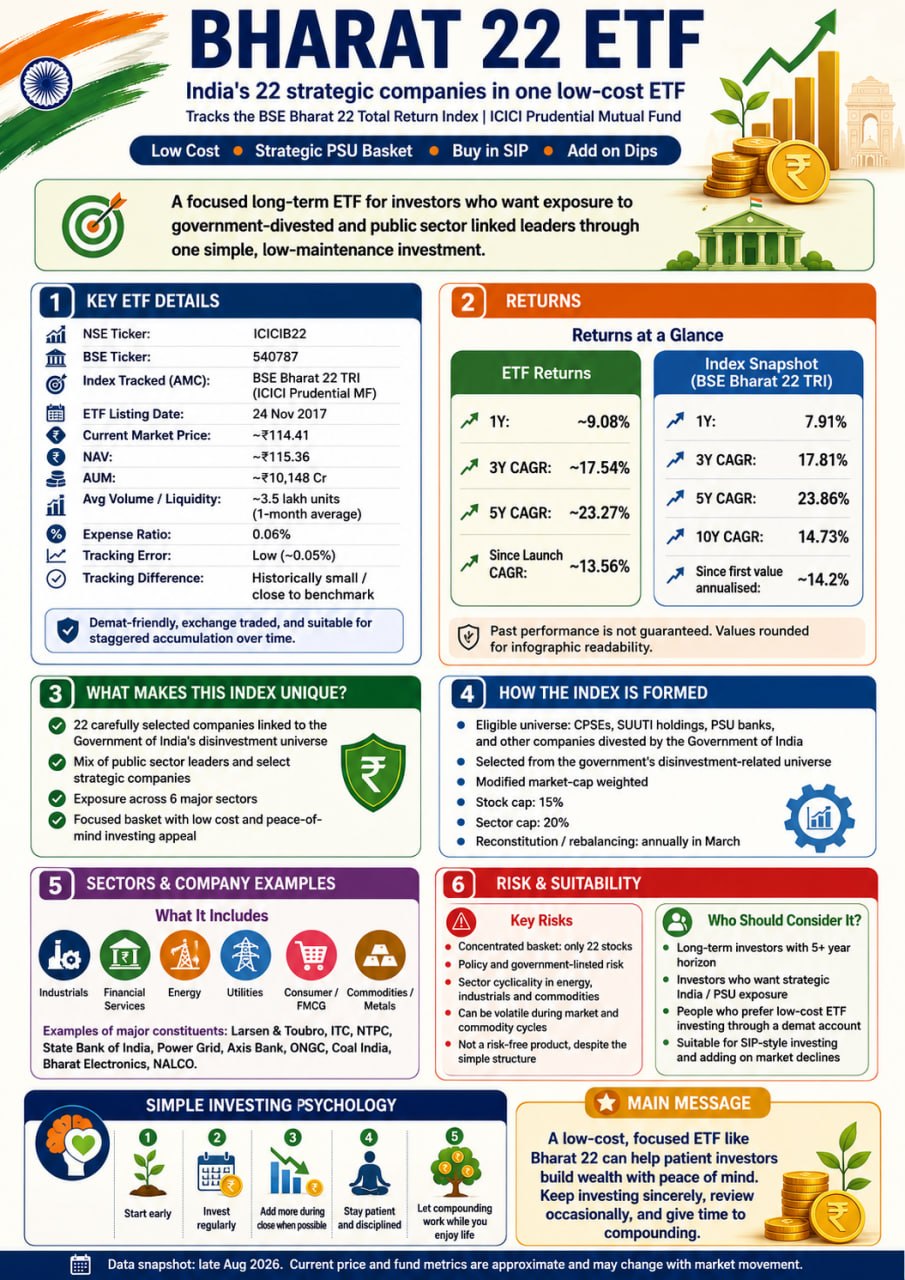
The BSE Bharat 22 Index offers a distinctive way to participate in a focused basket of companies linked to India’s public-sector and government-disinvestment universe. It was launched on 10 August 2017 and is designed around 22 select companies. For investors who prefer a simple, rules-based approach rather than continuously choosing individual shares, the index can serve as a long-term satellite allocation alongside broader-market investments.
The eligible universe includes Central Public Sector Enterprises, Specific Undertaking of the Unit Trust of India holdings, Public Sector Undertaking banks and other companies disinvested by the Government of India. The Government publishes the stocks included under its disinvestment programme, and these form the index. Constituents are weighted by float-adjusted market capitalisation, with an individual stock cap of 15% and a macro-economic sector cap of 20%. The index is rebalanced annually in March, while additions or deletions can occur when the Government changes its disinvestment programme.
Its uniqueness is that it is not a conventional broad-market index. It combines large strategic businesses across industrials, financial services, energy, utilities and consumer-oriented companies. Current important constituents include Larsen & Toubro, ITC, NTPC, State Bank of India, Power Grid, Axis Bank, Oil and Natural Gas Corporation, Coal India, Bharat Electronics and National Aluminium Company. This mix can benefit when public-sector companies, infrastructure, capital expenditure, energy, commodities, defence and value-oriented stocks lead the market.
The long-term record has been strong, although returns have not been smooth. According to the BSE factsheet dated 31 July 2026, the Total Return Index delivered 7.91% over one year, 17.81% CAGR over three years, 23.86% CAGR over five years and 14.73% CAGR over ten years. From the first value date of 17 March 2006, the Total Return Index rose from a base of 1,000 to 15,054.55, equivalent to roughly 14.2% annualised. These figures show the power of staying invested, but they do not guarantee future returns.
The index is available through the BHARAT 22 ETF of ICICI Prudential Mutual Fund, traded on NSE as ICICIB22. It was launched on 24 November 2017. As of 28 August 2026, the market price was about ₹114.41; latest reported assets were about ₹10,148 crore, expense ratio around 0.07% and tracking error around 0.05%. It can be bought through a demat account and accumulated periodically or during market corrections.
The main risk is concentration: only 22 stocks, meaningful exposure to government-linked businesses and cyclical sectors, and sensitivity to policy, regulation, commodity prices and market cycles. Therefore, this is a low-maintenance investment, not a risk-free investment. For a patient investor with a long horizon, disciplined regular buying and sensible diversification can make it a simple “peace-of-mind” approach—invest, review occasionally, and allow time and compounding to do the heavy work.