Factoral Indices in India
Alpha Series
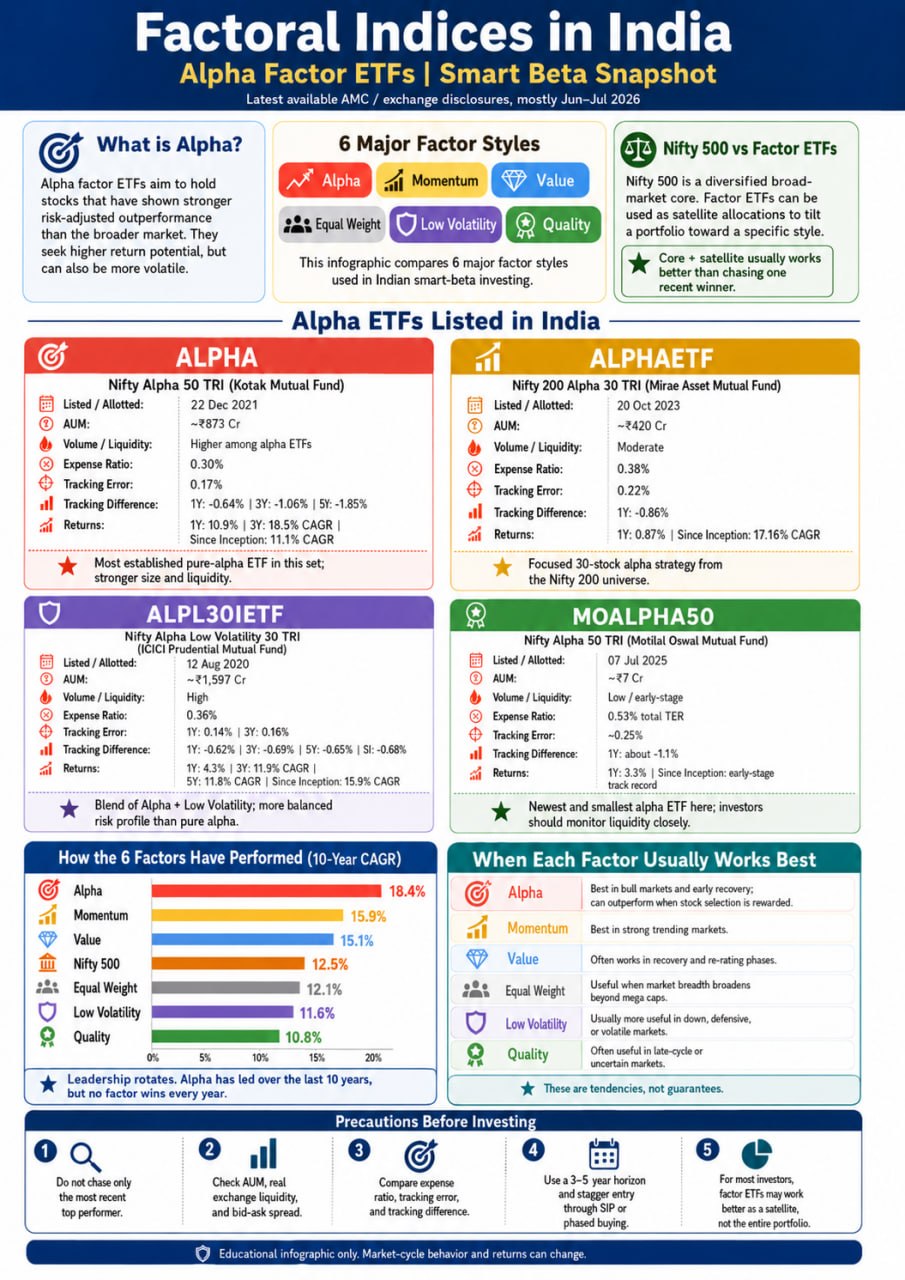
Factor investing selects stocks using defined characteristics rather than only market-capitalisation. In India, six commonly followed factor styles are Alpha, Momentum, Value, Equal Weight, Low Volatility and Quality. The supplied 10-year performance snapshot shows an important lesson: leadership keeps rotating and no factor wins every year. Over the 10-year period, Alpha led with an 18.4% CAGR, followed by Momentum at 15.9% and Value at 15.1%, while the broad Nifty 500 delivered 12.5%; Equal Weight, Low Volatility and Quality returned 12.1%, 11.6% and 10.8%, respectively. In 2026 through 11 August, Alpha was again ahead at 6.8%, with Equal Weight at 4.2%, while Nifty 500 was -1.0%. Therefore, Nifty 500 can remain a diversified core holding, while factor indices may be used as satellite allocations rather than chasing the latest winner.
Alpha aims to identify stocks that have generated stronger risk-adjusted performance than the market. This can enhance returns when the factor is in favour, but the year-by-year data also shows sharp reversals. Alpha was strong in several years, including 2017, 2021, 2023 and 2024, but was negative in 2018, 2022 and 2025. Hence, Alpha should be approached with a long horizon, discipline and tolerance for volatility.
Several Alpha-related ETFs are now listed in India. Kotak Nifty Alpha 50 ETF (NSE: ALPHA) tracks the Nifty Alpha 50 TRI; allotted 22 December 2021, it had AUM of about ₹874 crore, expense ratio 0.30% and tracking error 0.17% as at July 2026. Its 1-year, 3-year and since-inception CAGR were 10.90%, 18.48% and 11.11%; the 1-year return gap versus its benchmark was about -0.64 percentage point.
Mirae Asset Nifty 200 Alpha 30 ETF (NSE: ALPHAETF) tracks the Nifty 200 Alpha 30 TRI. Allotted 20 October 2023, it had AUM about ₹420 crore, expense ratio 0.38% and 1-year tracking error 0.22% at June 2026. Its 1-year return was 0.87% and since-inception CAGR 17.16%, with a 1-year benchmark gap of about -0.86 percentage point.
ICICI Prudential Nifty Alpha Low-Volatility 30 ETF (NSE: ALPL30IETF) combines Alpha with Low Volatility. Allotted 12 August 2020, its July 2026 closing AUM was about ₹1,597 crore, expense ratio 0.36%, tracking error 0.14% for one year, and tracking difference -0.62%. Returns were 4.30% for one year, 11.94% for three years, 11.78% for five years and 15.91% since inception.
Motilal Oswal Nifty Alpha 50 ETF (NSE: MOALPHA50), launched in July 2025, tracks the Nifty Alpha 50 TRI. Its July 2026 AUM was only about ₹7 crore; published expense ratio was around 0.53% and reported tracking error 0.28% for the available period. Its 1-year return was 3.30% versus 4.38% for the benchmark.
For ETF selection, returns alone are not enough. Compare AUM, actual exchange volume, bid-ask spread, expense ratio, tracking error and tracking difference. A broad-market core plus a measured Alpha allocation may provide a more balanced approach than making Alpha the entire portfolio.
Data points: latest available AMC disclosures through July 2026; factor-return snapshot through 11 August 2026.