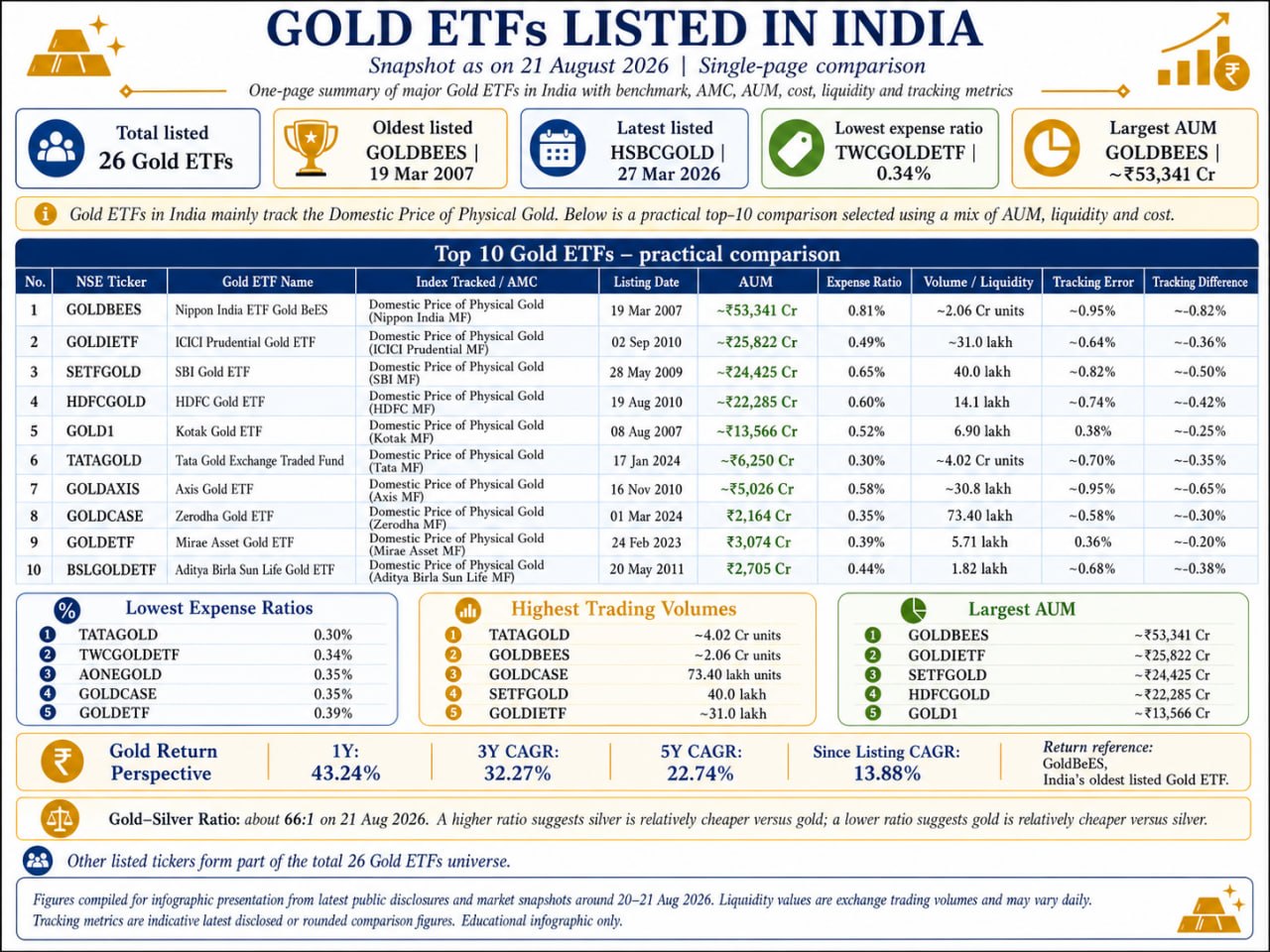
India now has 26 listed Gold ETFs. The pioneer is Nippon India ETF Gold BeES (GOLDBEES), listed on 19 March 2007. The most recently listed Gold ETF remains HSBC Gold ETF (HSBCGOLD), admitted to NSE trading from 27 March 2026. Since 22 August was a Saturday, the latest market trading data available for this update is from 21 August 2026.
How Gold ETFs work
A Gold ETF gives exchange-traded exposure to domestic gold prices. The scheme mainly holds physical gold and its NAV moves broadly with gold after expenses and tracking difference. Units can be bought and sold during market hours through a demat/trading account. Compared with jewellery, there are no making charges, purity-testing issues or personal storage concerns. The unit price itself does not tell whether an ETF is “cheap”; investors should compare AUM, trading liquidity, bid-ask spread, expense ratio and tracking error.
Market leaders
By latest reported AUM (31 July 2026), the five largest are GOLDBEES about ₹53,341 crore, ICICI Prudential Gold ETF about ₹25,822 crore, SBI Gold ETF about ₹24,425 crore, HDFC Gold ETF about ₹22,285 crore and Kotak Gold ETF about ₹13,567 crore. Their reported expense ratios are approximately 0.81%, 0.49%, 0.65%, 0.60% and 0.52%, respectively.
Trading activity changes every day. On the latest consolidated market snapshot around 20 August, the most active included TATAGOLD (about 4.02 crore units), GOLDBEES (2.06 crore), GOLDCASE (71.5 lakh), GOLDIETF (31.0 lakh) and GOLDAXIS (30.8 lakh). For cost, Zerodha Gold ETF reported a 0.30% expense ratio/BER and tracking error of about 0.58% on 20-21 August; The Wealth Company Gold ETF was around 0.34%, while Tata and Angel One were around 0.35%.
Investor psychology and allocation
Gold is best treated as portfolio insurance and diversification, not as the only wealth-creation asset. A practical educational allocation is often around 5-10% of a diversified portfolio, sometimes up to 15% depending on risk, goals and existing exposure. The biggest psychological mistakes are fear-buying during crises and FOMO-buying after a sharp rally. A disciplined investor can accumulate gradually or rebalance back to a target allocation instead of chasing price. A trader should focus more on liquidity, spread, momentum and stop-loss discipline.
Gold-Silver Ratio
The gold-silver ratio means how many ounces of silver equal the price of one ounce of gold; it is not normally expressed as 1:9. Using 21 August international spot prices (gold about US$4,624/oz and silver about US$69.62/oz), the ratio was roughly 66:1. A high ratio means silver is relatively cheaper versus gold; a low ratio means gold is relatively cheaper versus silver. It can guide relative-value thinking, but should not be used alone as a buy/sell signal. Local Indian ratios can vary slightly because of rupee movement, duties, taxes and market premiums.
For financial education only; not investment advice.
Sources: uploaded 04 August 2026 comparison; NSE listing circular; latest AMC factsheets/disclosures; market snapshots from 20-21 August 2026; Reuters spot prices, 21 August 2026.