Healthcare, Hospitals & Pharma ETFs in India – August 2026
Healthcare is an important long-term structural theme in India. Rising incomes, population ageing, lifestyle diseases, wider health-insurance coverage, hospital expansion, diagnostics, medical tourism and India’s global pharmaceutical manufacturing base can support long-duration growth. Yet this remains a sectoral investment: valuations, price controls, regulatory actions, drug approvals, currency movements and company-specific events can cause sharp cycles.
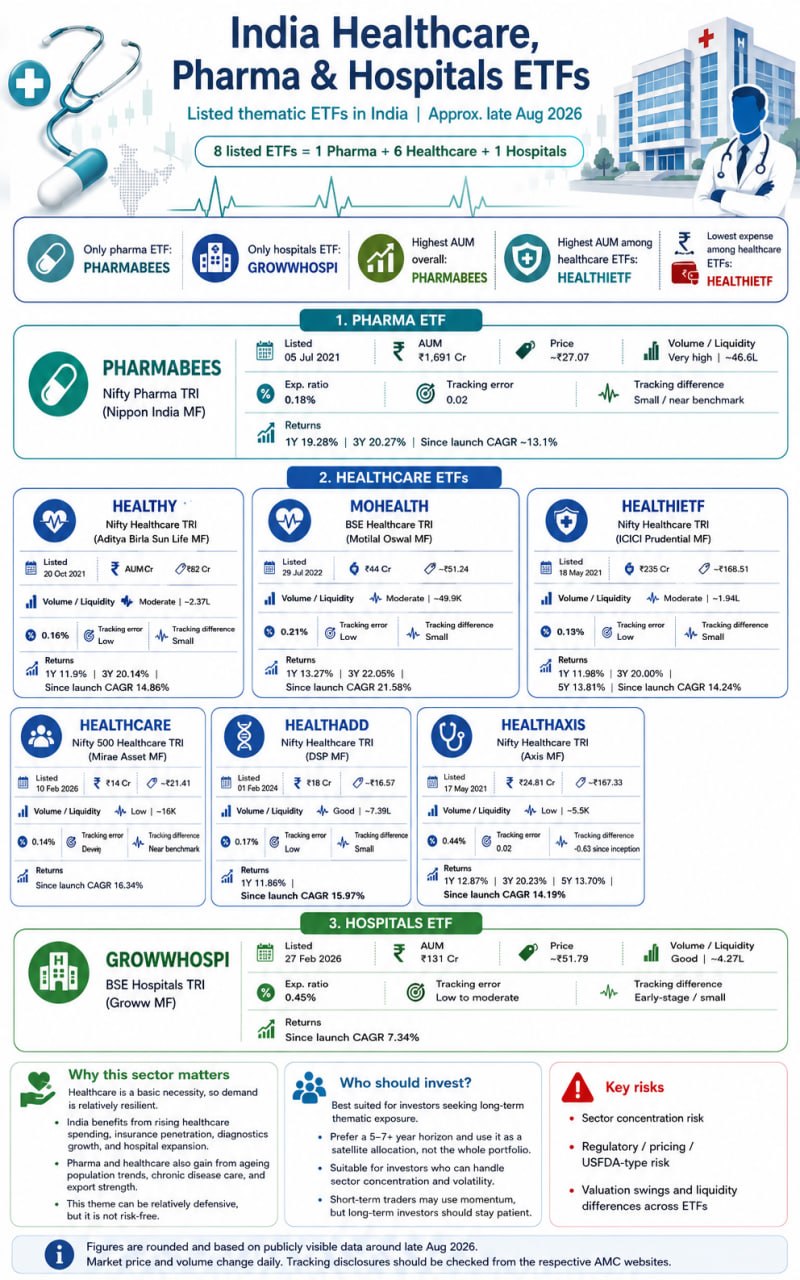
As of August 2026, the listed ETF choices in this theme can be viewed in three groups. For pure pharmaceuticals, Nippon India Nifty Pharma ETF (NSE: PHARMABEES) tracks the Nifty Pharma TRI. It is currently the established listed pure-pharma ETF, with AUM around ₹1,691 crore and one-month average trading volume above 40 lakh units. Its since-inception CAGR is about 13.2% as of July 2026.
For hospitals, Groww BSE Hospitals ETF (NSE: GROWHOSPI) tracks the BSE Hospitals TRI and gives focused exposure to listed hospital and healthcare-service companies. It is presently the only dedicated hospital ETF in this group. Launched in 2026, it has AUM around ₹131 crore. Its short since-inception annualised return is around 7%, but this is not yet a meaningful long-term performance record.
The broader healthcare category has six ETFs: Aditya Birla Sun Life Nifty Healthcare ETF (HEALTHY), Motilal Oswal BSE Healthcare ETF (MOHEALTH), ICICI Prudential Nifty Healthcare ETF (HEALTHIETF), Mirae Asset Nifty 500 Healthcare ETF (HEALTHCARE), DSP Nifty Healthcare ETF (HEALTHADD) and Axis Nifty Healthcare ETF (HEALTHAXIS). Most Nifty Healthcare ETFs combine pharmaceutical companies with hospitals and other healthcare businesses; Mirae uses the broader Nifty 500 Healthcare universe, while Motilal Oswal tracks the BSE Healthcare TRI.
Among these six, ICICI Prudential Nifty Healthcare ETF currently has the largest AUM, about ₹235 crore, and the lowest expense ratio, about 0.15%. Aditya Birla Sun Life Nifty Healthcare ETF has the highest reported one-month average volume among the six, around 2.75 lakh units, and tracking error around 0.01%. Recent since-inception annualised returns are approximately: HEALTHY 14.9%, MOHEALTH 22.4%, HEALTHIETF 14.5%, HEALTHCARE 16.3%, HEALTHADD 16.0% and HEALTHAXIS 14.0%. The newer funds have shorter histories, so these figures are not directly comparable.
These ETFs are best suited to investors with high risk tolerance, conviction in healthcare and a 5–10 year or longer horizon. They are usually better as a satellite allocation beside a diversified core portfolio, rather than the entire equity portfolio. Before selecting an ETF, compare the underlying index, AUM, liquidity, expense ratio, tracking error, tracking difference and market price versus iNAV/NAV—not past return alone.
Data snapshot: August 2026. AUM, liquidity, expenses and returns change over time. Past performance does not guarantee future returns.