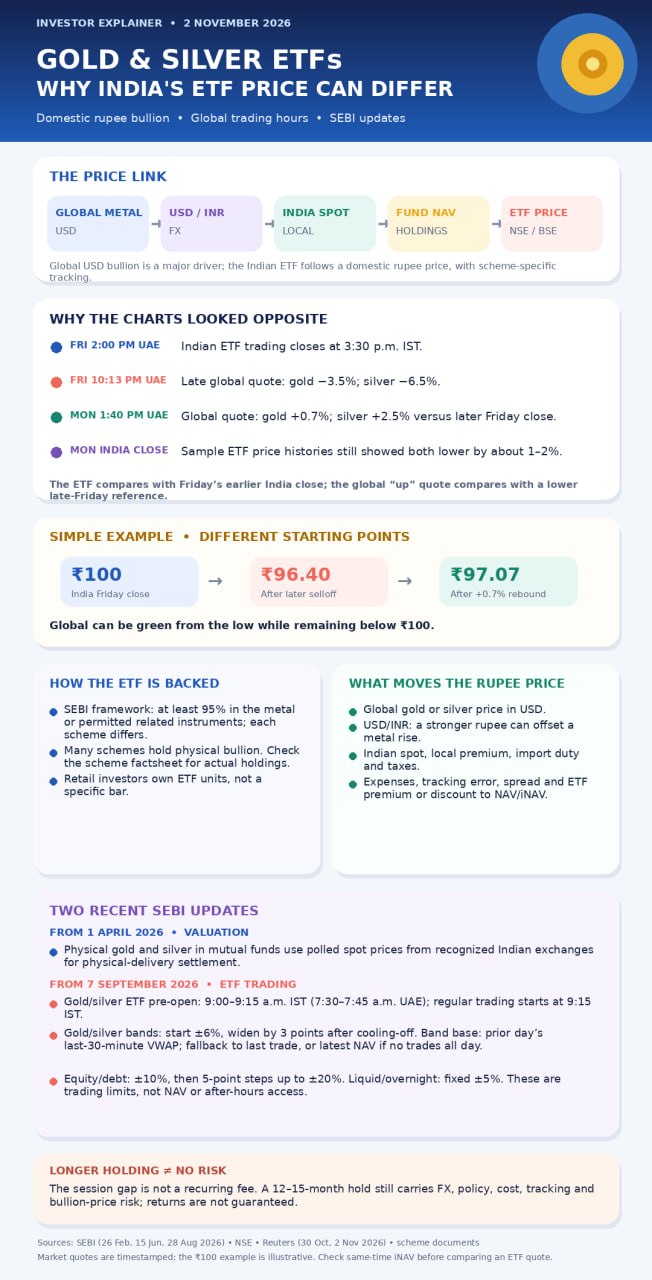
How the Indian price is formed
Indian gold and silver ETFs trade like shares and target a domestic rupee benchmark. SEBI rules require at least 95% of net assets in metal or permitted related instruments; holdings vary. Many hold physical bullion, but investors own ETF units, not a specific bar. Nippon Gold BeES tracks domestic gold through physical gold.
Global dollar prices drive Indian bullion, but USD/INR and local premiums, duties and taxes also matter. If gold rises 1% in dollars while the rupee strengthens 1%, the Indian price may stay nearly flat; a weaker rupee can amplify gains. Since 1 April 2026, SEBI requires funds to value physical gold and silver using polled spot prices from recognized exchanges settling physical metal derivatives. NAV thus uses a domestic reference.
ETF market price may differ from NAV or iNAV because of demand, liquidity and spreads. Expenses and tracking error affect returns. Compare price with same-time iNAV.
Why prices looked opposite on 2 November
NSE closes at 3:30 p.m. IST (2 p.m. UAE). After India closed Friday, 30 October, Reuters reported spot gold down 3.5% to $3,880.97 and silver down 6.5% to $49 at 18:13 GMT. On Monday, 2 November, it reported gold up 0.7% to $3,900.14 and silver up 2.5% to $50.35 at 09:40 GMT (1:40 p.m. UAE). Those gains used a later, lower global reference; ETF daily returns compared with Friday’s earlier Indian close. The bases differed. CME gold futures trade nearly 23 hours, so 6 p.m. UAE is not a fixed start.
Example: a ₹100 Indian reference falls to ₹96.40 after the ETF closes, then rebounds 0.7% to ₹97.07. The global quote is up from its low but below ₹100, so the ETF can still fall. Quote histories show sample GoldBeES and SilverBeES prices down about 1–2% on 2 November; providers differ slightly. India reprices the gap next session; recovery is not automatic.
SEBI trading update
SEBI’s 15 June 2026 rules, extended on 28 August, took effect on 7 September. Gold and silver ETFs have a 9:00–9:15 a.m. IST pre-open; trading starts at 9:15. Bands start at ±6% and widen by 3 points after cooling-off. Their base is the prior day’s last-30-minute VWAP; if no trade then, use the day’s last traded price; if no trade all day, use latest NAV. Equity/debt bands start ±10%, widen by 5 to ±20%; liquid/overnight stay ±5%. The base sets limits, not NAV; the rules do not change holdings or add after-hours trading.
What a longer holding period changes
The session gap is not a recurring fee, but 12–15 months does not remove currency, policy, cost, tracking or metal-price risks. Metals can move more than 1–2% in a day. A longer horizon may reduce one entry-time mismatch, but cannot guarantee a gain.
Sources
SEBI valuation circular (26 Feb 2026); SEBI ETF trading circular (15 Jun 2026); SEBI implementation extension (28 Aug 2026); NSE market timings and pre-open rules; Reuters Friday report; Reuters Monday report; SEBI ETF risk disclosure