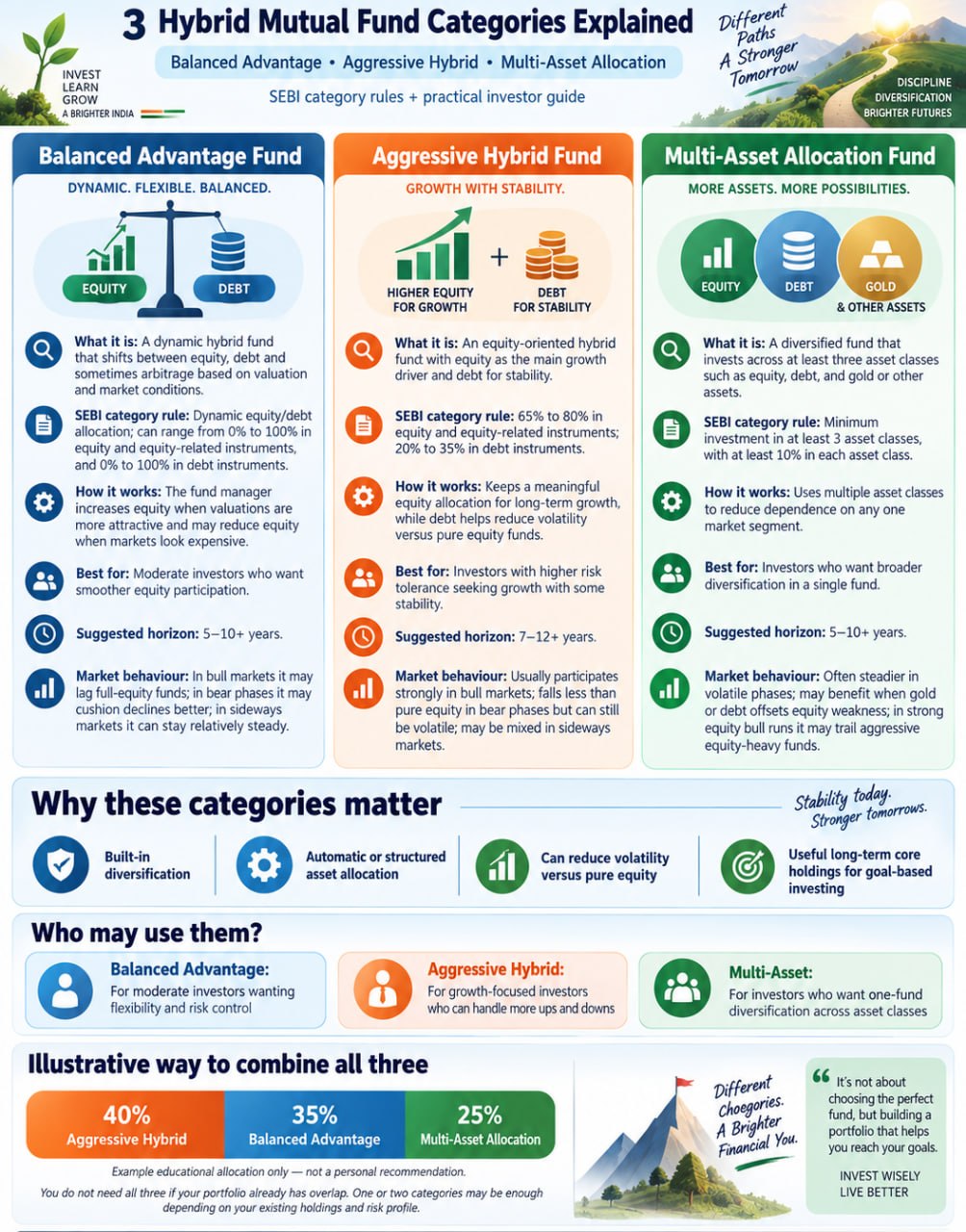
Hybrid mutual funds combine more than one asset class to balance growth and stability. Balanced Advantage, Aggressive Hybrid and Multi-Asset Allocation funds are useful for investors who want long-term wealth creation without depending entirely on pure equity. The three categories differ mainly in how they divide money between equity, debt and other assets.
Balanced Advantage Fund
A Balanced Advantage Fund dynamically changes its equity and debt allocation according to valuations, market conditions and the fund house's strategy. There is no fixed equity-debt proportion for the category. The fund may raise equity exposure when valuations are attractive and reduce it when markets become expensive. It is suitable for moderate investors who want equity participation with some automatic risk control. A practical horizon is at least 5-7 years, preferably longer. In strong bull markets it may lag pure equity funds, while in weak or volatile markets the debt or hedged portion may reduce downside.
Aggressive Hybrid Fund
An Aggressive Hybrid Fund generally invests 65-80% in equity and equity-related instruments and 20-35% in debt. Equity remains the main growth engine, while debt provides some stability. This category is more suitable for growth-oriented investors who can tolerate higher volatility and remain invested for 7-10 years or more. It usually participates strongly in bull markets, can fall during bear markets, and may behave more steadily than pure equity because of the debt allocation.
Multi-Asset Allocation Fund
A Multi-Asset Allocation Fund invests in at least three asset classes, with at least 10% in each selected asset class. Portfolios may include equity, debt, gold and other permitted assets. This broader diversification can reduce dependence on one market cycle. It may suit investors who want one fund to spread risk across different assets and who can invest for 5-10 years or more. It can be useful during sideways or volatile equity markets when debt or gold performs differently.
How the Three Can Be Used Together
It is not compulsory to hold all three categories. Investors who want a simple diversified hybrid basket may use one fund from each category. An illustrative allocation can be 40% Aggressive Hybrid, 35% Balanced Advantage and 25% Multi-Asset Allocation. The exact mix should depend on risk tolerance, existing equity exposure and investment goals. If a portfolio already has several equity and gold funds, one or two hybrid categories may be enough.
How to Screen Funds: CAARESA
Funds within each category can be screened using the CAARESA framework: Category; Age above 5 years; AUM above Rs. 500 crore; Returns assessed through 1-year, 3-year and 5-year trailing returns versus the relevant benchmark, SIP returns and calendar-year consistency over the last five years; Expense ratio preferably below 1% and lower within the category; Sortino ratio preferably above 1 and higher within the category; and Alpha preferably above 1 and higher within the category. The aim is to identify funds that perform consistently across several measures rather than selecting only on one recent return number.
Monitoring
Review the selected funds once a year rather than reacting to short-term market movements. Recheck long-term returns, benchmark consistency, expense ratio, Sortino ratio, alpha, AUM, fund-manager changes and whether the scheme continues to follow its stated strategy. For long horizons such as 7, 10, 12 or 15 years, discipline and consistency are usually more important than frequent switching.
Educational information only. Mutual fund investments are subject to market risk.