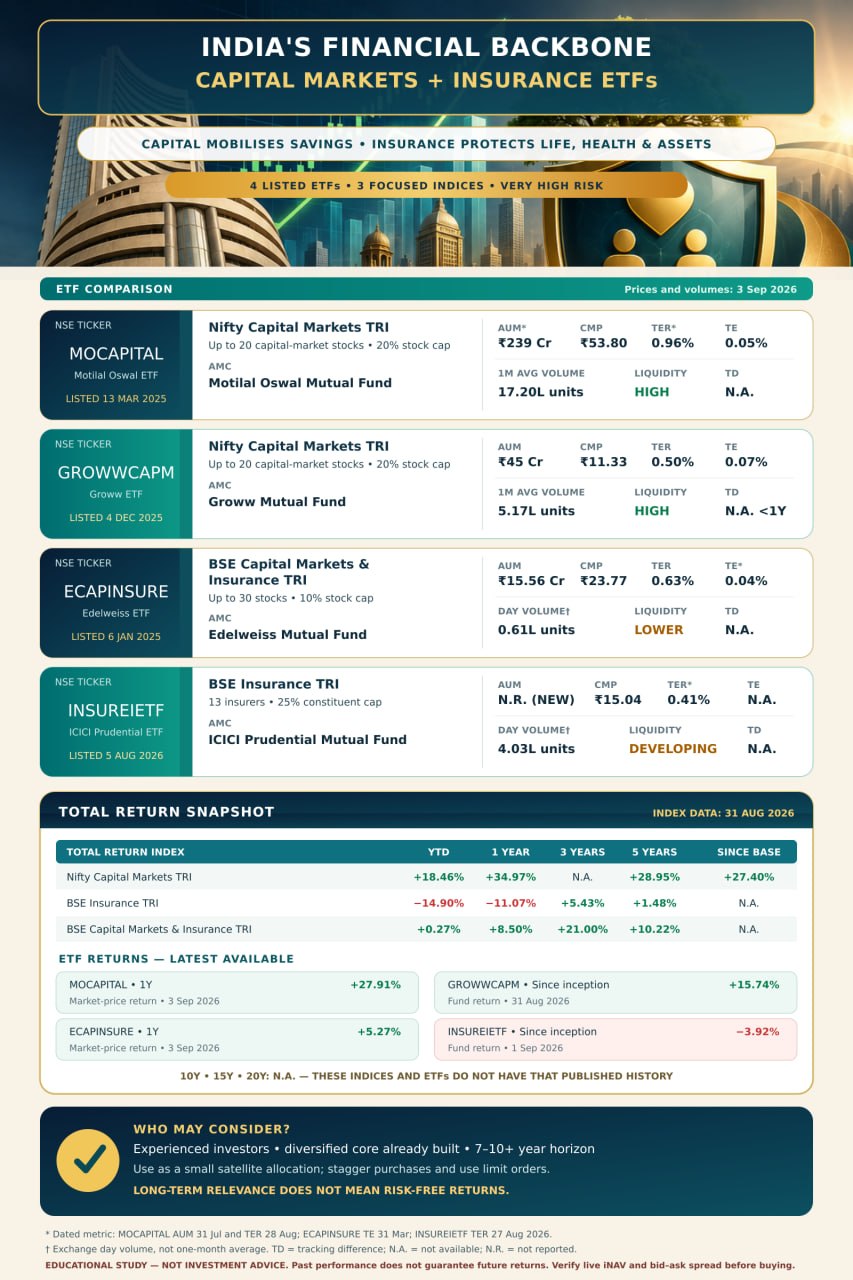
Three Routes to One Financial Theme
Capital markets mobilise savings into productive businesses, while insurance protects families and assets. As India's formal savings, demat participation, mutual funds, pensions and insurance penetration expand, these activities may benefit over time. Investors can access the theme through three focused indices, but each follows a different risk-and-return path.
Nifty Capital Markets Index
This index selects up to 20 capital-market companies from the Nifty 500, using six-month average free-float market capitalisation, semi-annual reconstitution and a 20% stock cap. It includes exchanges, depositories, brokers, wealth managers and asset-management companies. As at 31 August 2026, its Total Return Index delivered 34.97% over one year, 28.95% annualised over five years and 27.40% annualised since its 1 April 2019 base date. Strong returns also reflect high cyclicality and valuation sensitivity.
BSE Insurance Index
Drawn from insurance companies in the BSE 1000, this 13-stock index uses capped float-adjusted market capitalisation, with a 25% constituent cap. Its Total Return Index returned -11.07% over one year, 5.43% annualised over three years and 1.48% annualised over five years to 31 August 2026. Insurance is a long-duration structural need, but growth does not guarantee strong shareholder returns; regulation, competition, claims, distribution costs and valuations matter.
BSE Capital Markets & Insurance Index
This blended index selects up to 30 eligible capital-market and insurance companies from the BSE 500, caps each stock at 10%, reconstitutes semi-annually and rebalances quarterly. Its Total Return Index returned 8.50% over one year, 21.00% annualised over three years and 10.22% annualised over five years to 31 August 2026. Combining the two industries reduces single-subtheme dependence, although the portfolio remains concentrated in financial services.
ETF Choices and Current Snapshot
Motilal Oswal Nifty Capital Market ETF (MOCAPITAL), listed 13 March 2025, had AUM of INR 238.84 crore and a 0.96% expense ratio as at 31 July 2026; its one-year and since-inception returns were 22.59% and 48.55% annualised. Groww Nifty Capital Markets ETF (GROWWCAPM), listed 4 December 2025, reported AUM of INR 29.32 crore and a 0.69% expense ratio at 30 April 2026; its return since inception was 15.74% versus 16.21% for the benchmark at 31 August 2026. Edelweiss BSE Capital Markets & Insurance ETF (ECAPINSURE), listed 6 January 2025, had AUM of about INR 15.56 crore, a 0.58% expense ratio and approximately 4.9% one-year return by late August 2026. ICICI Prudential BSE Insurance ETF (INSUREIETF), listed 5 August 2026, had a 0.41% expense ratio; its first month-end AUM was not yet reported and its track record was too short for meaningful comparison.
Who May Consider Them?
These very-high-risk thematic ETFs may suit experienced investors with at least a seven-to-ten-year horizon who already hold a diversified core portfolio. Compare liquidity, bid-ask spread, AUM, expense ratio, tracking error and tracking difference before buying. Staggered investing can reduce timing risk, but it cannot prevent losses. This material is for financial education only, not investment advice. Past returns do not guarantee future performance.