The HDFC FTSE India Equity ETF is India's first exchange-traded fund to track the FTSE India Equity Index (Total Return Index). Managed by HDFC Asset Management Company Limited, it was listed on the National Stock Exchange on 16 October 2026 under the ticker HFTSEINDIA. The scheme aims to replicate index performance before fees and expenses, subject to tracking error. Because the fund has only recently listed, its own performance history is limited.
The FTSE India Equity Index measures Indian large- and mid-cap companies and covers about 90% of the market capitalization of the FTSE India All Cap Index. Eligible stocks are screened for the Securities and Exchange Board of India's liquidity and impact-cost requirements. Weights are based on free-float market capitalization, adjusted for foreign ownership limits. The index is reviewed semi-annually and applies concentration caps. As of 31 August 2026, it included 276 companies across 20 sectors.
Financial services was the largest sector, at 28.2%. The ten largest constituents were Reliance Industries, HDFC Bank, ICICI Bank, Bharti Airtel, Infosys, Mahindra & Mahindra, Axis Bank, Bajaj Finance, Larsen & Toubro, and Tata Consultancy Services. Together, they represented 29.72% of the index.
The latest published performance for the FTSE India Equity Total Return Index, as of 31 August 2026, showed compound annual growth rates of 3.4% over one year, 13.0% over three years, 12.4% over five years, 15.7% over seven years, and 13.3% over ten years. Since its inception on 19 September 2014, it had returned about 12.0% annually. These are historical index returns, not the newly listed ETF's returns, and past performance does not assure future results. ETF returns may differ because of fees and tracking error.
The index was designed to give investors a transparent, rules-based route to broad exposure across Indian large- and mid-cap companies. Compared with the Nifty 50 (50 stocks) and Nifty 100 (100 large-cap stocks), it includes a wider set of companies and both large- and mid-caps. The Nifty Midcap 150, by contrast, focuses on 150 mid-cap companies ranked 101 to 250 in the Nifty 500. These indices use different methods and should be compared over matching periods and in the same currency.
Back to Blog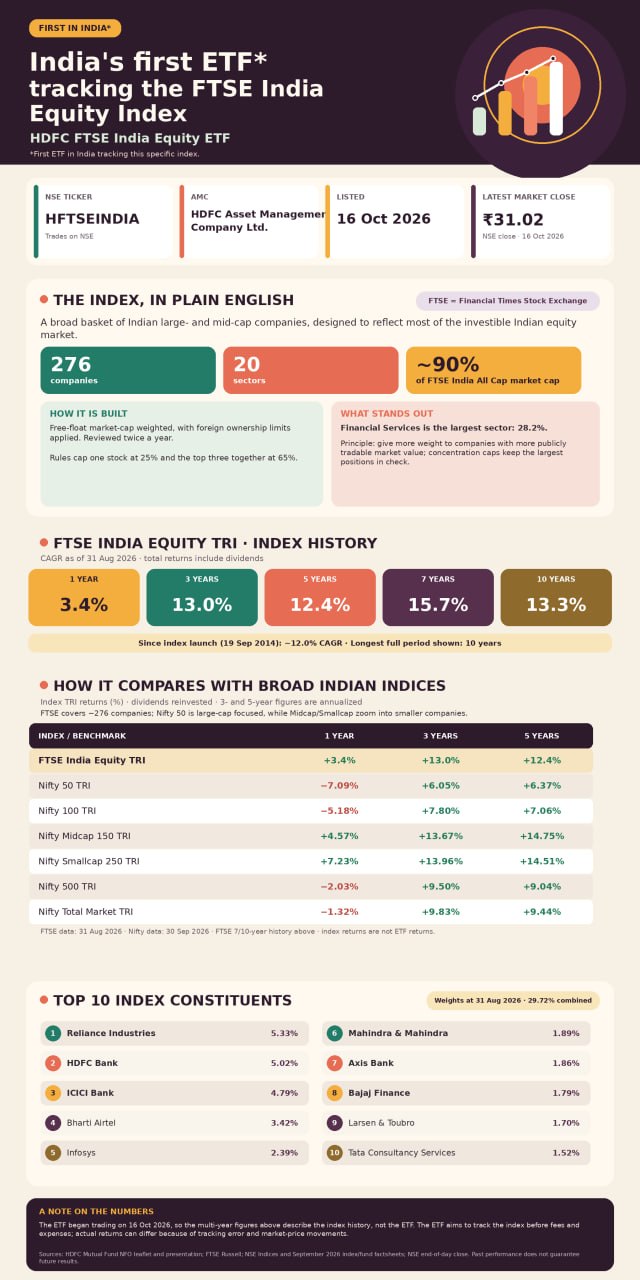
DP
Written by
Dr Pankaj Nandlal Tardeja
Pediatrician and Neonatologist, Al Ain , Abu Dhabi, UAE
Editorial Standards & Research Methodology →