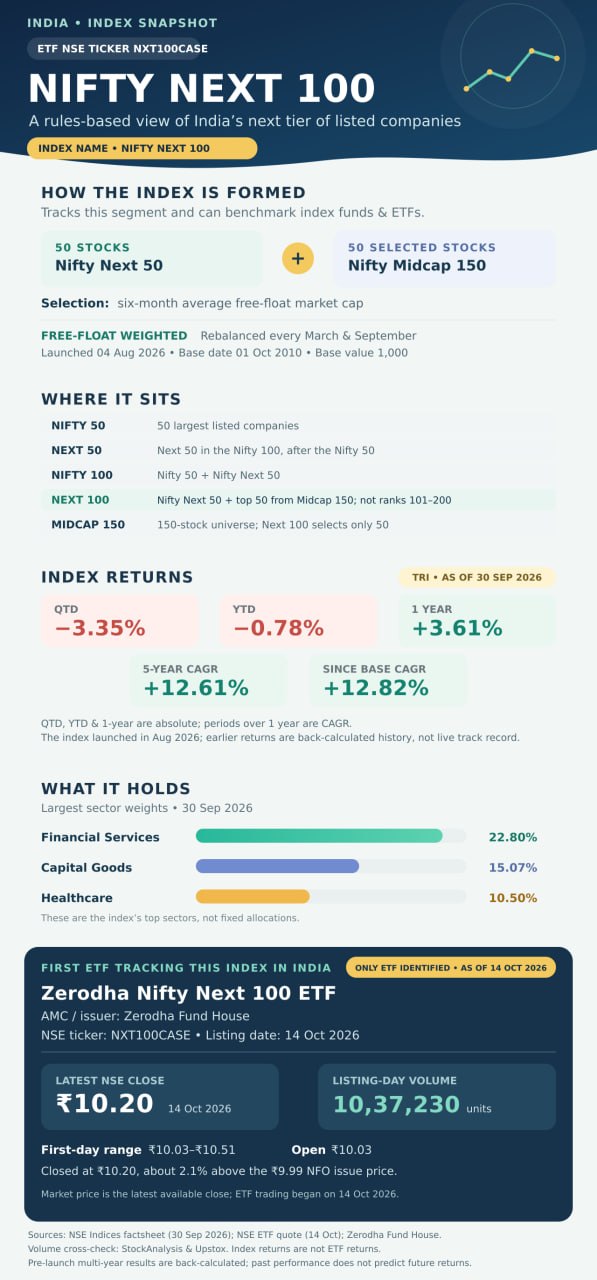
The Zerodha Nifty Next 100 ETF is India's first exchange-traded fund tracking the newly launched Nifty Next 100 Index, as described by Zerodha Fund House. Managed by Zerodha CASE Asset Management Private Limited (Zerodha Fund House), it began trading on the National Stock Exchange on 14 October 2026 under the symbol NXT100CASE. The ETF seeks to track the index, subject to expenses and tracking difference.
The Nifty Next 100 is an NSE broad-market equity index launched on 4 August 2026. It holds 100 stocks: 50 from the Nifty Next 50 and the top 50 from the Nifty Midcap 150, selected using six-month average free-float market capitalisation. Constituents are weighted by free-float market capitalisation, and the index is reconstituted twice a year, in March and September. Its base date is 1 October 2010 and its base value is 1,000.
The index therefore combines companies from the Nifty Next 50 with selected mid-cap companies. As of 30 September 2026, its largest sector weights were Financial Services (22.80%), Capital Goods (15.07%), Healthcare (10.50%), Automobile and Auto Components (8.31%), and Power (6.73%). Leading constituents included Divi's Laboratories, TVS Motor and Hindustan Aeronautics.
The NSE Indices factsheet dated 30 September 2026 reports Nifty Next 100 Total Returns Index performance of -0.78% year to date and +3.61% over one year (absolute returns), with a 12.61% five-year compound annual growth rate and 12.82% since the base date. The index went live only on 4 August 2026, so figures covering earlier periods are historical calculations using the index methodology, not live ETF returns. The ETF has no long-term performance record yet.
The Nifty 50 tracks 50 of India's largest companies. The Nifty Next 50 represents the other 50 companies in the Nifty 100, while the Nifty 100 combines those two indices. The Nifty Next 100 is a separate portfolio combining the Nifty Next 50 with 50 selected stocks from the Nifty Midcap 150. It therefore offers a large- and mid-cap blend; the broader Nifty Midcap 150 covers 150 mid-cap stocks.
The ETF may suit investors seeking long-term equity growth beyond the Nifty 50 who can tolerate very high risk and market volatility. The fund house describes it as a long-term product; investors should be prepared to hold through market cycles, while recognizing that no fixed holding period guarantees positive returns. As a passive ETF, it offers exposure to 100 companies through one exchange-traded product, but expenses, trading liquidity and tracking difference affect investor returns. Consider its role within a diversified portfolio and consult a financial adviser if unsure.