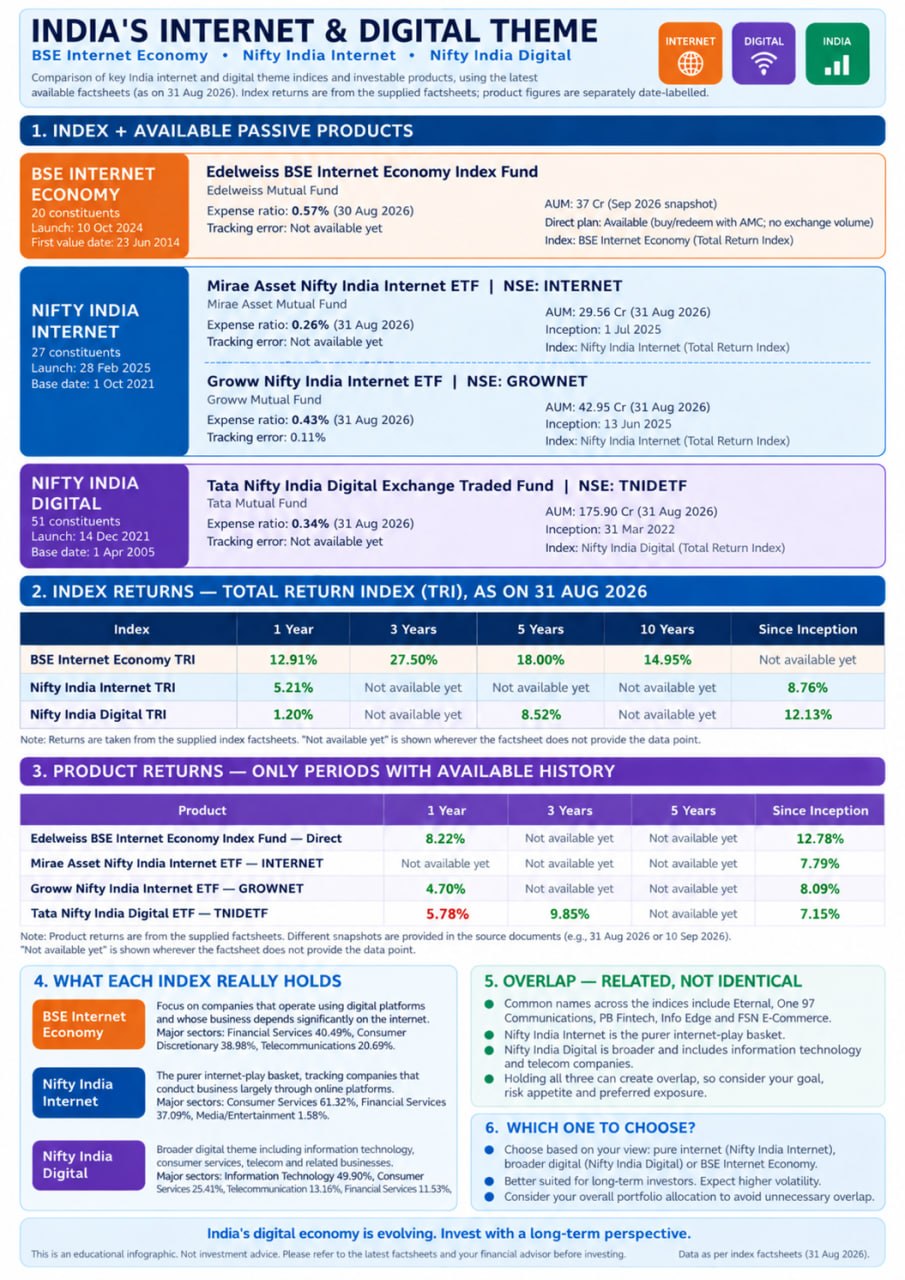
India's internet and digital economy is now large enough to be represented through different thematic indices rather than one single basket. The three useful benchmarks are the BSE Internet Economy Index, Nifty India Internet Index and Nifty India Digital Index. They are related, but they are not identical. Each captures a different part of India's digital growth story, so investors should understand the index construction before choosing a fund or exchange traded fund that tracks it.
The BSE Internet Economy Index is a compact 20-stock index drawn from the BSE 500. It focuses on businesses that operate through digital platforms or depend significantly on the internet. Its major sector exposure is Financial Services, Consumer Discretionary and Telecommunication. Important constituents include Eternal, Bharti Airtel, Multi Commodity Exchange of India, One 97 Communications, PB Fintech, Info Edge, FSN E-Commerce Ventures, Swiggy, Vodafone Idea and Tata Communications. This index is useful for investors who want a concentrated exposure to the internet economy rather than the entire technology sector.
The Nifty India Internet Index is the purest internet-platform basket among the three. It contains 27 companies from the Nifty Total Market that conduct a large part of their business through online platforms. Consumer Services and Financial Services dominate the index, with a small exposure to Media and Entertainment. Major holdings include Eternal, One 97 Communications, PB Fintech, Info Edge, FSN E-Commerce Ventures, Swiggy, Angel One, Motilal Oswal Financial Services, Billionbrains Garage Ventures and Indian Railway Catering and Tourism Corporation. It is suitable for investors specifically looking for e-commerce, fintech, online services, digital platforms and new-age internet businesses.
The Nifty India Digital Index is broader. It contains 51 companies and combines traditional digital enablers with new-age digital businesses. Its largest sector is Information Technology, followed by Consumer Services, Telecommunication and Financial Services. Key constituents include Eternal, HCL Technologies, Tata Consultancy Services, Infosys, Bharti Airtel, One 97 Communications, Tech Mahindra, PB Fintech, Info Edge and FSN E-Commerce Ventures. Because it includes large information technology and telecom companies, it is more diversified than a pure internet index.
These themes can perform strongly during periods of economic expansion, falling interest rates, improving risk appetite, strong technology spending and rapid digital adoption. They can underperform when valuations correct, interest rates remain high, global technology spending slows or markets become risk-averse. For most long-term investors, a five-to-ten-year or longer horizon is more appropriate than short-term trading. Holding all three may create meaningful overlap, so one well-chosen index may be sufficient; a broader digital index can also be paired with one pure internet index for a more targeted satellite allocation. These are thematic investments and are better used as part of a diversified portfolio rather than as the entire equity portfolio. This is for educational purposes only and is not investment advice.