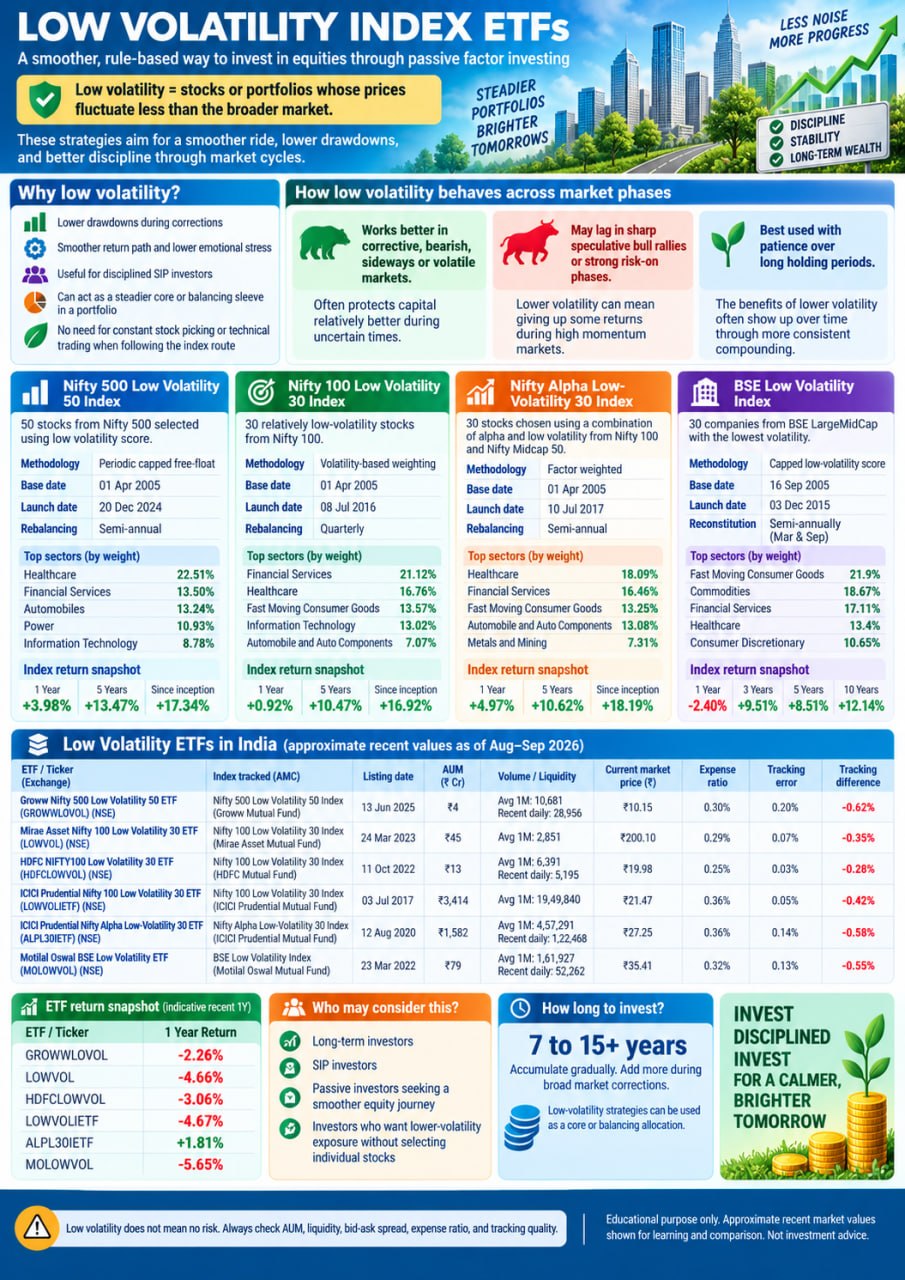
Low volatility is one of the better-known equity factors. In simple words, it focuses on companies or portfolios whose prices fluctuate less than the broader market. This does not mean no risk, but it often means a relatively smoother ride, lower drawdowns and better emotional comfort for disciplined investors. Low volatility strategies are generally useful in corrective, sideways, uncertain or bear phases, though they may sometimes lag sharply speculative rallies. For long-term investors, a 7 to 15 year or longer holding period with systematic investment plan discipline can be a practical way to use this factor.
The Nifty 500 Low Volatility 50 Index is a broader low-volatility strategy drawn from the Nifty 500. It selects 50 companies based on low volatility score and uses a periodic capped free-float approach. As on 31 August 2026, its total return figures were 3.98% for one year, 13.47% annualised for five years and 17.34% since inception. This is useful for investors wanting wider market diversification with a low-volatility tilt. A listed passive option available on this theme is the Groww Nifty 500 Low Volatility 50 ETF.
The Nifty 100 Low Volatility 30 Index is a more large-cap oriented low-volatility strategy. It selects 30 relatively low volatile stocks from the Nifty 100 and rebalances quarterly. As on 31 August 2026, total return figures were 0.92% for one year, 10.47% annualised for five years and 16.92% since inception. This index may suit investors seeking relatively defensive exposure among established large companies. ETFs visible on this theme include Mirae Asset Nifty 100 Low Volatility 30 ETF, HDFC NIFTY100 Low Volatility 30 ETF and ICICI Prudential Nifty 100 Low Volatility 30 ETF.
The Nifty Alpha Low-Volatility 30 Index combines two factors, alpha and low volatility, and therefore tries to balance return-seeking with stability. It contains 30 stocks and is rebalanced semiannually. As on 31 August 2026, total return figures were 4.97% for one year, 10.62% annualised for five years and 18.19% since inception. This may suit investors who want a smarter factor blend rather than plain low-volatility exposure. A visible ETF on this theme is the ICICI Prudential Nifty Alpha Low-Volatility 30 ETF.
The BSE Low Volatility Index is a 30-stock factor index drawn from the BSE LargeMidCap universe and selects stocks with the lowest volatility. As on 31 August 2026, total return figures were -2.40% for one year, 9.51% annualised for three years, 8.51% annualised for five years and 12.14% annualised for ten years. A listed ETF available on this theme is the Motilal Oswal BSE Low Volatility ETF.
In portfolio use, low-volatility ETFs can act as a steadier core or a balancing sleeve alongside broader, momentum or alpha strategies. Investors do not need frequent technical trading or stock-by-stock analysis when using the index route, but they should still watch expense ratio, tracking error, tracking difference, AUM and liquidity before buying. Educational content only, not investment advice.