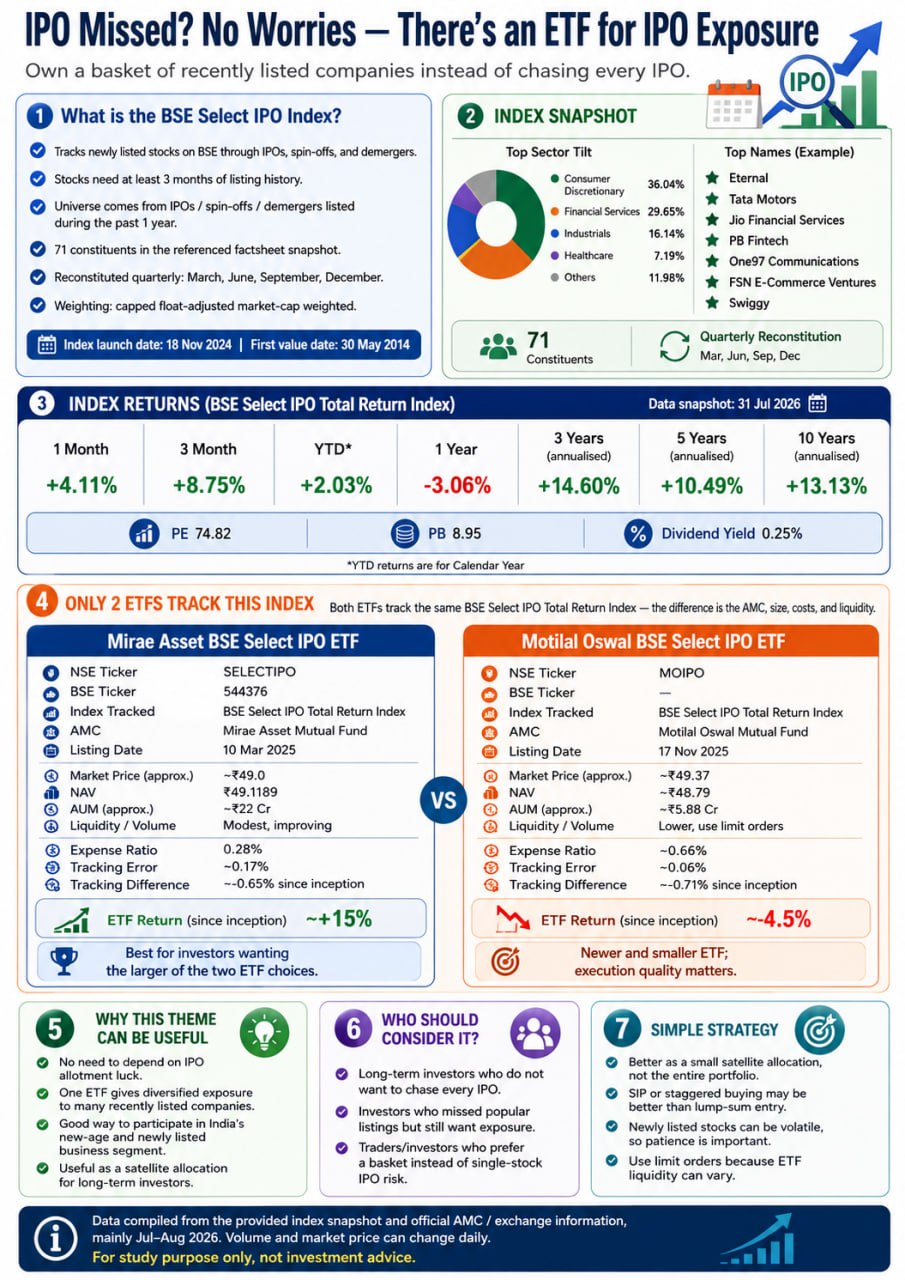
Missing an IPO allotment does not mean missing the company forever. The BSE Select IPO Index provides a rules-based way to own a basket of recently listed companies after they establish a trading history. Two exchange-traded funds track this same index, offering a diversified alternative to applying for individual IPOs.
The BSE Select IPO Index covers BSE companies listed through an IPO, spin-off or demerger. The eligible universe is drawn from securities listed during the previous one year, but each stock needs at least three months of listing history. The index keeps 20 to 100 stocks, uses capped float-adjusted market-capitalisation weighting and is reconstituted quarterly. As of 31 July 2026 it had 71 constituents. Major holdings included Eternal, Tata Motors, Jio Financial Services, PB Fintech and One 97 Communications, with consumer discretionary and financial services the largest sector exposures.
The index was launched on 18 November 2024, with a first value date of 30 May 2014 and base value of 1,000. By 31 July 2026 the Total Return Index stood at 5,204.81, implying roughly 14.5% annualised growth from the first value date. Official returns were +4.11% for one month, +8.75% for three months, +2.03% year-to-date, -3.06% for one year, +14.60% annualised over three years, +10.49% over five years and +13.13% over ten years. Historical periods before November 2024 are back-tested index history, not live-index performance.
Mirae Asset BSE Select IPO ETF - NSE ticker SELECTIPO, BSE code 544376 - was allotted on 10 March 2025 and listed on NSE on 17 March 2025. Around 28 August 2026 it traded near Rs 49.14, with AUM about Rs 22 crore, expense ratio about 0.48%, tracking error about 0.15%, one-month average volume around 50,000 units and one-year tracking difference around -0.42%. From allotment NAV Rs 39.6952 to NAV Rs 49.1189, the gain was about 23.7%, or about 15.6% CAGR.
Motilal Oswal BSE Select IPO ETF - NSE ticker MOIPO - was allotted on 17 November 2025 and listed on 20 November 2025. By late August 2026 it traded around Rs 49.2, with AUM about Rs 5.9-6 crore, expense ratio about 0.67%, tracking error around 0.08% and one-month average volume around 6,000 units. Its short since-launch record was broadly flat; a one-year tracking difference is not yet meaningful.
This is a very-high-risk, valuation-sensitive theme. It suits investors wanting post-IPO growth exposure without choosing individual IPOs. A practical strategy is to keep it as a satellite allocation, invest gradually or on corrections, compare market price with NAV/iNAV, and use limit orders because liquidity is lower than broad-market ETFs. It can complement a diversified core portfolio, not replace it.