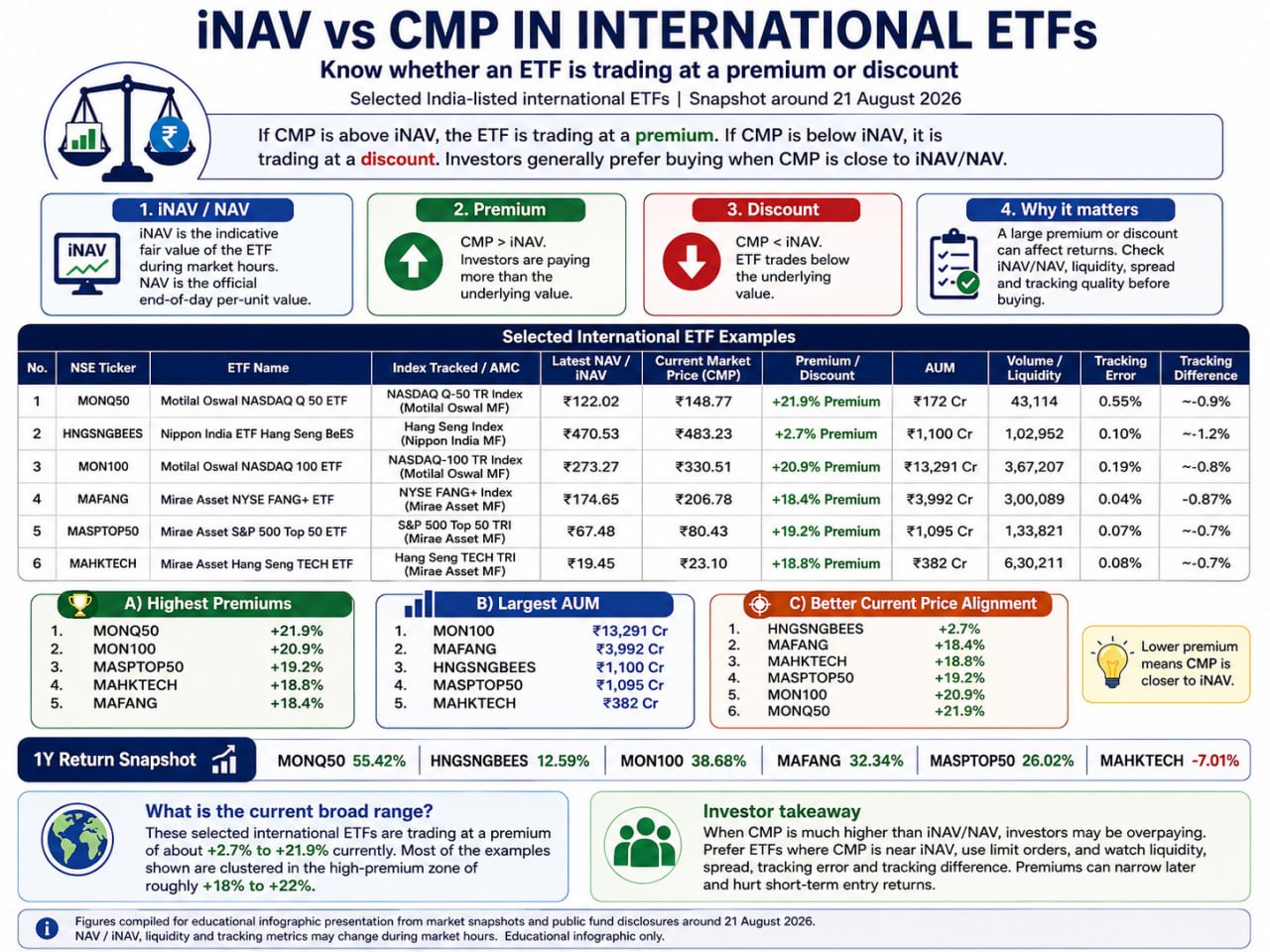
NAV, iNAV AND CURRENT MARKET PRICE IN ETFs: WHY THE RELATIONSHIP MATTERS
An ETF has two important values. NAV (Net Asset Value) represents the per-unit value of the assets held by the fund, usually calculated at the end of the day. iNAV (Indicative Net Asset Value) is an intraday estimate of fair value. CMP (Current Market Price) is the price at which the ETF is actually trading on the stock exchange.
The relationship is simple
If CMP is above iNAV/NAV, the ETF trades at a premium. If CMP is below iNAV/NAV, it trades at a discount. Premium/Discount (%) = (CMP - iNAV) / iNAV × 100.
Why is this important?
An investor can choose the correct ETF but still pay the wrong price. If an ETF worth about ₹100 is bought at ₹120, the investor has paid a 20% premium. Even if the underlying index does not fall, that premium can later shrink and the market price may decline. Therefore, before buying an ETF, especially an international ETF, compare CMP with the latest iNAV and check its timestamp. Ideally, the two should be reasonably close. A small temporary difference is normal; a large gap deserves caution.
International ETF example - 21 August 2026
Several India-listed international ETFs were trading well above their indicative value. Approximate premiums were: MONQ50 - Motilal Oswal Nasdaq Q 50 ETF ~21.9%; MON100 - Motilal Oswal Nasdaq 100 ETF ~21.0%; MAFANG - Mirae Asset NYSE FANG+ ETF ~20.0%; MASPTOP50 - Mirae Asset S&P 500 Top 50 ETF ~20.8%; MAHKTECH - Mirae Asset Hang Seng TECH ETF ~18.3%; HNGSNGBEES - Nippon India ETF Hang Seng BeES ~2.5%.
For example, MAFANG was around ₹206.78 while iNAV was about ₹172.27 - roughly a 20% premium. These large premiums can occur when fresh creation of international ETF units is restricted by overseas-investment limits while investor demand remains strong. The premium is an additional market-price risk; it is not extra value in the underlying shares.
Discount example
The reverse can also happen. If iNAV is ₹100 and CMP is ₹98, the ETF is at a 2% discount. Small discounts are common in normal ETF trading and may disappear through market-making and arbitrage.
What should investors do?
Check iNAV/NAV on NSE, the AMC website, broker platforms or demat/trading apps that display it. Compare it with the live CMP before placing an order. Prefer limit orders and avoid chasing an ETF that is trading far above fair value. For international ETFs, also verify whether the iNAV is fresh because overseas markets and Indian market hours may differ.
Key message
Do not buy an ETF only because you like its index. First ask, “Am I buying the underlying value at a fair price?” CMP close to iNAV is generally the healthier entry point.