Silver ETF landscape
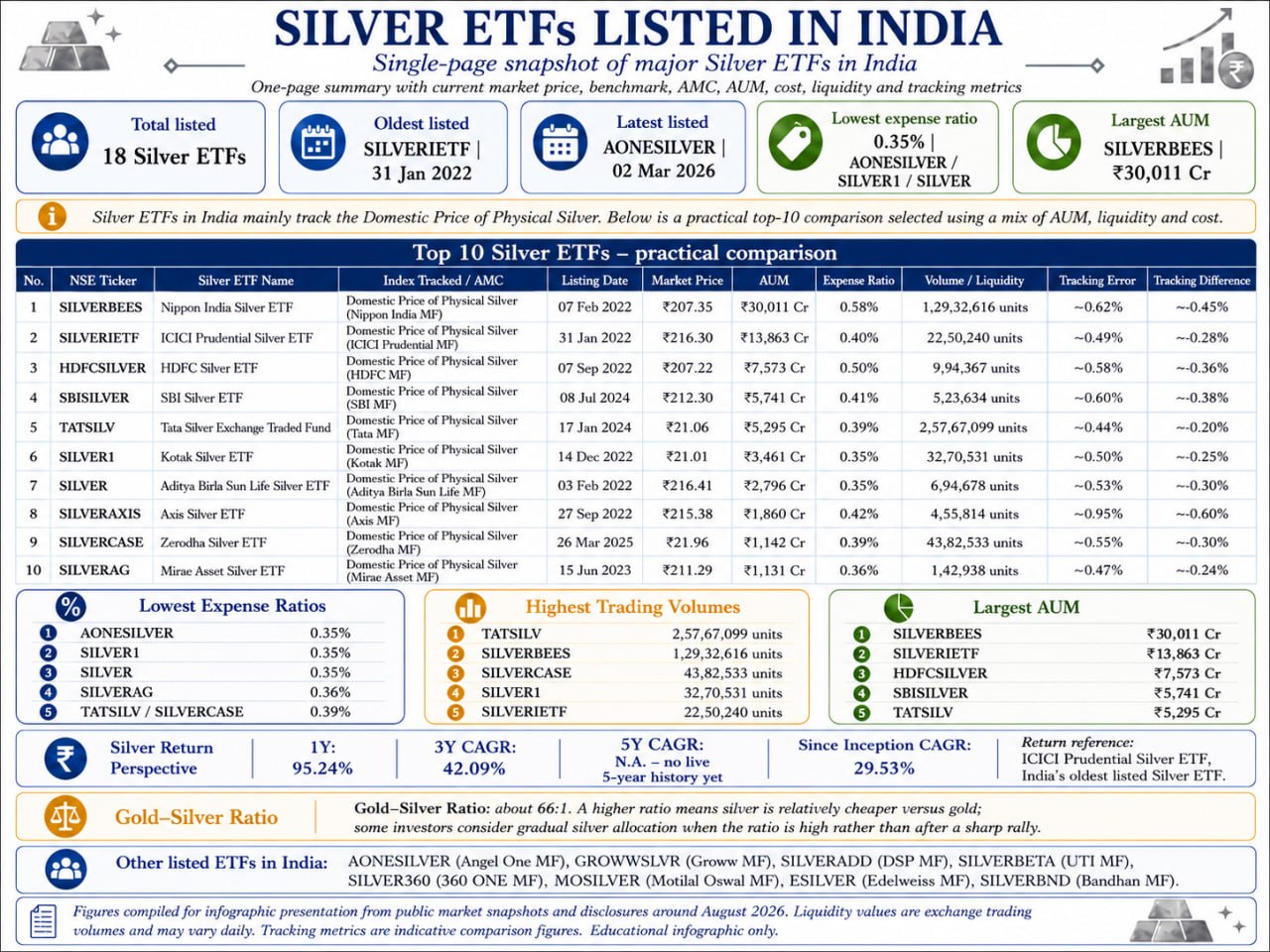
India has 18 listed Silver ETFs based on the latest available list through 21 August 2026. The oldest is ICICI Prudential Silver ETF (NSE: SILVERIETF), listed on 31 January 2022. The most recent is Angel One Silver ETF (AONESILVER), listed on 02 March 2026. Among the largest schemes, Nippon India Silver ETF remains the AUM leader at roughly ₹29,500–30,000 crore, followed by ICICI Prudential Silver ETF at about ₹13,700 crore and HDFC Silver ETF at about ₹7,470 crore.
How a Silver ETF works
A Silver ETF gives exchange-traded exposure to domestic silver prices without the need to store, insure or test physical silver. The fund mainly holds physical silver or permitted silver-related instruments, and its NAV broadly follows domestic silver prices after expenses and tracking difference. Units trade on the stock exchange like shares, so investors should compare AUM, liquidity, bid-ask spread, expense ratio, tracking error and tracking difference—not just the unit price.
Why consider silver?
Silver has a dual personality: it is a precious metal and an industrial metal. Demand comes from investment as well as electronics, solar energy, electric vehicles and manufacturing. This gives silver long-term opportunity, but also makes it more volatile and cyclical than gold. A long-term investor should preferably think in terms of at least 3–5 years and use staggered buying rather than chasing a sudden rally.
Gold-Silver Ratio
The Gold-Silver Ratio tells us how many ounces of silver equal the price of one ounce of gold. Using 21 August 2026 international spot prices—gold about US$4,624/oz and silver about US$69.62/oz—the ratio was about 66:1. A higher ratio means silver is relatively cheaper versus gold; a lower ratio means silver is relatively expensive versus gold. For example, a ratio moving toward 70–80 or above can strengthen the relative-value case for silver, while a much lower ratio may justify more caution. It should never be used as the only buy/sell signal.
Portfolio psychology
For a diversified investor, an educational starting point could be around 5–10% in gold and 2–5% in silver; for example, 8% gold plus 3% silver. Silver should usually remain the smaller allocation because its price swings can be sharper. The key psychology is discipline: avoid fear-buying, FOMO and over-allocation after strong returns. Accumulate gradually, rebalance periodically and treat silver as a satellite diversifier rather than the core of the portfolio.
For financial education only; not investment advice. Silver ETFs are market-linked and can be highly volatile.
Sources: Silver ETF comparison dated 04 August 2026; NSE listing circular; latest AMC/fund disclosures; Reuters precious-metal prices, 21 August 2026.