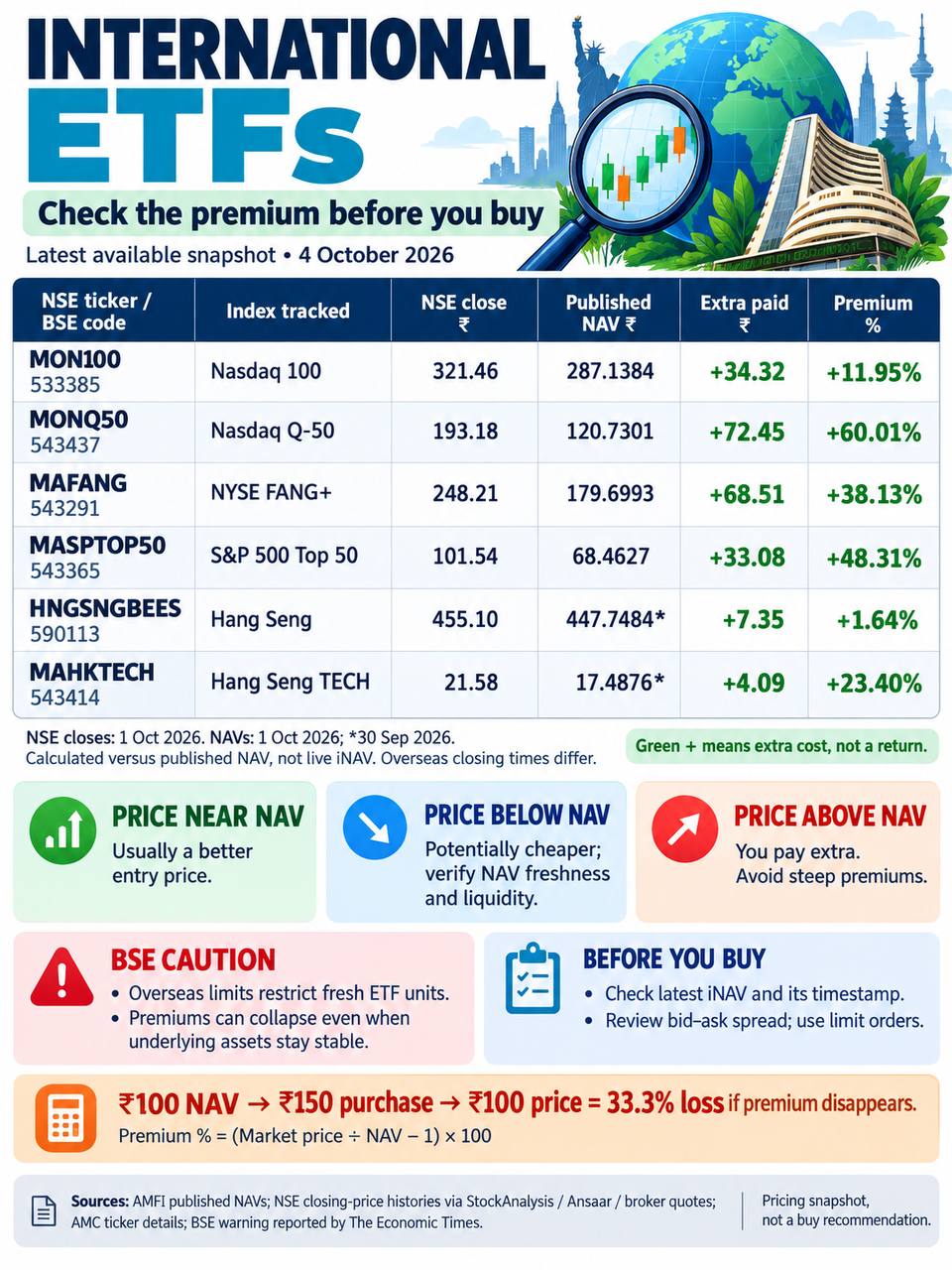
BSE has cautioned investors about international exchange traded funds (ETFs) trading at substantial premiums to their net asset value (NAV). The warning highlights a risk that is easy to overlook: an ETF’s exchange price can rise well above the value of the overseas assets it holds. Buying global exposure at an inflated price can therefore add a separate source of investment risk.
NAV represents the value of a fund’s assets after liabilities, per unit. Its market price depends on buyers and sellers on the exchange. Normally, the creation and redemption of ETF units help keep these values aligned. However, overseas investment limits have constrained fresh unit creation in affected international ETFs. Strong demand meeting restricted supply can push prices above underlying value.
The danger is premium compression. For illustration, an ETF with assets worth ₹100 per unit may trade at ₹150, a 50% premium. If its price returns to ₹100 while the assets remain unchanged, the buyer loses approximately 33.3%. A 50% premium does not mean the overseas portfolio has delivered a 50% return.
According to the warning reported by The Economic Times, premiums could contract if overseas investment limits are increased and fresh units become available. The report also identifies the planned shift to the previous trading day’s NAV as the base for ETF price bands from 1 April 2027 as a potential trigger. This is a pricing risk, rather than a prediction that overseas markets will fall.
Before buying, compare the exchange price with the latest published NAV and, where available, indicative NAV. Check their timestamps: overseas market holidays, different trading hours and currency movements can complicate comparisons. Calculate the premium as market price divided by NAV, minus one, multiplied by 100. Review trading volumes, bid–ask spreads and available order depth, and use limit orders to control the purchase price.
Existing investors should assess their purchase price, current premium and portfolio allocation before deciding whether to hold or reduce exposure. New investors should avoid chasing price spikes merely because an ETF offers access to a popular global index. International diversification can remain useful, but entry valuation matters alongside market and currency risks.
Six India listed international ETF tickers
- MON100 (Nasdaq 100 Index).
- MONQ50 (Nasdaq Q 50 Index).
- MAFANG (NYSE FANG+ Index).
- MASPTOP50 (S&P 500 Top 50 Index).
- HNGSNGBEES (Hang Seng Index).
- MAHKTECH (Hang Seng TECH Index).
Sources: The Economic Times, 29 September 2026, BSE caution report supplied in the attached screenshots; official Motilal Oswal, Mirae Asset and Nippon India fund information for ticker and index names.