ETF MARKET UPDATE
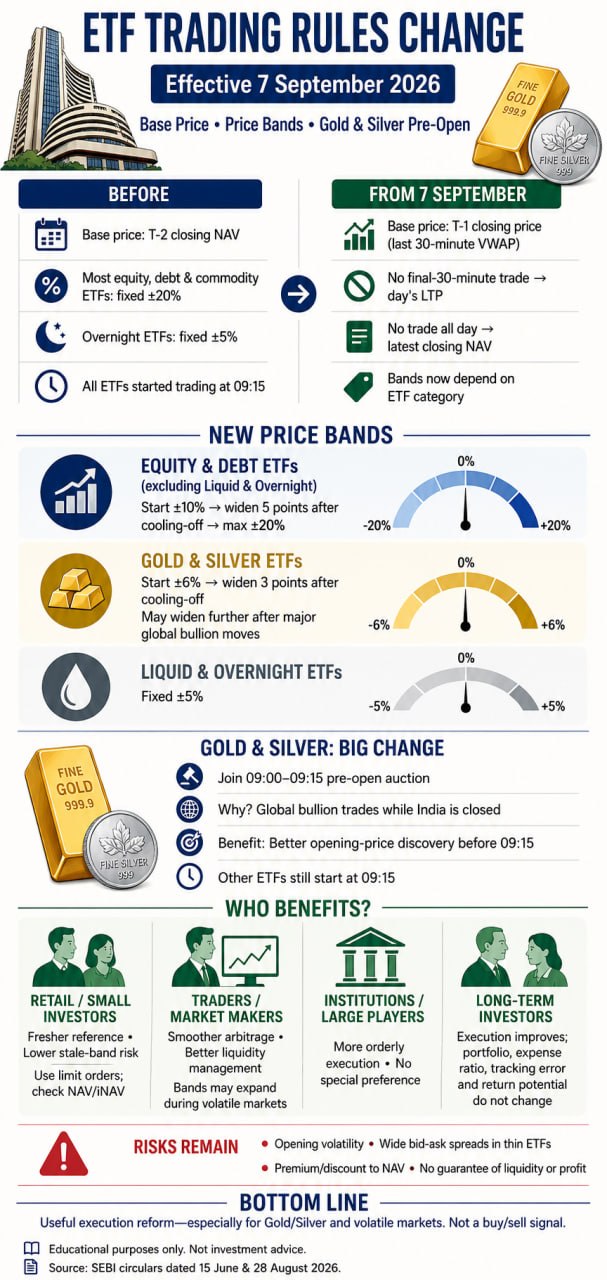
India's exchange-traded fund trading framework will change from Monday, 7 September 2026. The Securities and Exchange Board of India has revised ETF base prices and daily trading bands, while Gold and Silver ETFs will enter the pre-open session for the first time. The original 1 September implementation was postponed by one week for operational readiness.
Under the earlier framework, equity, debt and commodity ETFs generally had a fixed 20% band on either side of a base price derived from the net asset value of two trading days earlier. Overnight ETFs had a 5% band. This older reference could become stale after sharp moves, especially when international bullion prices changed while Indian exchanges were closed.
From 7 September, the main base price for every ETF will be the previous trading day's closing market price, calculated from the final 30-minute volume-weighted average price. If no trade occurred then, the day's last traded price will apply; if the ETF did not trade at all, the latest closing net asset value will be used.
Price bands will become category-specific. Equity and debt ETFs, excluding Liquid and Overnight ETFs, will start at 10% on either side and may expand by 5 percentage points after cooling-off, up to 20%. Gold and Silver ETFs will start at 6% on either side, expandable in 3 percentage-point steps; exchanges may relax the range further after major international moves. Liquid and Overnight ETFs will have a fixed 5% band.
Gold and Silver ETFs will join the 09:00 to 09:15 pre-open auction, allowing overnight information to help determine a single opening price. Equity, debt, Liquid and Overnight ETFs will continue to begin trading at 09:15.
Retail investors may benefit from a fresher reference price and a lower risk of stale bands distorting early trades. Active traders, market makers and institutions may gain from better price discovery, arbitrage and liquidity management. However, the rules do not guarantee liquidity, execution near net asset value or protection from volatility. Thin ETFs can still have wide bid-ask spreads.
For long-term investors, this reform improves trading mechanics; it does not change an ETF's portfolio, expense ratio, tracking error or return potential. Investors should still compare the market price with the latest net asset value or indicative net asset value and preferably use limit orders, particularly near the opening.
Overall, the change is useful for all participants but most relevant to Gold and Silver ETF traders and anyone transacting during volatile markets. It is an execution reform, not a reason by itself to buy or sell an ETF.
Source basis: Securities and Exchange Board of India circulars dated 15 June and 28 August 2026, and the Zerodha explainer dated 2 September 2026.
For educational purposes only. This is not investment advice.