DEFENCE ETFs IN FOCUS: DRDO MISSILE TECHNOLOGY TRANSFER STRENGTHENS INDIA’S DEFENCE MANUFACTURING STORY
India’s defence theme is again in focus after the Government approved transfer of DRDO-developed conventional missile technologies to eligible Indian industry for domestic production. The move can widen private-sector participation, accelerate indigenisation, reduce import dependence and strengthen India’s defence manufacturing ecosystem. For investors, this reinforces the long-term “Make in India / Atmanirbhar Bharat” opportunity, although defence remains a high-volatility thematic sector.
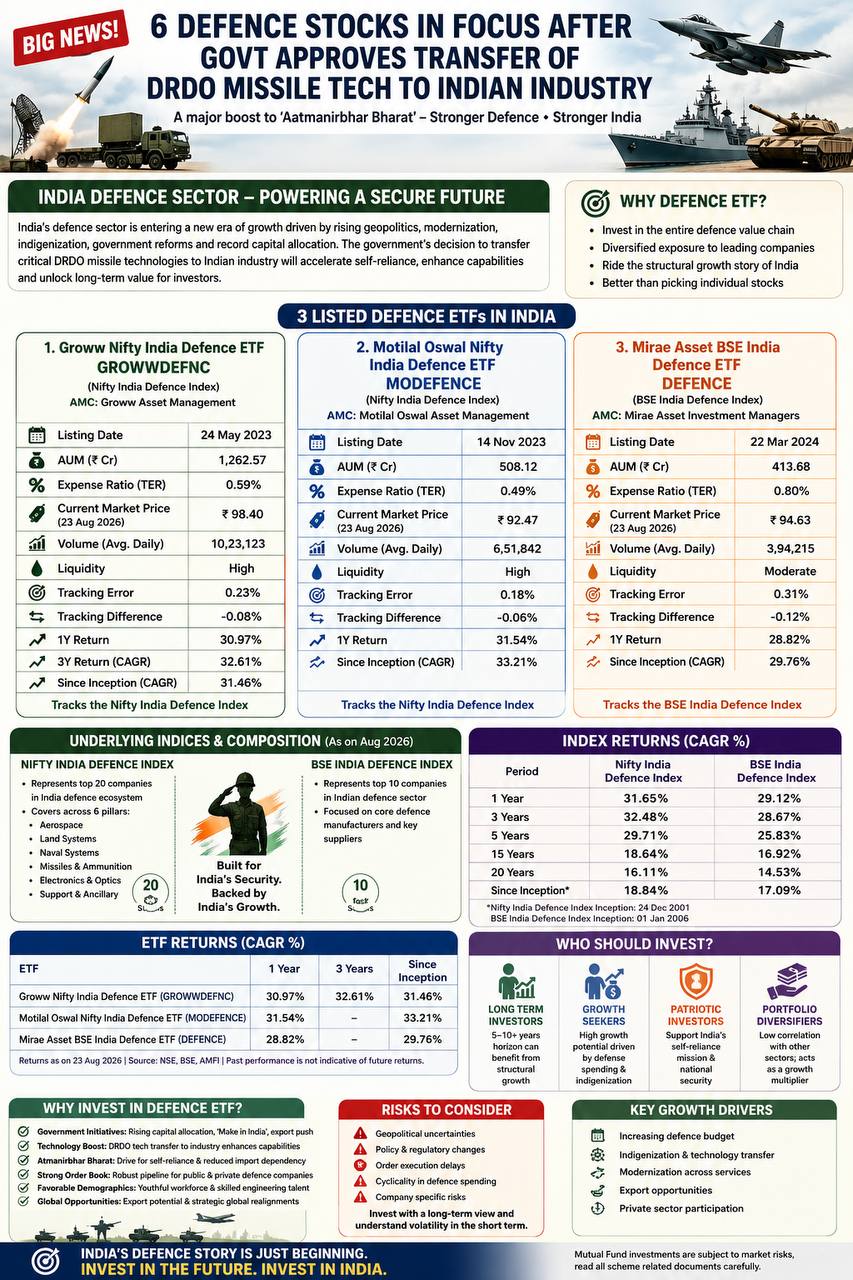
Two Defence Indices – Three Listed ETFs
India has three dedicated defence ETFs but only two underlying defence indices. Motilal Oswal Nifty India Defence ETF (NSE: MODEFENCE) and Groww Nifty India Defence ETF (NSE: GROWWDEFNC) track the Nifty India Defence Total Return Index. Mirae Asset BSE India Defence ETF (NSE: DEFENCE) tracks the BSE India Defence Total Return Index. ETFs therefore offer a convenient basket approach instead of repeatedly selecting individual defence stocks.
Index Composition and Returns
As of 31 July 2026, the Nifty India Defence Index had 19 constituents, led by Hindustan Aeronautics, Bharat Electronics, Bharat Forge, Solar Industries and Mazagon Dock Shipbuilders; capital goods formed about 73% of the index. Its Total Return Index delivered about 20.68% over one year, 54.33% annualised over five years and 32.34% annualised since inception. The BSE India Defence Index is broader, with roughly 33–35 defence manufacturers and enablers. Its March 2026 factsheet reported 7.37% one-year, 43.00% three-year and 45.52% five-year annualised total returns.
ETF Snapshot – AUM, Liquidity and Tracking
MODEFENCE was listed on 27 August 2024. It is currently the largest and most liquid: AUM about ₹1,310 crore, one-month average volume about 1.39 million units, expense ratio about 0.67% and tracking error about 0.06%; late-August 2026 one-year market return was around 27–28%. GROWWDEFNC was allotted on 8 October 2024: AUM about ₹344 crore, average monthly trading volume about 262,000 units, expense ratio about 0.65%, tracking error about 0.06% and one-year return around 26%. Mirae Asset DEFENCE was allotted on 13 February and listed on 19 February 2026: AUM about ₹147 crore, recent daily volume around 235,000 units, expense ratio about 0.29% and since-launch return about 22%. Its history is still too short for a meaningful one-year tracking difference.
Who Should Invest – and For How Long?
Defence ETFs are better suited to investors with high risk tolerance and a 5–10 year horizon who believe India’s defence production, exports, localisation and technology ecosystem can compound over time. Staggered buying or SIP-style accumulation can reduce the risk of entering after a sharp rally. The key psychology is patience: defence can rise rapidly, then correct or remain sideways for long periods.
Investor Takeaway
The sector has strong structural drivers, but valuations, government orders and policy expectations can create sharp swings. For investors seeking sector exposure rather than single-stock risk, an ETF provides diversification and automatic index rebalancing. Selection should depend on liquidity, expense ratio, tracking quality and whether one prefers the more concentrated Nifty basket or the broader BSE basket—not recent return alone.
Data snapshot: mainly 25–31 August 2026. Market data change over time; past performance does not guarantee future returns.