ICICI Prudential BSE Insurance ETF: India’s First Dedicated Insurance ETF
Updated: 25 August 2026
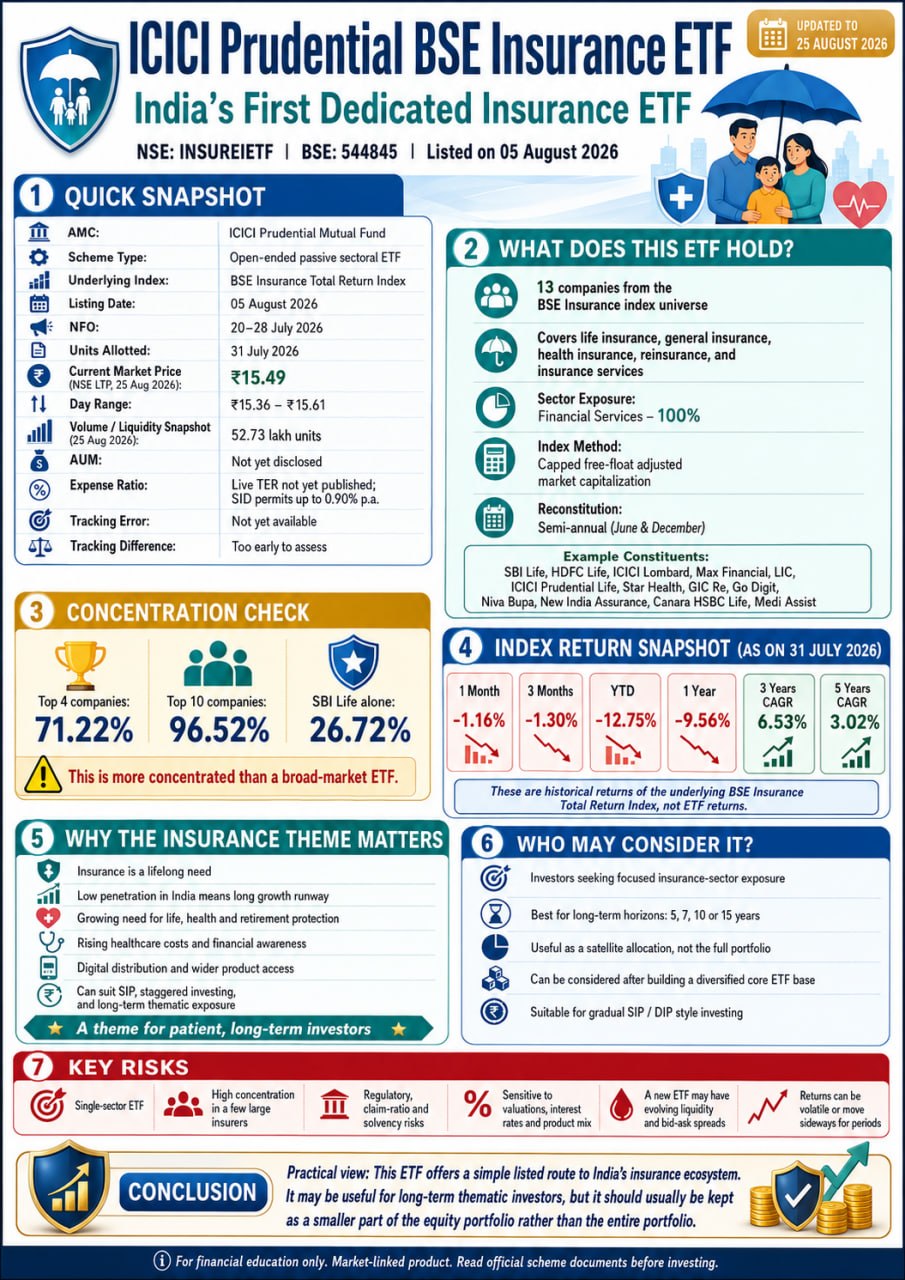
India’s exchange-traded fund universe has added a new sector-focused option with the ICICI Prudential BSE Insurance ETF, the country’s first dedicated insurance-sector ETF. Listed on 05 August 2026, the fund trades on the NSE under the ticker INSUREIETF and on the BSE under code 544845. It tracks the BSE Insurance Total Return Index and offers investors a single route to participate in listed life, general, health and reinsurance businesses.
As of 25 August 2026, INSUREIETF was trading at around ₹15.48 on the NSE, with an intraday range of approximately ₹15.45 to ₹15.61 and reported volume of about 48.03 lakh units. The latest reported NAV was around ₹15.49 as of 24 August, indicating that the market price was close to NAV at this snapshot. Because the ETF is still less than a month old, assets under management, live expense ratio and dependable tracking-error data are not yet consistently available across market-data platforms. These figures should be monitored through the AMC and exchange disclosures as the fund develops a longer trading history.
The underlying BSE Insurance Index contains 13 companies drawn from the BSE 1000 universe. It covers major segments of the insurance ecosystem, including life insurance, general insurance, health insurance, reinsurance and insurance-related services. The index uses capped free-float-adjusted market-cap weighting and is reconstituted semi-annually. It is also concentrated: the top four companies account for about 71.22% of the index and the top ten for about 96.52%, which means performance can be strongly influenced by a few large insurers.
Historical index data as of 31 July 2026 showed returns of -1.16% over one month, -1.30% over three months, -12.75% year-to-date and -9.56% over one year. The three-year and five-year historical CAGR figures were 6.53% and 3.02% respectively. These are index returns, not returns of the newly listed ETF.
The long-term insurance theme remains supported by rising financial awareness, growing demand for life and health protection, increasing healthcare costs, digital distribution and the formalisation of household savings. However, investors must also consider regulatory changes, claim ratios, solvency requirements, interest-rate sensitivity, valuation risk and sector concentration.
For investors with a 5–10 year horizon who understand sectoral volatility, this ETF may be considered as a small satellite allocation rather than a core portfolio holding. A diversified broad-market ETF can remain the foundation, while insurance exposure may be added gradually based on valuation, liquidity and tracking quality.
For financial education only. ETF prices and returns are market-linked. Read the official scheme documents before investing.