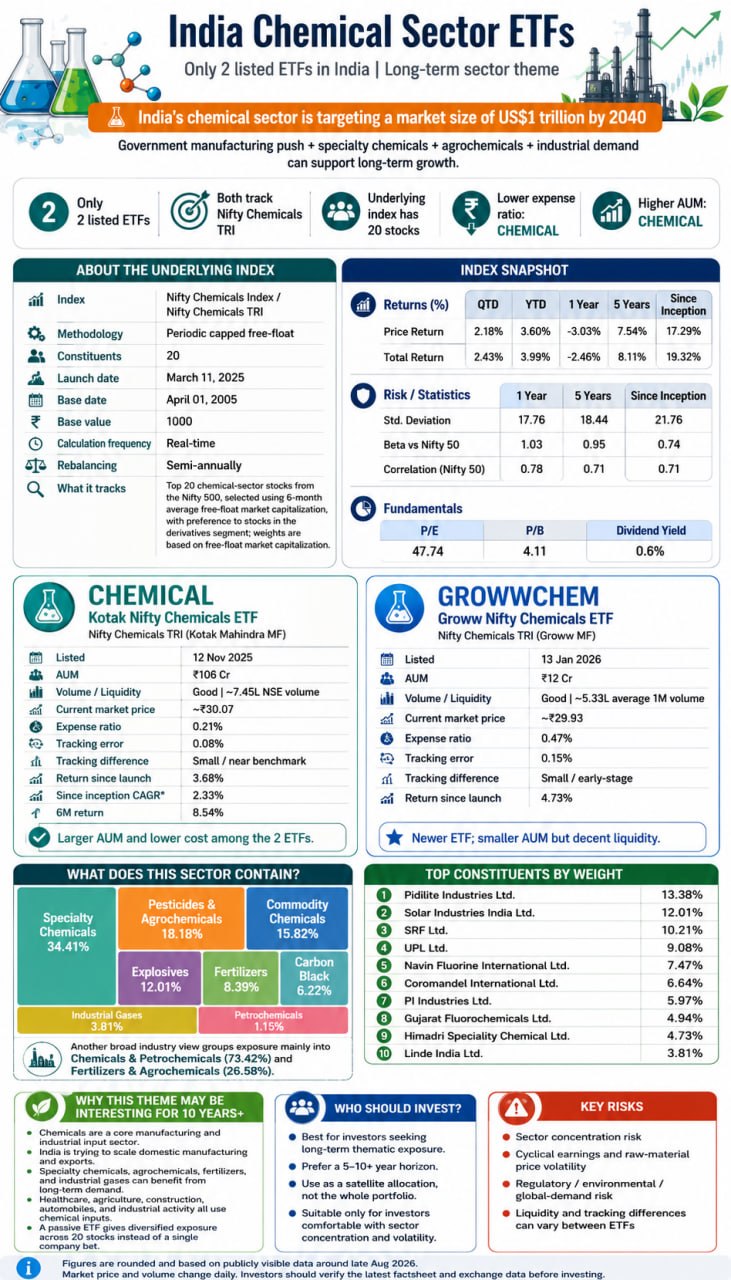
India's chemicals and petrochemicals industry is emerging as an important long-term manufacturing theme. The Government of India has highlighted an ambition for the sector, currently valued at around US$220 billion, to reach about US$1 trillion by 2040. Chemicals are essential inputs for agriculture, pharmaceuticals, automobiles, construction, electronics, textiles, consumer products and many other industries. This makes the sector a powerful "industry behind industries", although it remains cyclical and sensitive to raw-material prices, global demand, China-related supply, currency movements and environmental regulation.
Two ETFs currently provide direct passive exposure to the Nifty Chemicals Index: Kotak Nifty Chemicals ETF (NSE: CHEMICAL) and Groww Nifty Chemicals ETF (NSE: GROWWCHEM). Both aim to replicate the same Nifty Chemicals Total Return Index, so the underlying portfolio is broadly similar; the practical differences for investors are AUM, liquidity, expense ratio, tracking efficiency and market price.
How is the Nifty Chemicals Index built?
The Nifty Chemicals Index selects up to 20 chemical-sector companies from the Nifty 500 universe, using free-float market capitalisation with prescribed caps. It therefore gives investors diversified exposure across specialty chemicals, agrochemicals, fertilizers, explosives, commodity chemicals, carbon black, industrial gases and petrochemicals. As of 31 July 2026, specialty chemicals formed the largest basic-industry exposure at about 34.4%, followed by pesticides and agrochemicals at 18.2%, commodity chemicals at 15.8%, explosives at 12.0% and fertilizers at 8.4%.
Its largest constituents included Pidilite Industries (13.38%), Solar Industries (12.01%), SRF (10.21%), UPL (9.08%), Navin Fluorine (7.47%), Coromandel International (6.64%), PI Industries (5.97%), Gujarat Fluorochemicals (4.94%), Himadri Speciality Chemical (4.73%) and Linde India (3.81%).
What have returns looked like?
The Nifty Chemicals Total Return Index showed a 3.99% year-to-date return, -2.46% over one year, 8.11% annualised over five years and 19.32% annualised since inception, based on the July 2026 index data. The two ETFs are still young: Kotak's ETF was allotted in November 2025 and Groww's in January 2026. Around 21 August 2026, reported since-launch annualised returns were approximately 3.7% for Kotak and 7.0% for Groww; these short histories should not be used alone to judge long-term potential.
Investment perspective
Chemical ETFs are best viewed as a satellite sector allocation rather than a complete equity portfolio. Investors should ideally have a five-year-plus horizon, accept high volatility and evaluate AUM, trading liquidity, expense ratio, tracking error and tracking difference before choosing between the two ETFs. The long-term opportunity is attractive, but patience is important because chemical cycles can be sharp.
Data note: Index composition/returns are based on Nifty Indices data around 31 July 2026; ETF figures are approximate and time-sensitive.