NSE Indices has introduced the Nifty500 Ahimsa Index, a new benchmark designed to track companies from the Nifty 500 universe whose business practices are aligned with the principle of “Ahimsa,” or non-violence. The index was launched on July 10, 2026, with a base date of April 1, 2016 and a base value of 1,000. It offers investors a broad-market approach that combines conventional equity-index construction with a values-based screening framework. At each review, stocks that are part of the Nifty 500 are eligible for consideration. Companies categorized in the “Orange” and “Red” bands under the classification provided by the Ahimsagain Foundation are excluded. All remaining eligible companies become part of the index, and each stock is weighted according to its free-float market capitalization. The index is reviewed semi-annually, in March and September, and is calculated at the end of each trading day. As of July 31, 2026, the index had 326 constituents, providing wide diversification across the Indian equity market. Its largest sector exposures included Automobile and Auto Components at 13.67%, Information Technology at 13.23%, Capital Goods at 11.29%, Financial Services at 9.90%, Metals and Mining at 8.13%, Telecommunication at 7.73% and Power at 7.23%. At the broader macro-economic level, Consumer Discretionary represented 21.68%, followed by Commodities at 14.78%, Information Technology at 13.23% and Industrials at 12.18%. The portfolio is not concentrated in a handful of stocks. Bharti Airtel was the largest constituent at 6.18%, followed by Infosys at 4.09%, Mahindra & Mahindra at 3.13%, Tata Consultancy Services at 2.49% and Maruti Suzuki India at 1.91%. Other leading constituents included NTPC, Tata Steel, BSE, HCL Technologies and Hindalco Industries. Historical index data in the document shows a 1-year total return of 6.82%, a 5-year total return of 13.17% annualized and a since-inception total return of 15.37% annualized. The corresponding price-return figures were 5.60%, 11.83% and 13.67%. The index had a 1-year standard deviation of 14.49 and a beta of 0.99 versus the Nifty 50. Its reported valuation metrics were a price-to-earnings ratio of 24.21, price-to-book ratio of 4.05 and dividend yield of 1.29%. The Nifty500 Ahimsa Index is therefore an interesting development for investors who want broad Indian equity exposure while applying an ethical or values-oriented filter. NSE Indices also notes that the index can serve as a benchmark and may be used for the creation of index funds, exchange-traded funds and structured products. As with any screened index, the ethical filter does not by itself remove market risk or guarantee superior returns. Investors should still evaluate diversification, valuation, tracking quality, costs and suitability before investing in any future product based on it.
Back to News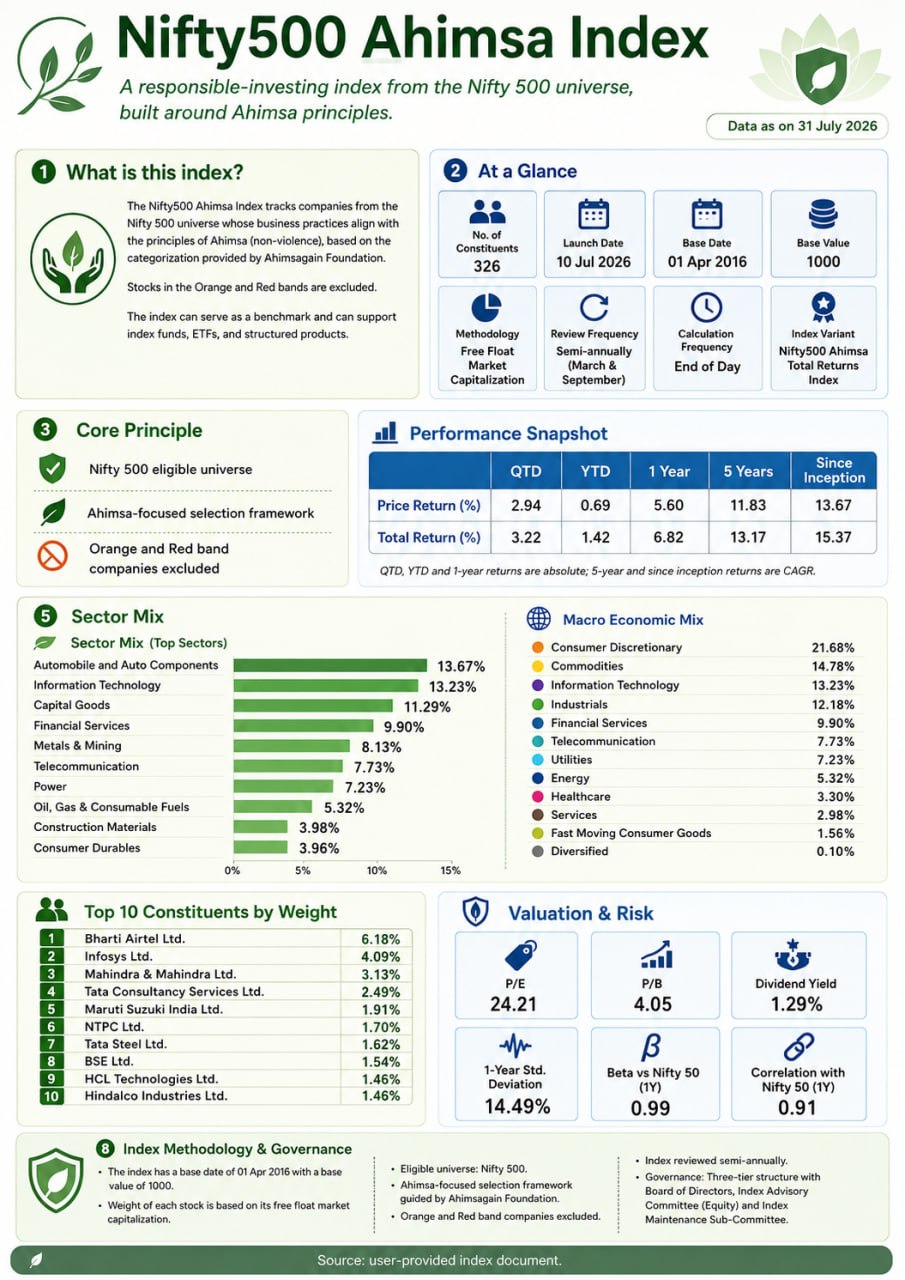
DP
Written by
Dr Pankaj Nandlal Tardeja
Pediatrician and Neonatologist, Al Ain , Abu Dhabi, UAE
Editorial Standards & Research Methodology →