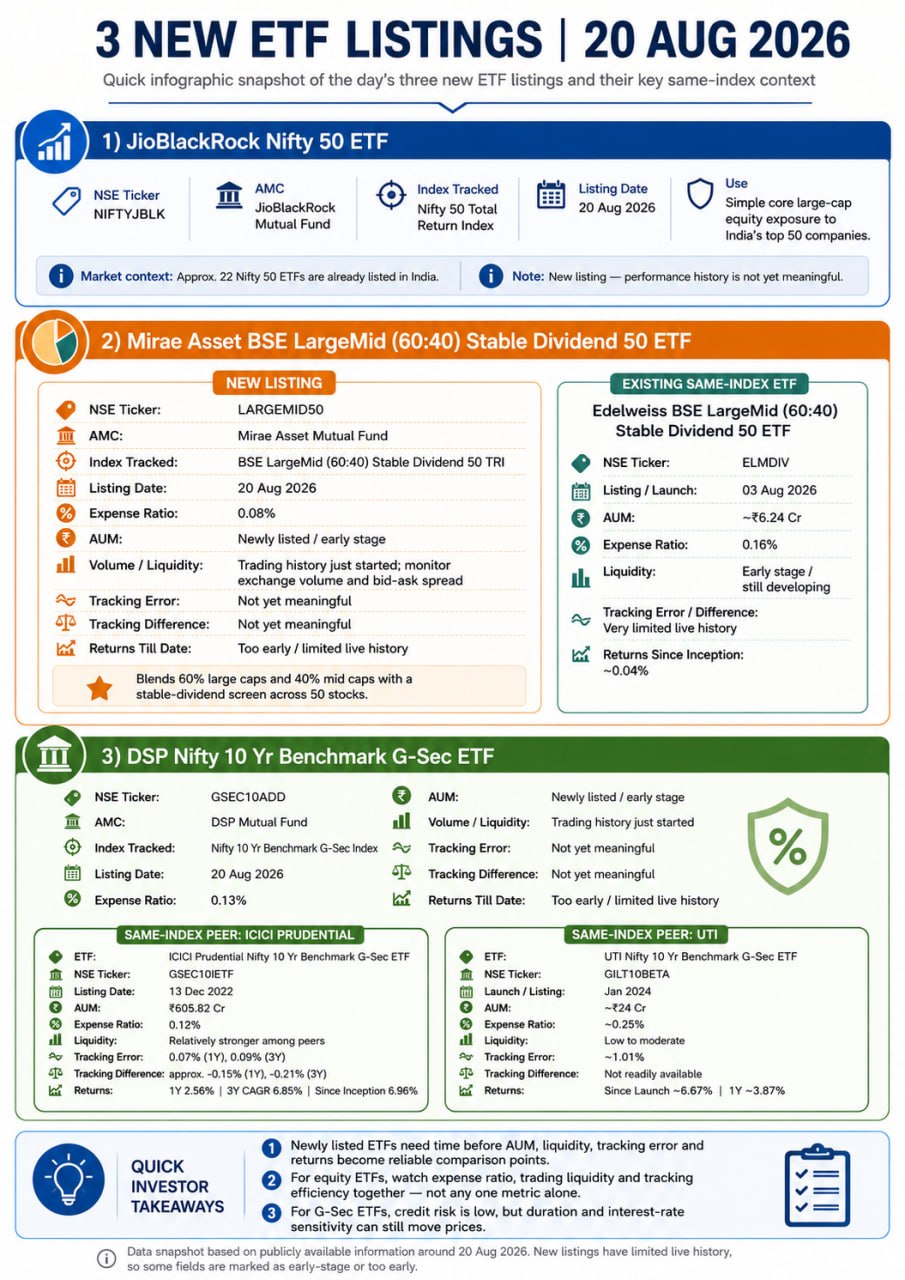
Three new exchange-traded funds were listed on 20 August 2026, covering three very different portfolio needs: core Nifty 50 equity exposure, a large-and-mid-cap stable-dividend strategy, and 10-year Government of India securities.
1. JioBlackRock Nifty 50 ETF - NSE: NIFTYJBLK
AMC: JioBlackRock Mutual Fund. Index: Nifty 50 Total Return Index. Listing date: 20 August 2026. The Nifty 50 represents 50 of India's largest and most liquid companies and can serve as a simple core equity allocation. There are now roughly 22 standard Nifty 50 ETFs in the market, excluding equal-weight variants. Among the largest established choices are SBI Nifty 50 ETF, UTI Nifty 50 ETF and Nippon India ETF Nifty 50 BeES, with expense ratios around 0.03%-0.05%. The new JioBlackRock ETF is too new for meaningful tracking error, tracking difference or return comparison; liquidity and bid-ask spread should be watched as trading develops.
2. Mirae Asset BSE LargeMid (60:40) Stable Dividend 50 ETF - NSE: LARGEMID50
AMC: Mirae Asset Mutual Fund. Index: BSE LargeMid (60:40) Stable Dividend 50 Total Return Index. Listing date: 20 August 2026. The strategy combines 60% large-cap and 40% mid-cap exposure with a stable-dividend screen across 50 stocks, making it a smart-beta rather than a plain market-cap index. An existing ETF on the same index is Edelweiss BSE LargeMid (60:40) Stable Dividend 50 ETF (ELMDIV), launched on 31 July 2026. Its July-end AUM was about Rs 6 crore and expense ratio about 0.16%. Both ETFs are very new, so long-term returns, tracking error and tracking difference are not yet meaningful. Investors should compare future AUM growth, daily volume, bid-ask spread and sustained tracking quality.
3. DSP Nifty 10 Yr Benchmark G-Sec ETF - NSE: GSEC10ADD
AMC: DSP Mutual Fund. Index: Nifty 10 Yr Benchmark G-Sec Index. Listing date: 20 August 2026. It provides exposure to the benchmark 10-year Government of India security. Credit risk is low because the underlying security is sovereign, but interest-rate and duration risk can cause price volatility. DSP's expense ratio was about 0.13% around listing.
Existing comparable ETFs include ICICI Prudential Nifty 10 Yr Benchmark G-Sec ETF (GSEC10IETF) and UTI Nifty 10 Yr Benchmark G-Sec ETF (GILT10BETA). ICICI Prudential had AUM of about Rs 605 crore, expense ratio about 0.12%, 1-year tracking error around 0.07% and 3-year return near 6.85% CAGR. UTI had AUM around Rs 24 crore, expense ratio about 0.30% and tracking error around 0.14%. SBI also has an ETF tracking this index.
Key takeaway
These three listings broaden investor choice, but the selection rule remains the same: do not judge an ETF only by the AMC or expense ratio. Over time, compare AUM, trading liquidity, bid-ask spread, expense ratio, tracking error and tracking difference. For newly listed ETFs, allow sufficient trading and performance history before drawing conclusions.