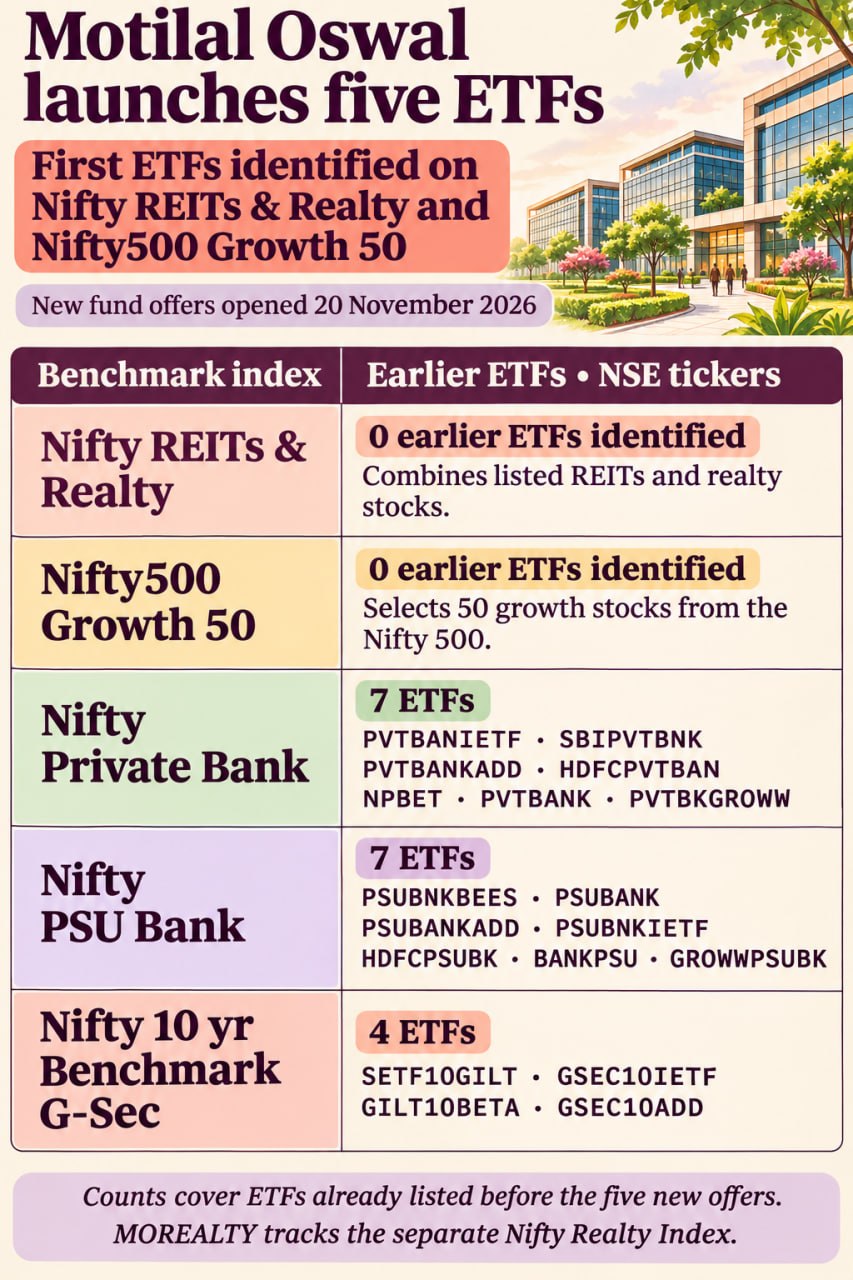
Motilal Oswal Mutual Fund opened new fund offers for five exchange-traded funds (ETFs) on 20 November 2026. Two track Indian banking indices. The other three cover growth stocks, listed real estate and the Government of India’s benchmark 10-year bond.
- Private banks : The Motilal Oswal Nifty Private Bank ETF tracks the Nifty Private Bank Total Return Index, which comprises ten private sector banks. At rebalancing, the index caps each bank at 23% and the three largest holdings together at 62%.
Four banks accounted for 81.48% of the private bank index on 30 September 2026. ICICI Bank led with 21.53%, followed by HDFC Bank at 20.83%, Kotak Mahindra Bank at 19.84% and Axis Bank at 19.28%.
- Public sector banks. The Motilal Oswal Nifty PSU Bank ETF tracks an index of 12 banks in which the central or a state government holds at least 51%. State Bank of India accounted for one-third of the index on 30 September 2026. Bank of Baroda was the next largest holding at 12.47%.
- Growth stocks. The Motilal Oswal Nifty500 Growth 50 ETF tracks 50 companies selected from the Nifty 500. Selection uses three measures of growth and market performance, namely three-year growth in profit after tax, three-year sales growth and one-year risk-adjusted return.
The growth index rebalances in June and December. At each review, it caps individual stocks at 5% and sectors at 30%, limiting how much any one company or industry can influence the index.
- Real estate. The Motilal Oswal Nifty REITs & Realty ETF tracks 15 listed real estate investment trusts (REITs) and real estate stocks. The index assigns at least 60% of its weight to REITs. On 30 September 2026, Embassy Office Parks REIT was the largest holding at 15.09%, followed by Knowledge Realty Trust at 12.83%.
- Government bonds. The Motilal Oswal Nifty 10 yr Benchmark G-Sec ETF follows an index with a single holding, the current 10-year Government of India benchmark bond. The scheme will invest 95% to 100% of its assets in the index security.
The bond fund carries a moderate risk rating. Its A-III classification indicates relatively low credit risk and relatively high interest rate risk. A rise in market yields can lower the price of the bond and the value of the ETF.
The scheme documents assign a very high risk rating to both banking ETFs, the growth ETF and the real estate ETF. Each of the five funds aims to match its benchmark’s total return, subject to tracking error.